


Sleep-Wake Disturbances After Traumatic Brain Injury: Synthesis of Human and Animal Studies
- PMID: 28329120
- PMCID: PMC6251652
- DOI: 10.1093/sleep/zsx044
Sleep-Wake Disturbances After Traumatic Brain Injury: Synthesis of Human and Animal Studies
Abstract
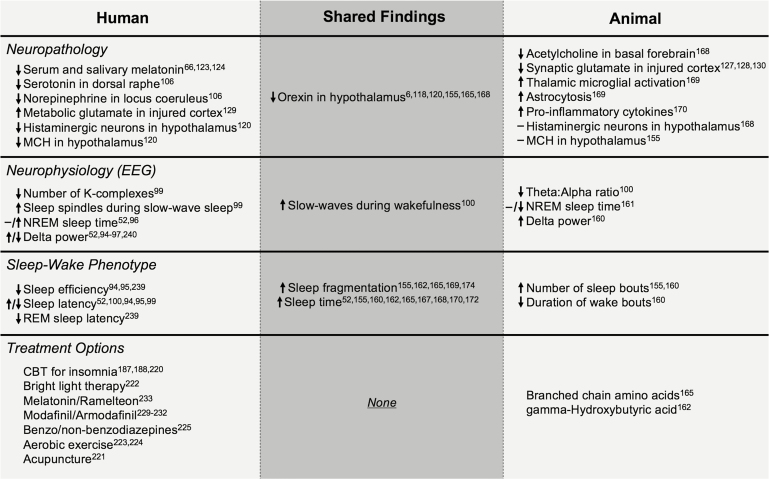
Sleep-wake disturbances following traumatic brain injury (TBI) are increasingly recognized as a serious consequence following injury and as a barrier to recovery. Injury-induced sleep-wake disturbances can persist for years, often impairing quality of life. Recently, there has been a nearly exponential increase in the number of primary research articles published on the pathophysiology and mechanisms underlying sleep-wake disturbances after TBI, both in animal models and in humans, including in the pediatric population. In this review, we summarize over 200 articles on the topic, most of which were identified objectively using reproducible online search terms in PubMed. Although these studies differ in terms of methodology and detailed outcomes; overall, recent research describes a common phenotype of excessive daytime sleepiness, nighttime sleep fragmentation, insomnia, and electroencephalography spectral changes after TBI. Given the heterogeneity of the human disease phenotype, rigorous translation of animal models to the human condition is critical to our understanding of the mechanisms and of the temporal course of sleep-wake disturbances after injury. Arguably, this is most effectively accomplished when animal and human studies are performed by the same or collaborating research programs. Given the number of symptoms associated with TBI that are intimately related to, or directly stem from sleep dysfunction, sleep-wake disorders represent an important area in which mechanistic-based therapies may substantially impact recovery after TBI.
Keywords: BCAA; EEG; TBI; animal models; glutamate; orexin; pediatric; sleep.
Published by Oxford University Press on behalf of Sleep Research Society (SRS) 2017. This work is written by (a) US Government employee(s) and is in the public domain in the US.
Figures
References
-
- Centers for Disease and Control. Injury Prevention and Control: Traumatic Brain Injury and Concussion.; 2016. http://www.cdc.gov/traumaticbraininjury/get_the_facts.html.
-
- Katz DI, Cohen SI, Alexander MP. Mild traumatic brain injury . Handb Clin Neurol. 2015; 127: 131–156. - PubMed
-
- Duclos C, Dumont M, Wiseman-Hakes C, et al. Sleep and wake disturbances following traumatic brain injury. Pathol Biol (Paris). 2014; 62(5): 252–261. - PubMed
-
- Orff HJ, Ayalon L, Drummond SP. Traumatic brain injury and sleep disturbance: a review of current research. J Head Trauma Rehabil. 2009; 24(3): 155–165. - PubMed
Publication types
MeSH terms
Grants and funding
LinkOut - more resources
Full Text Sources
Other Literature Sources
Medical
