Randomized Controlled Trial
. 2017 Jun 1;64(11):1522-1531.
doi: 10.1093/cid/cix185.

Treatment Response in Enteric Fever in an Era of Increasing Antimicrobial Resistance: An Individual Patient Data Analysis of 2092 Participants Enrolled into 4 Randomized, Controlled Trials in Nepal

Affiliations
Randomized Controlled Trial

Treatment Response in Enteric Fever in an Era of Increasing Antimicrobial Resistance: An Individual Patient Data Analysis of 2092 Participants Enrolled into 4 Randomized, Controlled Trials in Nepal

Corinne N Thompson et al. Clin Infect Dis. .

Erratum in

  • Erratum.
    [No authors listed] [No authors listed] Clin Infect Dis. 2017 Oct 15;65(8):1431-1433. doi: 10.1093/cid/cix563. Clin Infect Dis. 2017. PMID: 29017252 Free PMC article. No abstract available.

Abstract

Background.: Enteric fever, caused by Salmonella Typhi and Salmonella Paratyphi A, is the leading cause of bacterial febrile disease in South Asia.

Methods.: Individual data from 2092 patients with enteric fever randomized into 4 trials in Kathmandu, Nepal, were pooled. All trials compared gatifloxacin with 1 of the following comparator drugs: cefixime, chloramphenicol, ofloxacin, or ceftriaxone. Treatment outcomes were evaluated according to antimicrobial if S. Typhi/Paratyphi were isolated from blood. We additionally investigated the impact of changing bacterial antimicrobial susceptibility on outcome.

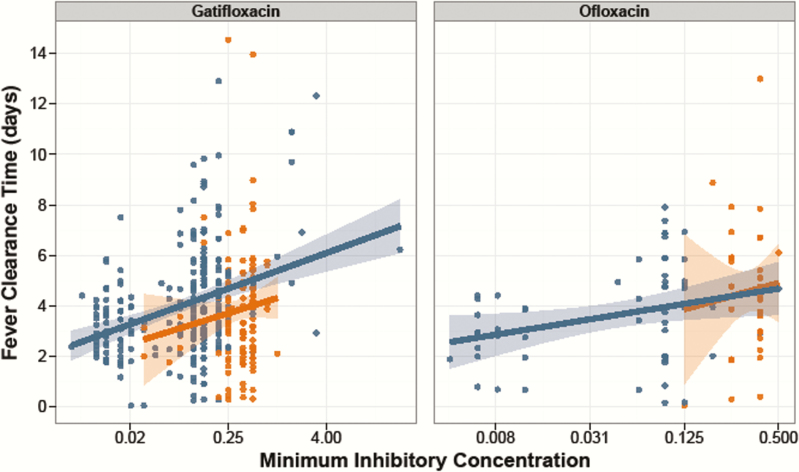
Results.: Overall, 855 (41%) patients had either S. Typhi (n = 581, 28%) or S. Paratyphi A (n = 274, 13%) cultured from blood. There were 139 (6.6%) treatment failures with 1 death. Except for the last trial with ceftriaxone, the fluoroquinolone gatifloxacin was associated with equivalent or better fever clearance times and lower treatment failure rates in comparison to all other antimicrobials. However, we additionally found that the minimum inhibitory concentrations (MICs) against fluoroquinolones have risen significantly since 2005 and were associated with increasing fever clearance times. Notably, all organisms were susceptible to ceftriaxone throughout the study period (2005-2014), and the MICs against azithromycin declined, confirming the utility of these alternative drugs for enteric fever treatment.

Conclusion.: The World Health Organization and local government health ministries in South Asia still recommend fluoroquinolones for enteric fever. This policy should change based on the evidence provided here. Rapid diagnostics are urgently required given the large numbers of suspected enteric fever patients with a negative culture.

Keywords: Nepal; antimicrobial resistance; enteric fever; fluoroquinolone; typhoid.


Figures

Figure 1.
Figure 1.
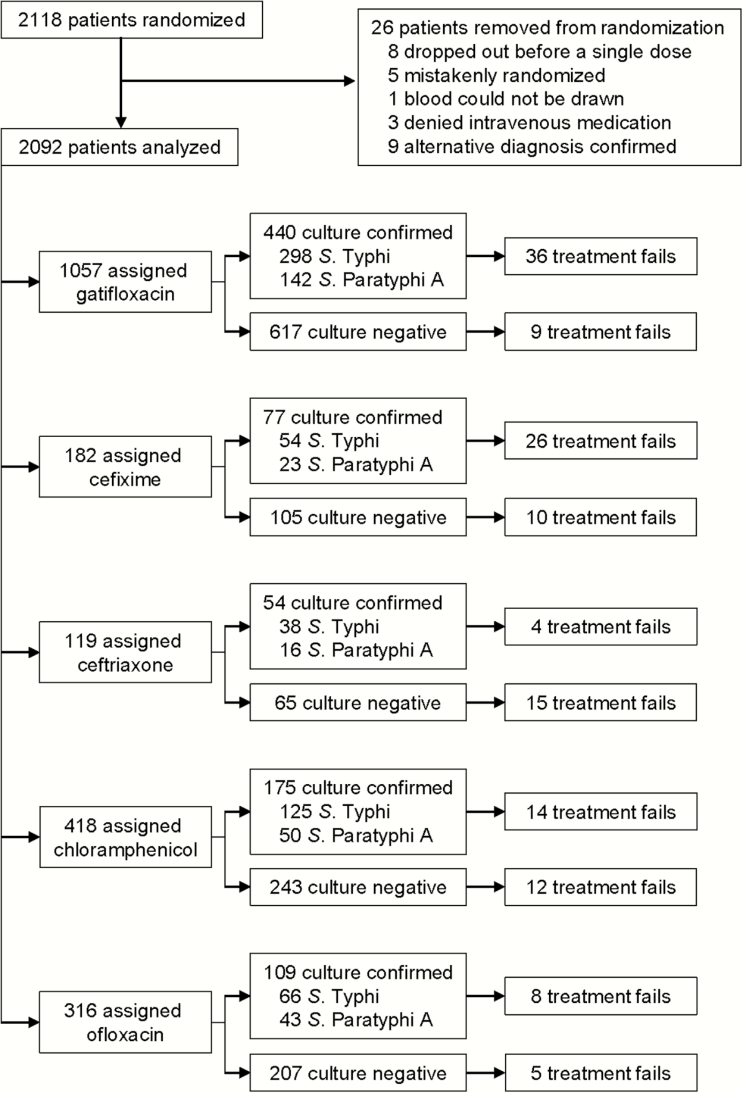
Enrollment of patients into enteric fever treatment trials in Nepal. Flow chart showing enrollment of patients into the 4 individual, randomized, controlled trials according to antimicrobial treatment and blood culture result.
Figure 2.
Figure 2.
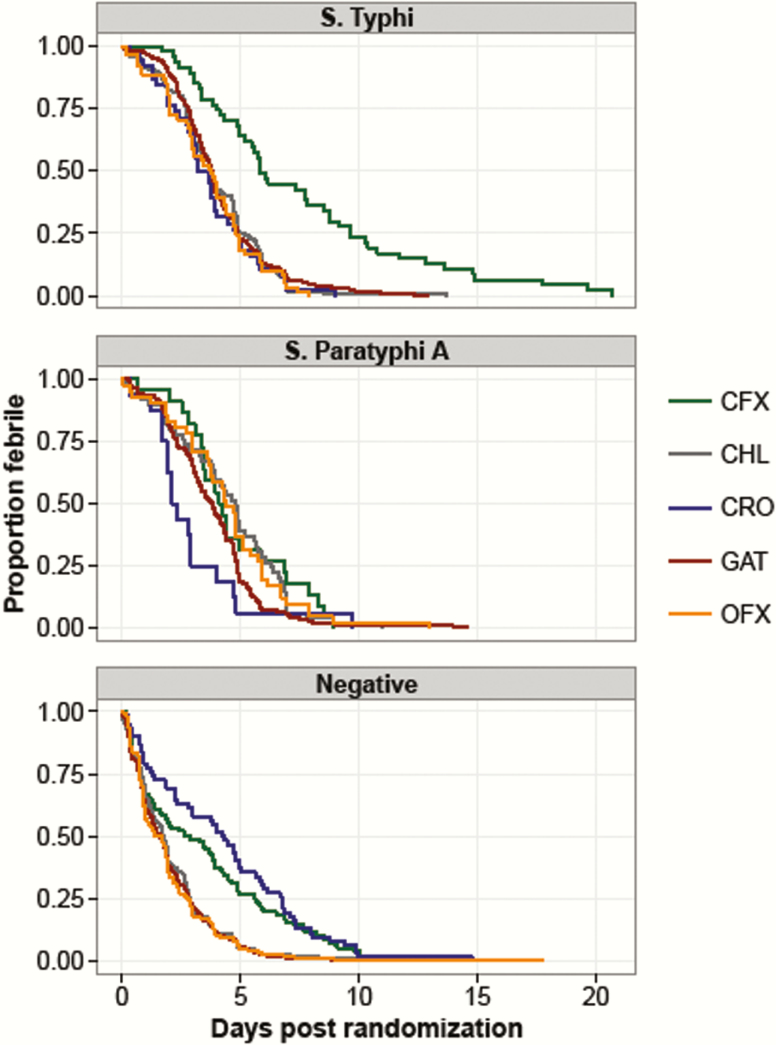
Fever clearance time (FCT) by treatment arm and culture result. FCT (in days) is shown for Salmonella Typhi, S. Paratyphi A, and culture-negative patients. Colors indicate the different treatment arms. Abbreviations: CFX, cefixime; CHL, chloramphenicol; CRO, ceftriaxone; GAT, gatifloxacin; OFX, ofloxacin.
Figure 3.
Figure 3.
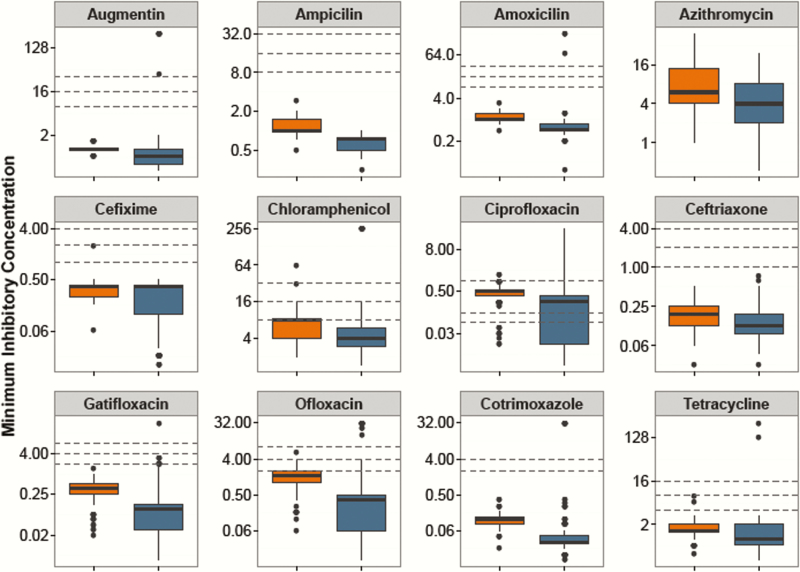
Distribution of minimum inhibitory concentrations (MICs) against antimicrobials for Salmonella Typhi and S. Paratyphi A. MICs shown on a log2 scale against 12 antimicrobials for S. Typhi (blue) and S. Paratyphi A (orange). Lower, middle, and upper horizontal dashed lines represent the current Clinical and Laboratory Standards Institute cutoffs for susceptible/intermediate and intermediate/resistant, respectively.
Figure 4.
Figure 4.
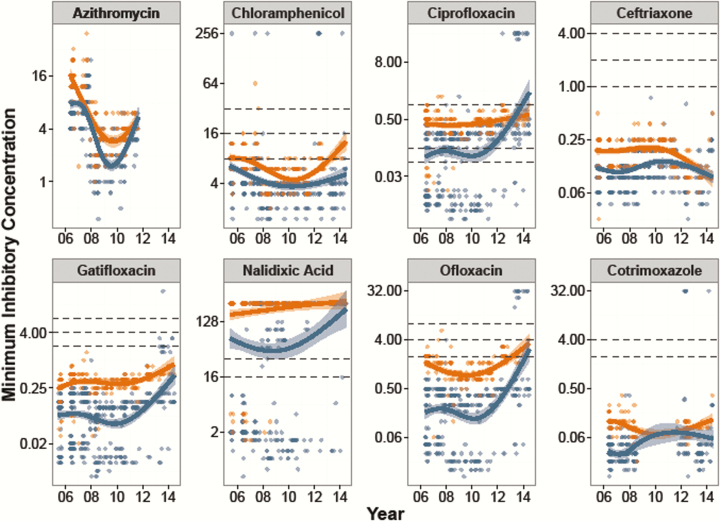
Minimum inhibitory concentrations (MICs) over time for Salmonella Typhi and S. Paratyphi A. MICs shown on a log2 scale for 8 antimicrobials over the period 2005–2014. Salmonella Typhi are shown in blue and S. Paratyphi A are shown in orange. The smoothed line is derived from the generalized additive model showing a nonlinear increase in MICs over time, with the shaded region showing the 95% confidence interval. Lower, middle, and upper horizontal dashed lines represent the current Clinical and Laboratory Standards Institute cutoffs for susceptible/intermediate and intermediate/resistant, respectively.
Figure 5.
Figure 5.
Fever clearance time and minimum inhibitory concentrations (MICs) against fluoroquinolones for Salmonella Typhi and S. Paratyphi A. Fever clearance time (in days) is shown plotted against log2 MIC for gatifloxacin (left) and ofloxacin (right). Salmonella Typhi isolates are shown in blue and S. Paratyphi A isolates are shown in orange. The lines represent the best-fit linear model, with 95% confidence interval shown by the shaded region.

References

    1. Crump JA, Mintz ED. Global trends in typhoid and paratyphoid fever. Clin Infect Dis 2010; 50:241–6. - PMC - PubMed
    1. Lozano R, Naghavi M, Foreman K, et al. Global and regional mortality from 235 causes of death for 20 age groups in 1990 and 2010: a systematic analysis for the Global Burden of Disease Study 2010. Lancet 2012; 380:2095–128. - PMC - PubMed
    1. Parry CM, Hien TT, Dougan G, White NJ, Farrar JJ. Typhoid fever. N Engl J Med 2002; 347:1770–82. - PubMed
    1. Bhan MK, Bahl R, Bhatnagar S. Typhoid and paratyphoid fever. Lancet 2005; 366:749–62. - PubMed
    1. Bhutta ZA. Current concepts in the diagnosis and treatment of typhoid fever. BMJ 2006; 333:78–82. - PMC - PubMed

Publication types

MeSH terms