. 2017 Jun 1;64(11):1547-1554.
doi: 10.1093/cid/cix191.

The Causal Effect of Tracing by Peer Health Workers on Return to Clinic Among Patients Who Were Lost to Follow-up From Antiretroviral Therapy in Eastern Africa: A "Natural Experiment" Arising From Surveillance of Lost Patients

Affiliations

The Causal Effect of Tracing by Peer Health Workers on Return to Clinic Among Patients Who Were Lost to Follow-up From Antiretroviral Therapy in Eastern Africa: A "Natural Experiment" Arising From Surveillance of Lost Patients

Anna Bershetyn et al. Clin Infect Dis. .

Erratum in

  • Erratum.
    [No authors listed] [No authors listed] Clin Infect Dis. 2017 Oct 15;65(8):1431-1433. doi: 10.1093/cid/cix563. Clin Infect Dis. 2017. PMID: 29017252 Free PMC article. No abstract available.

Abstract

Background.: The effect of tracing human immunodeficiency virus (HIV)-infected patients who are lost to follow-up (LTFU) on reengagement has not been rigorously assessed. We carried out an ex post analysis of a surveillance study in which LTFU patients were randomly selected for tracing to identify the effect of tracing on reengagement.

Methods.: We evaluated HIV-infected adults on antiretroviral therapy who were LTFU (>90 days late for last visit) at 14 clinics in Uganda, Kenya, and Tanzania. A random sample of LTFU patients was selected for tracing by peer health workers. We assessed the effect of selection for tracing using Kaplan-Meier estimates of reengagement among all patients as well as the subset of LTFU patients who were alive, contacted in person by the tracer, and out of care.

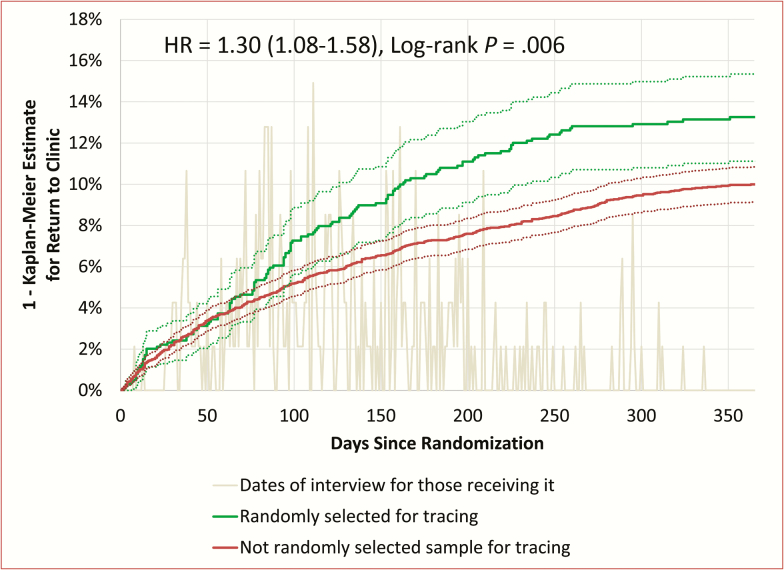
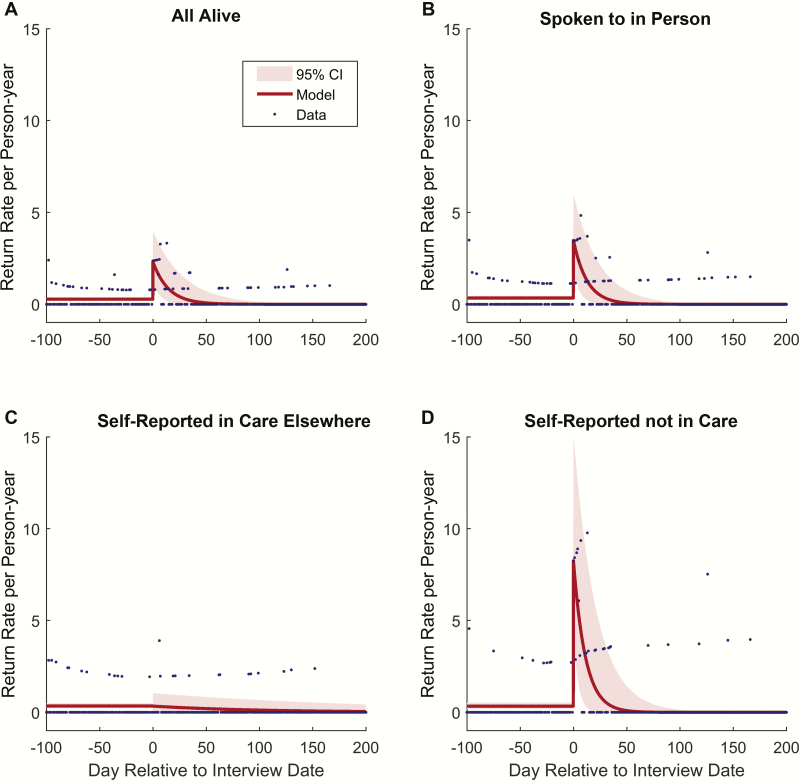
Results.: Of 5781 eligible patients, 991 (17%) were randomly selected for tracing. One year after selection for tracing, 13.3% (95% confidence interval [CI], 11.1%-15.3%) of those selected for tracing returned compared with 10.0% (95% CI, 9.1%-10.8%) of those not randomly selected, an adjusted risk difference of 3.0% (95% CI, .7%-5.3%). Among patients found to be alive, personally contacted, and out of care, tracing increased the absolute probability of return at 1 year by 22% (95% CI, 7.1%-36.2%). The effect of tracing on rate of return to clinic decayed with a half-life of 7.0 days after tracing (95% CI, 2.6 %-12.9%).

Conclusions.: Tracing interventions increase reengagement, but developing methods for targeting LTFU patients most likely to benefit can make this practice more efficient.

Keywords: Africa; antiretroviral therapy; loss to follow-up.; retention.


Figures

Figure 1.
Figure 1.
Inverted Kaplan-Meier estimate for returning to clinic over time, where time zero is the date of random sampling of lost patients to identify the sample to be traced. The gray line shows the distribution of dates that the tracers contacted patients, relative to the date of randomization. The solid green line shows the Kaplan-Meier estimate for return to clinic among all those randomized to tracing (including patients who were found to have died prior to tracing). The solid red line shows the Kaplan-Meier estimate for return to clinic among those not randomly assigned to tracing. Dashed lines show 95% confidence intervals (CIs). The hazard ratio (HR) for returning to clinic was 1.30 (95% CI, 1.08–1.58), which was statistically significant (log-rank test, P = .006).
Figure 2.
Figure 2.
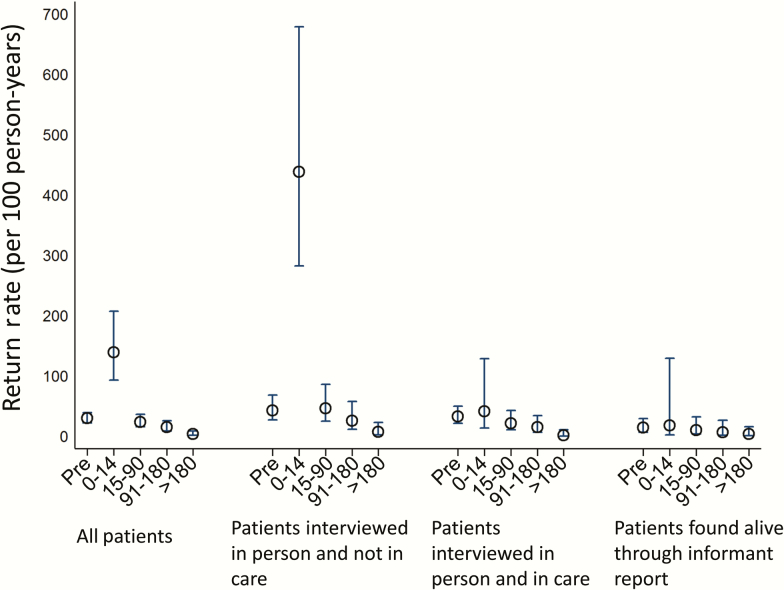
Rates of return before and after tracing stratified by time interval, where time zero is the date of tracing. Rates are adjusted for age, sex, and CD4 count at antiretroviral therapy initiation using a Cox model. Among all those traced, the hazard ratio (HR) for return to clinic was significantly elevated in the first 2 weeks after tracing (HR, 5.9; 95% confidence interval [CI], 3.4–10.2). When the traced population is stratified into those interviewed in person and out of care, those interviewed in person and in care elsewhere, and those not directly interviewed (ie, interview conducted with an informant), the increase in return rate was only significant in those interviewed in person and out of care (HR, 8.1; 95% CI, 3.9–16.6). After 2 weeks, the return rate was no longer significantly different than the pretracing return rate, suggesting that tracing has a large but transient effect on return to clinic.
Figure 3.
Figure 3.
Half-life of the effect of tracing. Date of return to care on each day of observation, where day zero is the date of tracing, was fit to an exponential decay model using Levenberg-Marquardt nonlinear least squares optimization, with confidence intervals (CIs) generated by bootstrap resampling of traced patients. Model parameters including the half-life of the impact of tracing were estimated for all traced patients (half-life of 7.8 days; 95% CI, 3.4–13.0 days), only those patients interviewed in person (half-life of 7.3 days; 95% CI, 3.4–12.2 days), and the subset of all interviewed patients, including both those who reported being in care or out of care (half-life of 7.0 days; 95% CI, 2.6–12.9 days). No significant trend in return date could be identified for those self-reporting to be in care elsewhere. The effect of tracing appeared to be concentrated in patients self-reporting to be out of care, and had a half-life of approximately 1 week until.

Comment in

References

    1. Nachega JB, Chaisson RE, Goliath R et al. . Randomized controlled trial of trained patient-nominated treatment supporters providing partial directly observed antiretroviral therapy. AIDS 2010; 24:1273–80. - PMC - PubMed
    1. Chung MH, Richardson BA, Tapia K et al. . A randomized controlled trial comparing the effects of counseling and alarm device on HAART adherence and virologic outcomes. PLoS Med 2011; 8:e1000422. - PMC - PubMed
    1. Siedner MJ, Lankowski A, Haberer JE et al. . Rethinking the “pre” in pre-therapy counseling: no benefit of additional visits prior to therapy on adherence or viremia in Ugandans initiating ARVs. PLoS One 2012; 7:e39894. - PMC - PubMed
    1. McMahon JH, Elliott JH, Hong SY, Bertagnolio S, Jordan MR. Effects of physical tracing on estimates of loss to follow-up, mortality and retention in low and middle income country antiretroviral therapy programs: a systematic review. PLoS One 2013; 8:e56047. - PMC - PubMed
    1. Ware NC, Wyatt MA, Geng EH et al. . Toward an understanding of disengagement from HIV treatment and care in sub-Saharan Africa: a qualitative study. PLoS Med 2013; 10:e1001369; discussion e1001369. - PMC - PubMed

Substances