


Clinical Status of Adolescents with Perinatal HIV at Transfer to Adult Care in the UK/Ireland
- PMID: 28329212
- PMCID: PMC5714266
- DOI: 10.1093/cid/cix063
Clinical Status of Adolescents with Perinatal HIV at Transfer to Adult Care in the UK/Ireland
Abstract
Background: Increasing numbers of children infected perinatally with human immunodeficiency virus (HIV) are surviving to adolescence and transitioning to adult care, yet there are scarce data on their clinical status at transfer.
Methods: We analyzed prospective cohort data from the UK/Ireland national Collaborative HIV Pediatric Study (CHIPS). Clinical status at last pediatric clinic visit prior to transfer was described. Factors associated with higher CD4 cell count and viral load (VL) suppression<400 c/mL among patients on antiretroviral therapy (ART) at transfer were assessed using linear and logistic regression, respectively. Data were matched with the UK HIV Drug Resistance Database (UKHIVDRB) to assess cumulative resistance profiles at transfer.
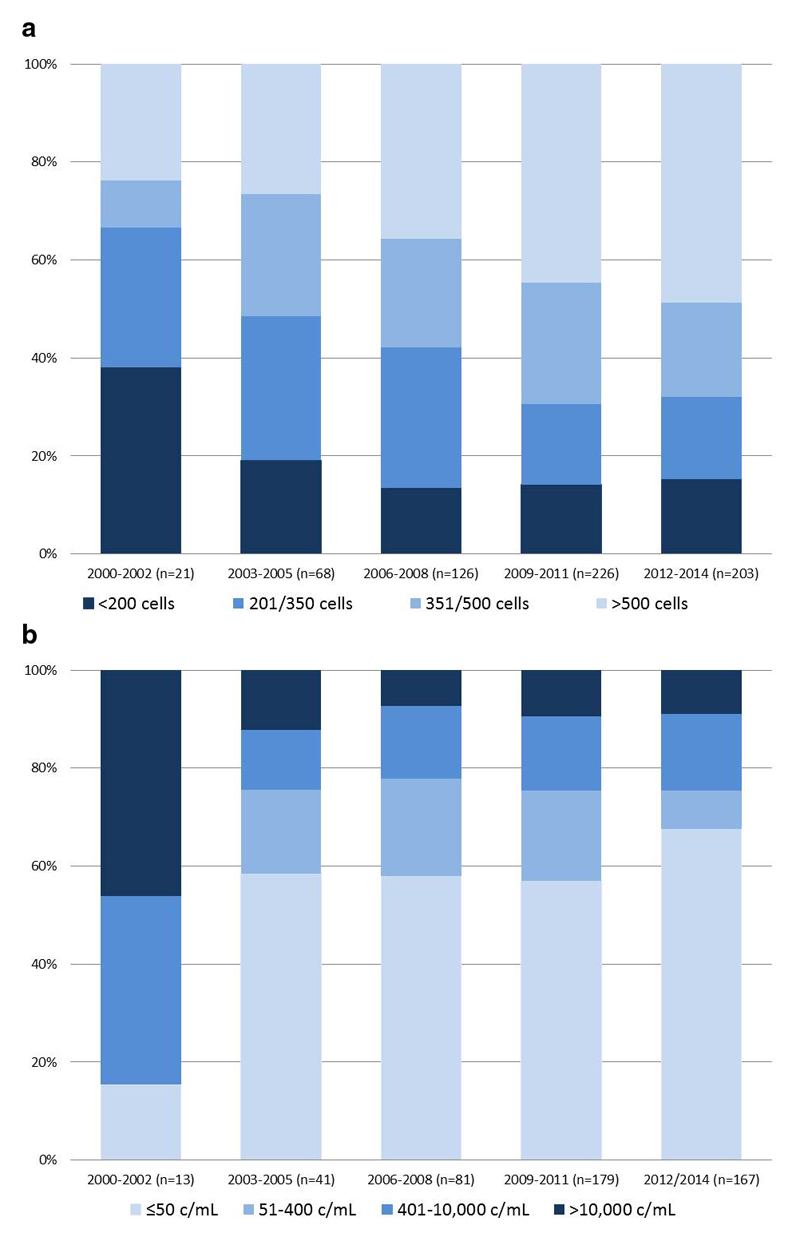
Results: Of 1,907 children followed in CHIPS from 1996 to November 2014, 644 (34%) transferred to adult care: 53% were female, 62% born outside the UK/Ireland, 75% black African. At last pediatric follow-up, median age was 17.4 years [interquartile range 16.5,18.1], 27% had previous AIDS diagnosis, CD4 was 444 cells/mm3 [280, 643], 76% were on ART, 13% off-ART, and 11% ART-naive. Among patients on ART, 74% had VL<400 c/mL. In multivariable analysis, higher CD4 at transfer was associated with younger age, higher CD4 at ART initiation and lower VL at transfer (P ≤ .001). Predictors of viral suppression include no AIDS diagnosis and later year of transfer (P ≤ .05). Of 291 patients with resistance data, 82% had resistance to ≥1 drug class, 56% to ≥2 classes and 12% had triple-class resistance.
Conclusion: Three-quarters of adolescents were on stable ART at transfer, of whom 74% were virologically suppressed. The prevalence of triple-class resistance was relatively low at 12%.
Keywords: HIV; adolescents; antiretroviral therapy; children; UK.
© The Author 2017. Published by Oxford University Press for the Infectious Diseases Society of America. All rights reserved. For permissions, e-mail: journals.permissions@oup.com
Figures
Comment in
-
Old Problems for New Providers: Managing the Postpediatric HIV Generation.Clin Infect Dis. 2017 Apr 15;64(8):1113-1114. doi: 10.1093/cid/cix068. Clin Infect Dis. 2017. PMID: 28369317 Free PMC article. No abstract available.
References
-
- UNAIDS. Children and HIV: Fact Sheet. [Accessed Access date: 25 July 2016]; Available at: http://www.unaids.org/sites/default/files/media_asset/FactSheet_Children....
-
- Dollfus C, Le Chenadec J, Faye A, et al. Long-term outcomes in adolescents perinatally infected with HIV-1 and followed up since birth in the French perinatal cohort (EPF/ANRS CO10) Clinical infectious diseases : an official publication of the Infectious Diseases Society of America. 2010;51(2):214–24. - PubMed
-
- Foster C, Judd A, Tookey P, et al. Young people in the United Kingdom and Ireland with perinatally acquired HIV: the pediatric legacy for adult services. AIDS Patient Care STDS. 2009;23(3):159–66. - PubMed
-
- Slogrove A, A J, Leroy A, Collaboration CIfPHEaRCGC . AIDS 2015. Durban, South Africa: 2016. The epidemiology of perinatally HIV-infected adolescents: a CIPHER cohort collaboration global analysis (WEACO301)
MeSH terms
Substances
Grants and funding
LinkOut - more resources
Full Text Sources
Other Literature Sources
Medical
Research Materials
