


Rates, Delays, and Completeness of General Practitioners' Responses to a Postal Versus Web-Based Survey: A Randomized Trial
- PMID: 28330830
- PMCID: PMC5382256
- DOI: 10.2196/jmir.6308
Rates, Delays, and Completeness of General Practitioners' Responses to a Postal Versus Web-Based Survey: A Randomized Trial
Abstract
Background: Web-based surveys have become a new and popular method for collecting data, but only a few studies have directly compared postal and Web-based surveys among physicians, and none to our knowledge among general practitioners (GPs).
Objective: Our aim is to compare two modes of survey delivery (postal and Web-based) in terms of participation rates, response times, and completeness of questionnaires in a study assessing GPs' preventive practices.
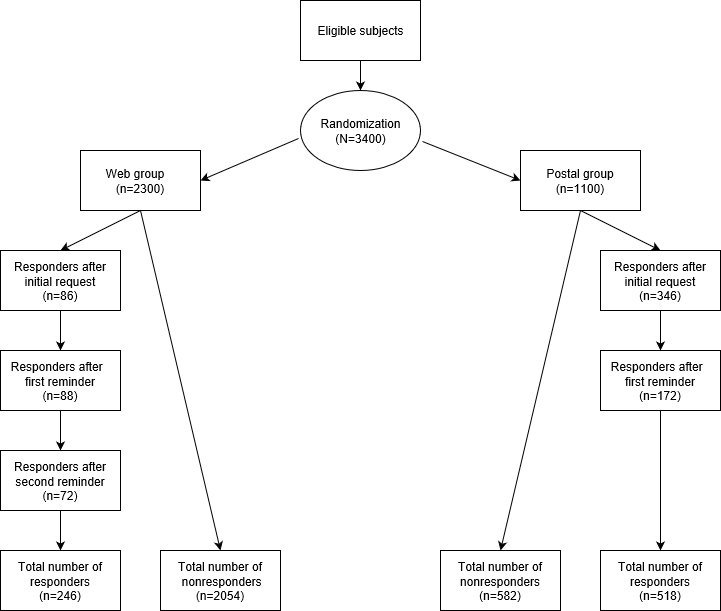
Methods: This randomized study was conducted in Western Switzerland (Geneva and Vaud) and in France (Alsace and Pays de la Loire) in 2015. A random selection of community-based GPs (1000 GPs in Switzerland and 2400 GPs in France) were randomly allocated to receive a questionnaire about preventive care activities either by post (n=700 in Switzerland, n=400 in France) or by email (n=300 in Switzerland, n=2000 in France). Reminder messages were sent once in the postal group and twice in the Web-based group. Any GPs practicing only complementary and alternative medicine were excluded from the study.
Results: Among the 3400 contacted GPs, 764 (22.47%, 95% CI 21.07%-23.87%) returned the questionnaire. Compared to the postal group, the participation rate in the Web-based group was more than four times lower (246/2300, 10.70% vs 518/1100, 47.09%, P<.001), but median response time was much shorter (1 day vs 1-3 weeks, P<.001) and the number of GPs having fully completed the questionnaire was almost twice as high (157/246, 63.8% vs 179/518, 34.6%, P<.001).
Conclusions: Web-based surveys offer many advantages such as reduced response time, higher completeness of data, and large cost savings, but our findings suggest that postal surveys can be still considered for GP research. The use of mixed-mode approaches is probably a good strategy to increase GPs' participation in surveys while reducing costs.
Keywords: completeness; participation rate; primary care; response time; survey methods.
©Paul Sebo, Hubert Maisonneuve, Bernard Cerutti, Jean Pascal Fournier, Nicolas Senn, Dagmar M Haller. Originally published in the Journal of Medical Internet Research (http://www.jmir.org), 22.03.2017.
Conflict of interest statement
Conflicts of Interest: None declared.
References
-
- Armstrong B, White E, Saracci R. Principles of Exposure Measurement in Epidemiology. Oxford: Oxford University Press; 1992.
-
- Rhodes SD, Bowie DA, Hergenrather KC. Collecting behavioural data using the world wide web: considerations for researchers. J Epidemiol Community Health. 2003 Jan;57(1):68–73. http://jech.bmj.com/cgi/pmidlookup?view=long&pmid=12490652 - PMC - PubMed
-
- Beebe TJ, Locke GR, Barnes SA, Davern ME, Anderson KJ. Mixing web and mail methods in a survey of physicians. Health Serv Res. 2007 Jun;42(3 Pt 1):1219–1234. doi: 10.1111/j.1475-6773.2006.00652.x. http://europepmc.org/abstract/MED/17489911 HESR652 - DOI - PMC - PubMed
-
- Schleyer TK, Forrest JL. Methods for the design and administration of web-based surveys. J Am Med Inform Assoc. 2000;7(4):416–425. http://jamia.oxfordjournals.org/cgi/pmidlookup?view=long&pmid=10887169 - PMC - PubMed
-
- Bergeson SC, Gray J, Ehrmantraut LA, Laibson T, Hays RD. Comparing Web-based with mail survey administration of the consumer assessment of healthcare providers and systems (CAHPS(®)) clinician and group survey. Prim Health Care. 2013 Apr 15;3:pii. doi: 10.4172/2167-1079.1000132. http://europepmc.org/abstract/MED/24078901 - DOI - PMC - PubMed
Publication types
MeSH terms
LinkOut - more resources
Full Text Sources
Other Literature Sources
