


Muscle sympathetic nerve activity response to heat stress is attenuated in chronic heart failure patients
- PMID: 28330967
- PMCID: PMC5495922
- DOI: 10.1152/ajpregu.00355.2016
Muscle sympathetic nerve activity response to heat stress is attenuated in chronic heart failure patients
Abstract
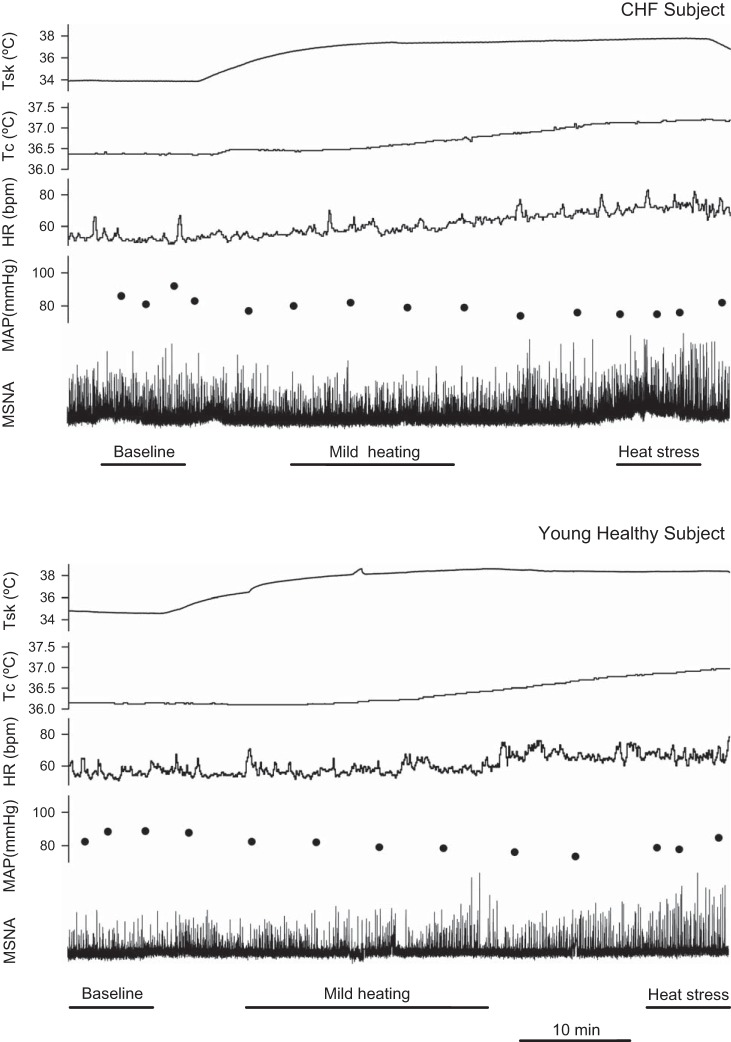
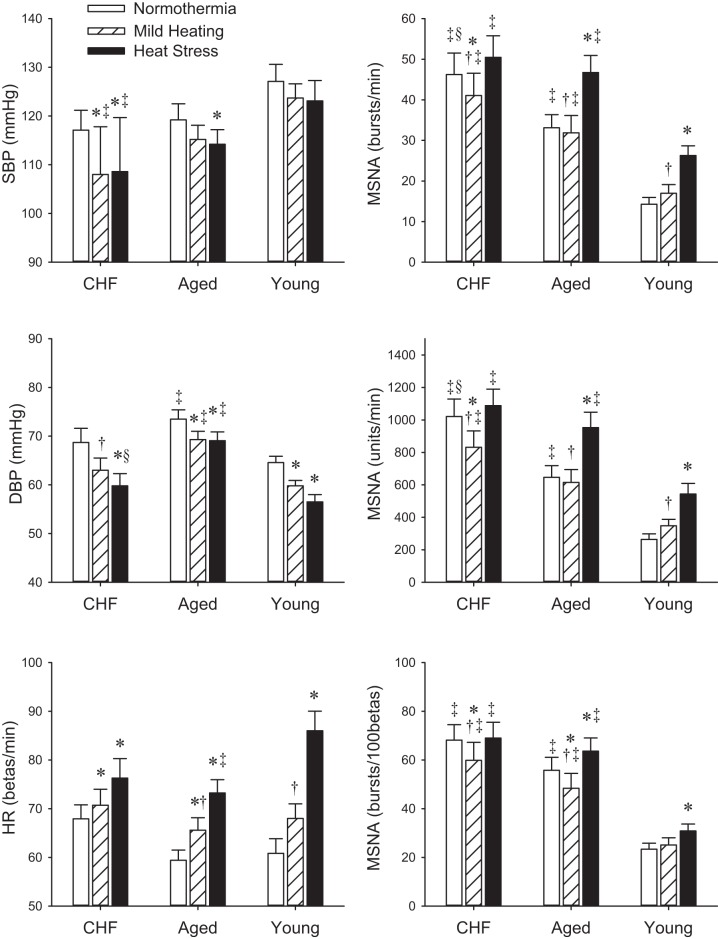
Heat stress evokes significant increases in muscle sympathetic nerve activity (MSNA) in healthy individuals. The MSNA response to heat stress in chronic heart failure (CHF) is unknown. We hypothesized that the MSNA response to heat stress is attenuated in CHF. Passive whole body heating was applied with water-perfused suits in 13 patients (61 ± 2 yr) with stable class II-III CHF, 12 age-matched (62 ± 2 yr) healthy subjects, and 14 young (24 ± 1 yr) healthy subjects. Mild heating (i.e., increases in skin temperature ΔTsk ~2-4°C, internal temperature ΔTcore <0.3°C) significantly decreased MSNA in CHF patients; however, it did not significantly alter the MSNA in the age-matched and young healthy subjects. Heat stress (i.e., ΔTsk ~4°C and ΔTcore ~0.6°C) raised MSNA in the age-matched (32.9 ± 3.2 to 45.6 ± 4.2 bursts/min; P < 0.001) and young (14.3 ± 1.7 to 26.3 ± 2.4 bursts/min; P < 0.001) controls, but not in CHF (46.2 ± 5.3 to 50.5 ± 5.3 bursts/min; P = 0.06). The MSNA increase by the heat stress in CHF (Δ4.2 ± 2.0 bursts/min) was significantly less than those seen in the age-matched (Δ12.8 ± 1.7 bursts/min, P < 0.05) and young (Δ12.0 ± 2.7 bursts/min, P < 0.05) control groups. These data suggest that the MSNA response to heat stress is attenuated in CHF patients. We speculate that the attenuated MSNA response to heat stress may contribute to impaired cardiovascular adjustments in CHF in a hot environment.
Keywords: heart failure; hemodynamics; nervous system; stress; sympathetic.
Copyright © 2017 the American Physiological Society.
Figures
References
-
- Azevedo ER, Kubo T, Mak S, Al-Hesayen A, Schofield A, Allan R, Kelly S, Newton GE, Floras JS, Parker JD. Nonselective versus selective beta-adrenergic receptor blockade in congestive heart failure: differential effects on sympathetic activity. Circulation 104: 2194–2199, 2001. doi:10.1161/hc4301.098282. - DOI - PubMed
-
- Barretto AC, Santos AC, Munhoz R, Rondon MU, Franco FG, Trombetta IC, Roveda F, de Matos LN, Braga AM, Middlekauff HR, Negrão CE. Increased muscle sympathetic nerve activity predicts mortality in heart failure patients. Int J Cardiol 135: 302–307, 2009. doi:10.1016/j.ijcard.2008.03.056. - DOI - PubMed
Publication types
MeSH terms
Grants and funding
LinkOut - more resources
Full Text Sources
Other Literature Sources
Medical
