


Comparing the role of standard references on the prevalence of Iranian children and adolescents' overweight and obesity: A systematic review and meta-analysis
- PMID: 28331507
- PMCID: PMC5348832
- DOI: 10.4103/1735-1995.193512
Comparing the role of standard references on the prevalence of Iranian children and adolescents' overweight and obesity: A systematic review and meta-analysis
Abstract
Background: Obesity is a major risk factor for chronic diseases and has a role on high blood pressure, diabetes type II, etc., This review assesses the prevalence of Iranian children obesity and overweight for different age categories and compares the three standard definitions of obesity.
Materials and methods: To retrieve desirable studies concerning childhood anthropometric data from different area of Iran, the MEDLINE, Scopus, and different local databases such as Scientific Information database were used. The studies reported the prevalence of obesity or overweight of children < 6, 6-12, and 12-20 years old, despite differences between definitions of childhood obesity, were included in the study. We combined the reported prevalence of the overweight and obesity with regard to age and gender, and also by the different standard references which are the Centers for Disease Control and Prevention (CDC), the World Health Organization (WHO) definition, and the International Obesity Task Force (IOTF) references. The analysis was carried out using STATA software.
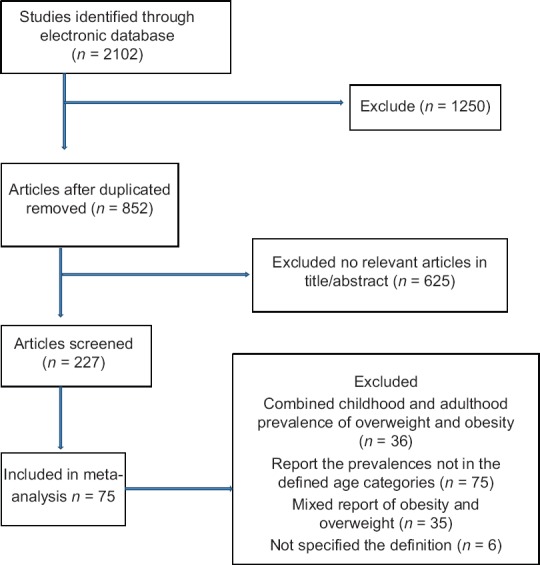
Results: Our review covered 75 articles reported the prevalence of overweight or obesity among children and adolescents for different age groups in Iran. Our meta-regression analysis showed that the prevalence of obesity and overweight did not vary significantly in gender and age categories, but different definitions provide different prevalence of overweight and obesity.
Conclusion: The effective factors on obesity and overweight included administration policy and organizational, interpersonal, intrapersonal, and social factors. CDC and WHO references intended in monitoring children's growth and the IOTF cutoffs would rather provide a common set of definitions that researchers and policymakers could use for descriptive and comparative purposes.
Keywords: Children; Iran; meta-analysis; obesity; overweight; prevalence.
Conflict of interest statement
The authors have no conflicts of interest.
References
-
- Poirier P, Giles TD, Bray GA, Hong Y, Stern JS, Pi-Sunyer FX, et al. Obesity and cardiovascular disease: Pathophysiology, evaluation, and effect of weight loss: An update of the 1997 American Heart Association Scientific Statement on Obesity and Heart Disease from the Obesity Committee of the Council on Nutrition, Physical Activity, and Metabolism. Circulation. 2006;113:898–918. - PubMed
-
- Loos RJ, Bouchard C. FTO: The first gene contributing to common forms of human obesity. Obes Rev. 2008;9:246–50. - PubMed
-
- Flynn MA, McNeil DA, Maloff B, Mutasingwa D, Wu M, Ford C, et al. Reducing obesity and related chronic disease risk in children and youth: A synthesis of evidence with ’best practice’ recommendations. Obes Rev. 2006;7(Suppl 1):7–66. - PubMed
-
- Mirmiran P, Sherafat-Kazemzadeh R, Jalali-Farahani S, Azizi F. Childhood obesity in the Middle East: A review. East Mediterr Health J. 2010;16:1009–17. - PubMed
-
- Kelishadi R, Cook SR, Amra B, Adibi A. Factors associated with insulin resistance and non-alcoholic fatty liver disease among youths. Atherosclerosis. 2009;204:538–43. - PubMed
Publication types
LinkOut - more resources
Full Text Sources
Other Literature Sources