Randomized controlled trial of an early child obesity prevention intervention: Impacts on infant tummy time
- PMID: 28332324
- PMCID: PMC5404992
- DOI: 10.1002/oby.21779
Randomized controlled trial of an early child obesity prevention intervention: Impacts on infant tummy time
Abstract
Objective: To describe infant activity at 3 months old and to test the efficacy of a primary care-based child obesity prevention intervention on promoting infant activity in low-income Hispanic families.
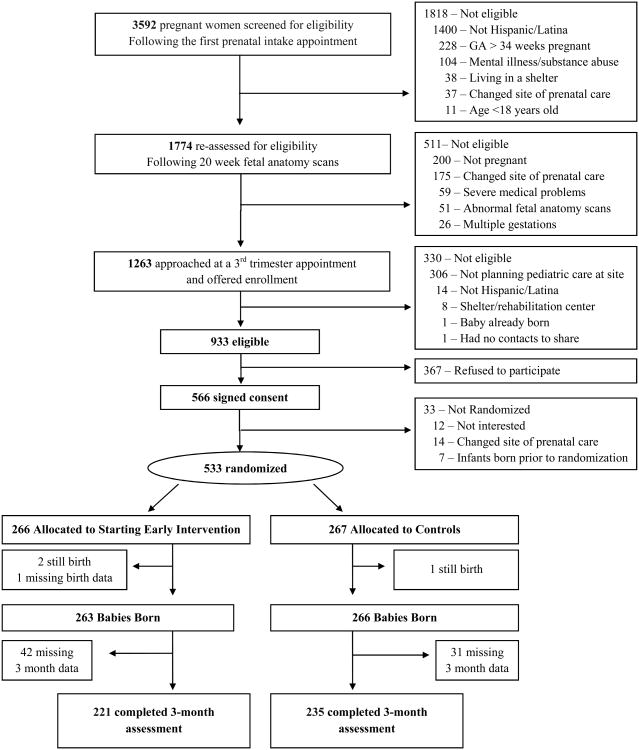
Methods: This study was a randomized controlled trial (n = 533) comparing a control group of mother-infant dyads receiving standard prenatal and pediatric primary care with an intervention group receiving "Starting Early," with individual nutrition counseling and nutrition and parenting support groups coordinated with prenatal and pediatric visits. Outcomes included infant activity (tummy time, unrestrained floor time, time in movement-restricting devices). Health literacy was assessed using the Newest Vital Sign.
Results: Four hundred fifty-six mothers completed 3-month assessments. Infant activity results were: 82.6% ever practiced tummy time; 32.0% practiced tummy time on the floor; 34.4% reported unrestrained floor time; 56.4% reported ≥1 h/d in movement-restricting devices. Inadequate health literacy was associated with reduced tummy time and unrestrained floor time. The intervention group reported more floor tummy time (OR 2.16, 95% CI 1.44-3.23) and unrestrained floor time (OR 1.69, 95% CI 1.14-2.49) compared to controls. No difference in the time spent in movement-restricting devices was found.
Conclusions: Tummy time and unrestrained floor time were low. Primary care-based obesity prevention programs have potential to promote these activities.
Trial registration: ClinicalTrials.gov NCT01541761.
© 2017 The Obesity Society.
Conflict of interest statement
Figures
Comment in
-
Early infancy interventions to prevent childhood obesity.Obesity (Silver Spring). 2017 May;25(5):817-818. doi: 10.1002/oby.21829. Epub 2017 Mar 23. Obesity (Silver Spring). 2017. PMID: 28337849 No abstract available.
Similar articles
-
INSIGHT responsive parenting intervention reduces infant's screen time and television exposure.Int J Behav Nutr Phys Act. 2018 Mar 15;15(1):24. doi: 10.1186/s12966-018-0657-5. Int J Behav Nutr Phys Act. 2018. PMID: 29544506 Free PMC article. Clinical Trial.
-
Randomized Controlled Trial of a Primary Care-Based Child Obesity Prevention Intervention on Infant Feeding Practices.J Pediatr. 2016 Jul;174:171-177.e2. doi: 10.1016/j.jpeds.2016.03.060. Epub 2016 Apr 21. J Pediatr. 2016. PMID: 27113376 Free PMC article. Clinical Trial.
-
Starting Early Program Impacts on Feeding at Infant 10 Months Age: A Randomized Controlled Trial.Child Obes. 2020 Aug;16(S1):S4-S13. doi: 10.1089/chi.2019.0236. Epub 2020 Jan 14. Child Obes. 2020. PMID: 31934788 Free PMC article. Clinical Trial.
-
Examining Childhood Obesity From Infancy: The Relationship Between Tummy Time, Infant BMI-z, Weight Gain, and Motor Development-An Exploratory Study.J Pediatr Health Care. 2019 Jan;33(1):80-91. doi: 10.1016/j.pedhc.2018.06.006. Epub 2018 Aug 18. J Pediatr Health Care. 2019. PMID: 30131199 Review.
-
Offspring body size and metabolic profile - effects of lifestyle intervention in obese pregnant women.Dan Med J. 2014 Jul;61(7):B4893. Dan Med J. 2014. PMID: 25123127 Review.
Cited by
-
A Health-Literacy Intervention for Early Childhood Obesity Prevention: A Cluster-Randomized Controlled Trial.Pediatrics. 2021 May;147(5):e2020049866. doi: 10.1542/peds.2020-049866. Pediatrics. 2021. PMID: 33911032 Free PMC article. Clinical Trial.
-
The effectiveness of interventions during the first 1,000 days to improve energy balance-related behaviors or prevent overweight/obesity in children from socio-economically disadvantaged families of high-income countries: a systematic review.Obes Rev. 2023 Jan;24(1):e13524. doi: 10.1111/obr.13524. Epub 2022 Nov 17. Obes Rev. 2023. PMID: 36394375 Free PMC article.
-
Feasibility of an Obesity Prevention Program for Latino Families from First Trimester of Pregnancy to Child Age 18 Months and Predictors of Program Attendance.Child Obes. 2025 Mar;21(2):157-167. doi: 10.1089/chi.2024.0340. Epub 2024 Nov 29. Child Obes. 2025. PMID: 39612164
-
Effect of Social Media on Child Obesity: Application of Structural Equation Modeling with the Taguchi Method.Int J Environ Res Public Health. 2018 Jun 26;15(7):1343. doi: 10.3390/ijerph15071343. Int J Environ Res Public Health. 2018. PMID: 29949902 Free PMC article.
-
Associations between Feeding Patterns and Infant Health in China: A Propensity Score Matching Approach.Nutrients. 2021 Dec 17;13(12):4518. doi: 10.3390/nu13124518. Nutrients. 2021. PMID: 34960071 Free PMC article.
References
-
- Hesketh KD, Crawford DA, Abbott G, Campbell KJ, Salmon J. Prevalence and stability of active play, restricted movement and television viewing in infants. Early Child Dev Care. 2015;185(6):883–894.
-
- Downing KL, Hnatiuk J, Hesketh KD. Prevalence of sedentary behavior in children under 2 years: A systematic review. Prev Med. 2015;78:105–114. - PubMed
Publication types
MeSH terms
Associated data
Grants and funding
LinkOut - more resources
Full Text Sources
Other Literature Sources
Medical
