The Need for New Donor Stratification to Predict Graft Survival in Deceased Donor Kidney Transplantation
- PMID: 28332370
- PMCID: PMC5368150
- DOI: 10.3349/ymj.2017.58.3.626
The Need for New Donor Stratification to Predict Graft Survival in Deceased Donor Kidney Transplantation
Abstract
Purpose: The aim of this study was to determine whether stratification of deceased donors by the United Network for Organ Sharing (UNOS) criteria negatively impacts graft survival.
Materials and methods: We retrospectively reviewed deceased donor and recipient pretransplant variables of kidney transplantations that occurred between February 1995 and December 2009. We compared clinical outcomes between standard criteria donors (SCDs) and expanded criteria donors (ECDs).
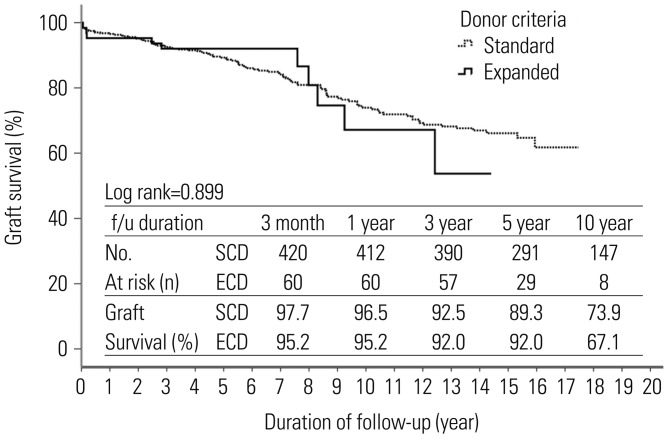
Results: The deceased donors consisted of 369 patients. A total of 494 transplant recipients were enrolled in this study. Mean age was 41.7±11.4 year (range 18-69) and 273 patients (55.4%) were male. Mean duration of follow-up was 8.8±4.9 years. The recipients from ECD kidneys were 63 patients (12.8%). The overall mean cold ischemia time was 5.7±3.2 hours. Estimated glomerular filtration rate at 1, 2, and 3 years after transplantation were significantly lower in ECD transplants (1 year, 62.2±17.6 vs. 51.0±16.4, p<0.001; 2 year, 62.2±17.6 vs. 51.0±16.4, p=0.001; 3 year, 60.9±23.5 vs. 54.1±18.7, p=0.047). In multivariate analysis, donor age (≥40 years) was an independent risk factor for graft failure. In Kaplan-Meier analyses, there was no significant difference in death-censored graft survival (Log rank test, p>0.05), although patient survival was lower in ECDs than SCDs (Log rank test, p=0.011).
Conclusion: Our data demonstrate that stratification by the UNOS criteria does not predict graft survival. In order to expand the donor pool, new criteria for standard/expanded donors need to be modified by regional differences.
Keywords: Kidney transplantation; allocation; deceased donor; expanded criteria donor; standard criteria donor.
© Copyright: Yonsei University College of Medicine 2017
Conflict of interest statement
The authors have no financial conflicts of interest.
Figures

References
-
- Mathur AK, Ashby VB, Sands RL, Wolfe RA. Geographic variation in end-stage renal disease incidence and access to deceased donor kidney transplantation. Am J Transplant. 2010;10(4 Pt 2):1069–1080. - PubMed
-
- Cusumano AM, Romao JE, Poblete Badal H, Elgueta Miranda S, Gomez R, Cerdas Calderon M, et al. [Latin-American dialysis and kidney transplantation registry: data on the treatment of end-stage renal disease in Latin America] G Ital Nefrol. 2008;25:547–553. - PubMed
-
- Port FK, Bragg-Gresham JL, Metzger RA, Dykstra DM, Gillespie BW, Young EW, et al. Donor characteristics associated with reduced graft survival: an approach to expanding the pool of kidney donors. Transplantation. 2002;74:1281–1286. - PubMed
-
- United Network for Organ Sharing. Organ procurement and transplantation network policies. Policy 8: allocation of kidneys. [2016 March 1]. Available at: http://optn.transplant.hrsa.gov/governance/policies.
MeSH terms
Substances
LinkOut - more resources
Full Text Sources
Other Literature Sources
Medical