Review
. 2017 Jun;174(12):1533-1554.
doi: 10.1111/bph.13792. Epub 2017 May 10.

The epigenetic landscape related to reactive oxygen species formation in the cardiovascular system

Affiliations
Review

The epigenetic landscape related to reactive oxygen species formation in the cardiovascular system

Thomas Kietzmann et al. Br J Pharmacol. 2017 Jun.

Abstract

Cardiovascular diseases are among the leading causes of death worldwide. Reactive oxygen species (ROS) can act as damaging molecules but also represent central hubs in cellular signalling networks. Increasing evidence indicates that ROS play an important role in the pathogenesis of cardiovascular diseases, although the underlying mechanisms and consequences of pathophysiologically elevated ROS in the cardiovascular system are still not completely resolved. More recently, alterations of the epigenetic landscape, which can affect DNA methylation, post-translational histone modifications, ATP-dependent alterations to chromatin and non-coding RNA transcripts, have been considered to be of increasing importance in the pathogenesis of cardiovascular diseases. While it has long been accepted that epigenetic changes are imprinted during development or even inherited and are not changed after reaching the lineage-specific expression profile, it becomes more and more clear that epigenetic modifications are highly dynamic. Thus, they might provide an important link between the actions of ROS and cardiovascular diseases. This review will provide an overview of the role of ROS in modulating the epigenetic landscape in the context of the cardiovascular system.

Linked articles: This article is part of a themed section on Redox Biology and Oxidative Stress in Health and Disease. To view the other articles in this section visit http://onlinelibrary.wiley.com/doi/10.1111/bph.v174.12/issuetoc.


Figures

Figure 1
Figure 1
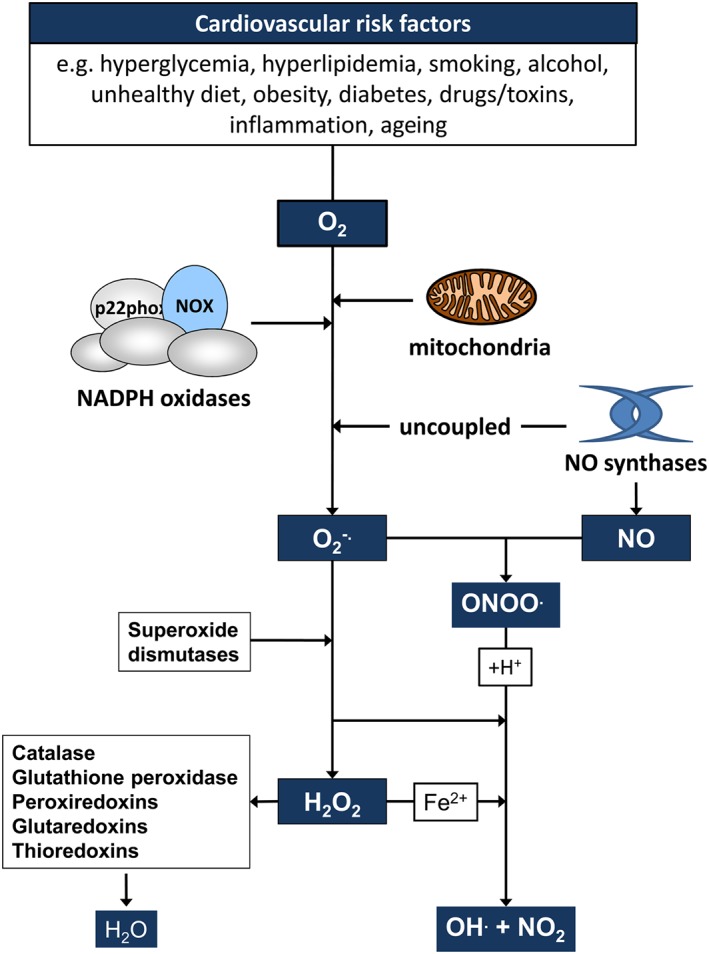
Cardiovascular risk factors promote the generation of ROS. Cardiovascular risk factors have been associated with increased generation of ROS. Superoxide anion radicals (O2 ·−) are generated from molecular oxygen via important sources such as NADPH oxidases, the mitochondrial electron transfer chain and uncoupled NO synthases. O2 ·− can be converted to H2O2 via superoxide dismutases (SOD) or in the presence of NO to peroxynitrite (ONOO). H2O2 is decomposed or scavenged by catalase, glutathion peroxidase, glutaredoxins, peroxiredoxins or thioredoxins, respectively. O2 ·−, H2O2 and ONOO can react via different reactions to form hydroxyl anion radicals (·OH) and nitrite (NO2).
Figure 2
Figure 2
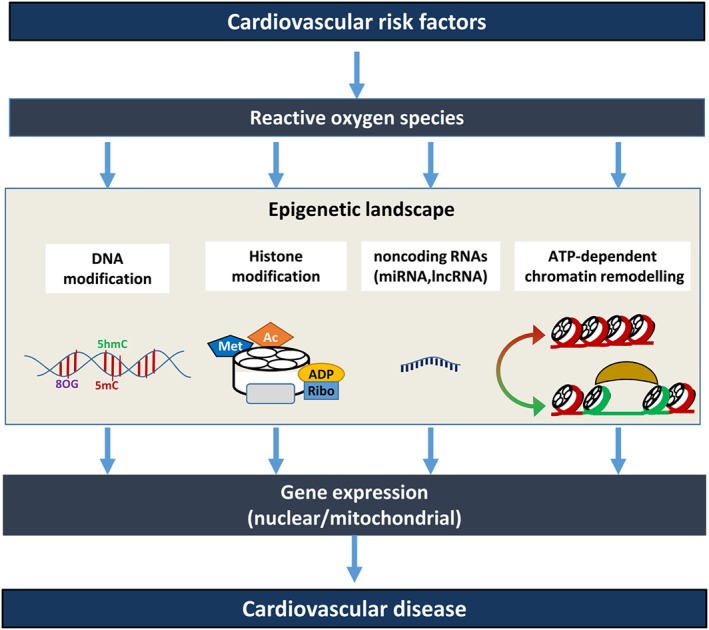
ROS modulate the epigenetic landscape contributing to the pathogenesis of cardiovascular diseases. Cardiovascular risk factors modulate the levels of ROS, which affect the epigenetic landscape by modulating histone modifications, DNA modifications, the expression of non‐coding RNAs and ATP‐dependent chromatin remodelling. This will subsequently affect gene expression patterns in the nucleus and mitochondria, which can contribute to cardiovascular diseases. DNA modifications include cytosine methylation (5mC), hydroxymethylation (5hmC) or 8‐oxo‐2′‐deoxyguanosine (8OG) formation. Histone modifications include methylation (Met), acetylation (Ac), ubiquitylation (Ubi), ADP‐ribosylation (ADP‐Ribo), SUMOylation (SUMO) and phosphorylation (P). Non‐coding RNAs include microRNAs (miRNA) and long non‐coding RNAs (lncRNA). ATP‐dependent chromatin remodelling includes moving and adding/removing nucleosomes by ATPase containing complexes (see text).
Figure 3
Figure 3
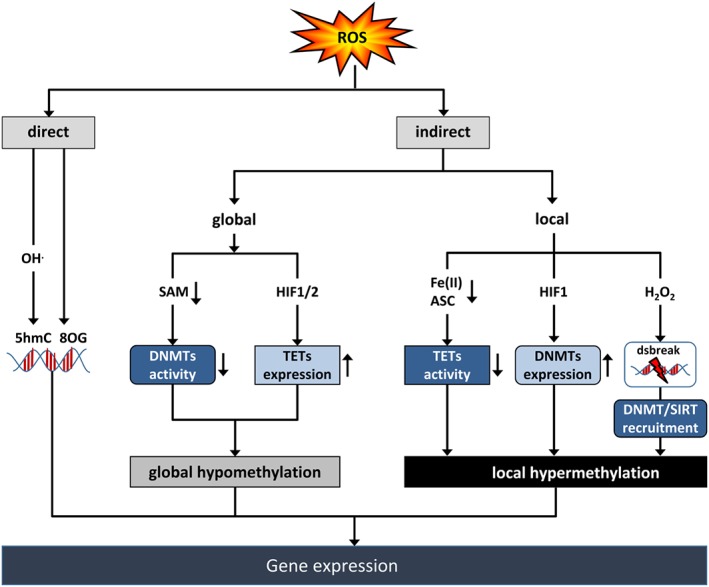
ROS affect DNA methylation. ROS can directly affect DNA by formation of 8‐oxo‐2′‐deoxyguanosine (8OG) or, via hydroxyl radicals (OH), by formation of 5‐hydroxymethylcytosine (5hmC). ROS can also indirectly affect DNA methylation at the global or local level leading to modulation of gene expression. Reduction of the activity of DNA methyltransferases (DNMT) by reducing the availability of SAM or increasing the expression of TET proteins via the transcription factor HIF1 can lead to global hypomethylation. Decreasing TET activity by reducing Fe(II) or ascorbate (ASC) levels, or increasing DNMT expression via HIF1, or recruiting DNMT and the HDM SIRT1 containing complexes to H2O2‐induced DNA double strand breaks (dsbreak) can result in local hypermethylation.
Figure 4
Figure 4
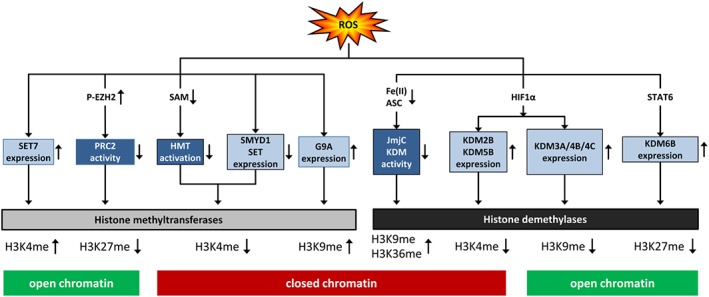
ROS affect histone lysine methylation. ROS affect histone lysine methylation via HMT or HDM either by diminishing their activity or modulating their expression, thus affecting either activating (H4K3me) or repressing (H3K9me, H3K27me, H3K36me) histone lysine methylation marks, subsequently resulting in open or closed chromatin. JmjC KDM, jumonji‐C domain‐containing HDM; STAT6, signal transducer and activator of transcription 6; p‐EZH2, enhancer of zeste 2 PRC2 subunit, phosphorylated.
Figure 5
Figure 5
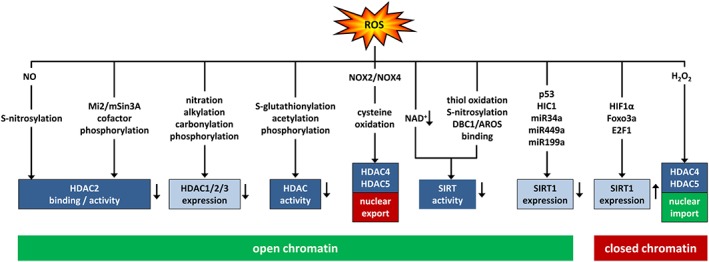
ROS shape histone acetylation by modulating histone deacetylases. ROS can affect histone acetylation by differentially modulating HDACs of class I (HDAC1/2/3), class II (HDAC4/5) and class III (SIRT). This can occur by affecting their activity or binding affinity, their expression or their nuclear localization. ROS can decrease expression or activity of class I HDACs due to posttranslational modifications or modulation of the cofactor mi2/mSin3a leading to increased histone acetylation and open chromatin. Similarly, ROS can promote nuclear export of oxidized class II HDACs or decrease activity of class III HDACs due to decreased availability of the cofactor NAD+ or posttranslational modifications or decreased expression of SIRT1 due to transcriptional or miRNA‐mediated repression leading to open chromatin. ROS can increase expression of SIRT1 or nuclear import of class II HDACs leading to decreased histone acetylation and closed chromatin. DBC1, deleted in breast cancer 1; AROS, active regulator of SIRT1; HIC1, hypermethylated in cancer 1; miR, microRNA; FOXO3a, Forkhead box O3a.

References

    1. Abdulla A, Zhao X, Yang F (2013). Natural polyphenols inhibit lysine‐specific demethylase‐1 in vitro. J Biochem Pharmacol Res 1: 56–63. - PMC - PubMed
    1. Adenuga D, Yao H, March TH, Seagrave J, Rahman I (2009). Histone deacetylase 2 is phosphorylated, ubiquitinated, and degraded by cigarette smoke. Am J Respir Cell Mol Biol 40: 464–473. - PMC - PubMed
    1. Afanas'ev I (2014). New nucleophilic mechanisms of ros‐dependent epigenetic modifications: comparison of aging and cancer. Aging Dis 5: 52–62. - PMC - PubMed
    1. Ago T, Liu T, Zhai P, Chen W, Li H, Molkentin JD et al. (2008). A redox‐dependent pathway for regulating class II HDACs and cardiac hypertrophy. Cell 133: 978–993. - PubMed
    1. Alexander SPH, Fabbro D, Kelly E, Marrion N, Peters JA, Benson HE et al. (2015a). The Concise Guide to PHARMACOLOGY 2015/16: Enzymes. Br J Pharmacol 172: 6024–6109. - PMC - PubMed

Publication types

MeSH terms

Substances

LinkOut - more resources