. 2017 Mar 23;9(3):964-985.
doi: 10.18632/aging.101203.

APOE ε4 specific imbalance of arachidonic acid and docosahexaenoic acid in serum phospholipids identifies individuals with preclinical Mild Cognitive Impairment/Alzheimer's Disease

Affiliations

APOE ε4 specific imbalance of arachidonic acid and docosahexaenoic acid in serum phospholipids identifies individuals with preclinical Mild Cognitive Impairment/Alzheimer's Disease

Laila Abdullah et al. Aging (Albany NY). .

Abstract

This study was designed to explore the influence of apolipoprotein E (APOE) on blood phospholipids (PL) in predicting preclinical Alzheimer's disease (AD). Lipidomic analyses were also performed on blood from an AD mouse model expressing human APOE isoforms (EFAD) and five AD mutations and from 195 cognitively normal participants, 23 of who converted to mild cognitive impairment (MCI)/AD within 3 years. APOE ε4-carriers converting to MCI/AD had high arachidonic acid (AA)/docosahexaenoic acid (DHA) ratios in PL compared to cognitively normal ε4 and non-ε4 carriers. Arachidonic acid and DHA containing PL species, ε4-status and Aβ42/Aβ40 ratios provided 91% accuracy in detecting MCI/AD. Fish oil/omega-3 fatty acid consumption was associated with lower AA/DHA ratios even among ε4 carriers. High plasma AA/DHA ratios were observed in E4FAD compared to EFAD mice with other isoforms. In particular, alterations in plasma AA and DHA containing PL species were also observed in the brains of E4FAD mice compared to E3FAD mice. Despite the small sample size and a short follow-up, these results suggest that blood PL could potentially serve as biomarkers of preclinical MCI/AD.

Keywords: Alzheimer’s disease; arachidonic acid; docosahexaenoic acid; lipidomics; phospholipid.


Conflict of interest statement

CONFLICTS OF INTEREST

The authors declare no conflict of interest.

Figures
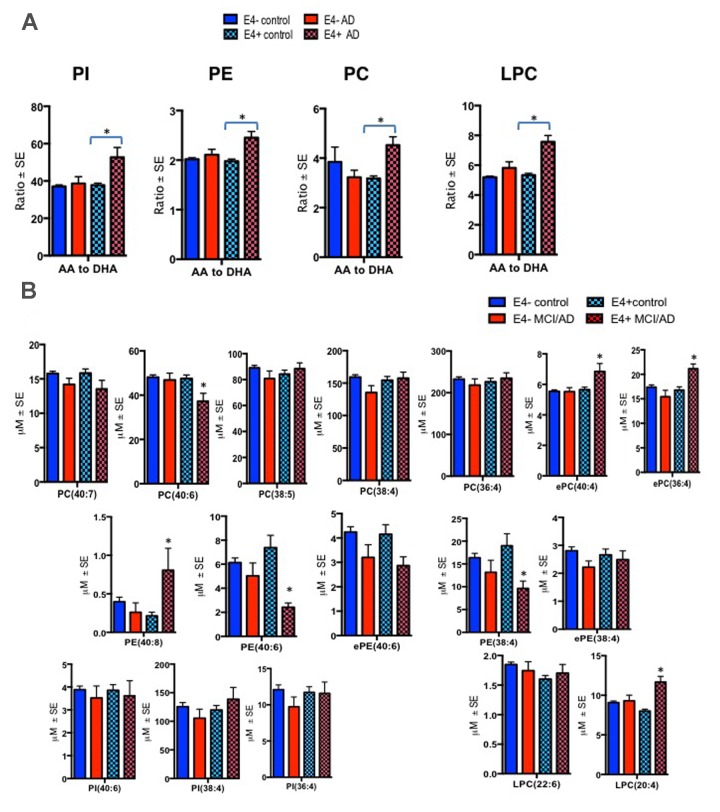
Figure 1
Figure 1. Ratios of AA to DHA and individual PL species stratified by diagnosis and the APOE ε4 carrier status
Mean ± SE (ε4-non carriers = 119 control and 13 MCI/AD; ε4 carrier = 53 controls and MCI/AD = 10). (A) There was an interaction between MCI/AD diagnosis and ε4 allele for PC (F = 10.81, p = 0.001), PE (F = 4.95, p = 0.027), PI (F = 9.13, p = 0.003) and LPC (F = 15.05, p < 0.001). Subjects with the ε4 allele who later converted to MCI/AD had higher ratios of AA to DHA within PC, LPC, PI and PE relative to ε4 controls and ε4 non-carriers. (B) Individual AA and DHA species which significantly contributed to the imbalance in AA to DHA ratios among ε4 carries with MCI/AD compared to other groups include ePC(36:4), ePC(40:4), PC(40:6), PE(38:4), PE(40:6), PE(40:8) and LPC(20:4). *p < 0.05 for post-hoc analyses.
Figure 2
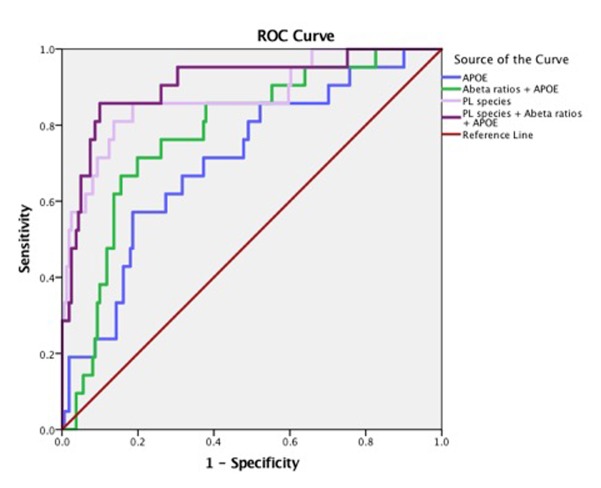
Figure 2. Arachidonic acid and DHA containing PL species along with ε4 carrier status and Aβ have high accuracy for predicting MCI/AD diagnosis
Pilot ROC analyses were performed using the Cox-regression model consisting of a panel of PL that contained AA and DHA which included PE(36:4), PE(38:6), ePE(40:6), PE(40:6), LPC(20:4), LPC(22:6), ePC(36;4), ePC(40:4), ePC(40:6), PC(36:4), PC(38:4), PC(38:5), PC(40:4), PC(40:6), and PC(40:7). An AUC of 91% towards the diagnosis of MCI/AD was observed for this PL panel, ε4 and Aβ42/Aβ40 ratios. PL species alone provide an AUC of 88%. The APOE and ε4 together provided an AUC of 71%.
Figure 3
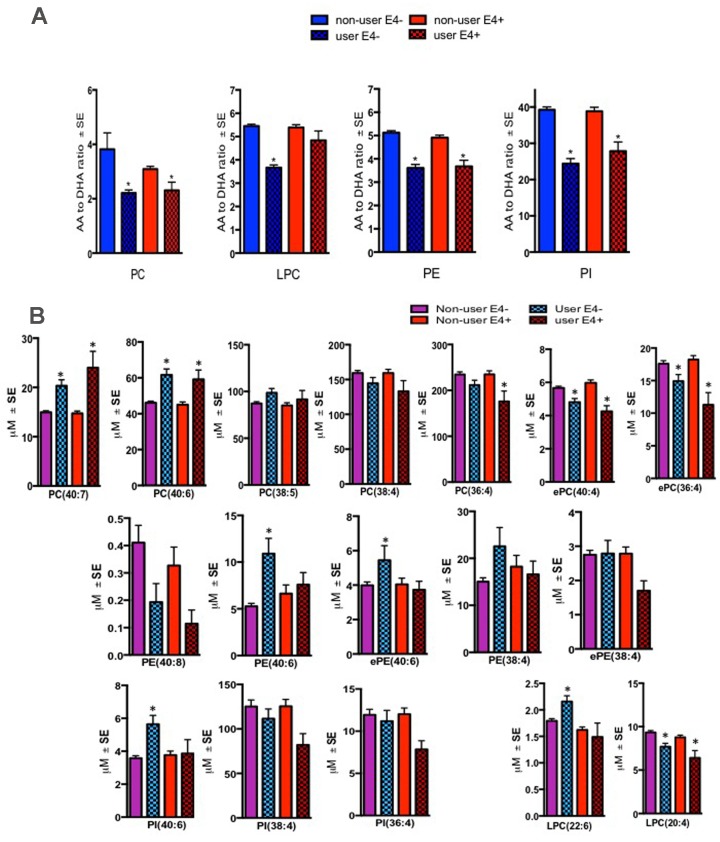
Figure 3. Effect of fish oil/omega-3 supplement use on the AA and DHA containing species within blood PL classes
Mean ± SE(17 ε4- controls and 5 ε4 controls) for subjects who reported yes for using fish oil/omega-3 supplement. (A) Relative to non-users, ratios of AA to DHA were decreased in several PL classes in both ε4- and ε4+ controls who reported using fish-oil/omega-3 supplements. (B) Individual AA species (ePC(36:4), ePC(38:4), PC(36:4), LPC(20:4)) were generally decreased whereas DHA containing species (PC(40:6), PC(40:7), ePE(40:6), PE(40:6), and PI(40:6) were increased in several PL classes in both ε4- and ε4+ controls who reported using fish-oil/omega-3 supplements. While LPC(22:6) was increased in supplement users with ε4- genotype, levels of this lipid did not change in ε4+ individuals. *p < 0.05 for post-hoc analyses.
Figure 4
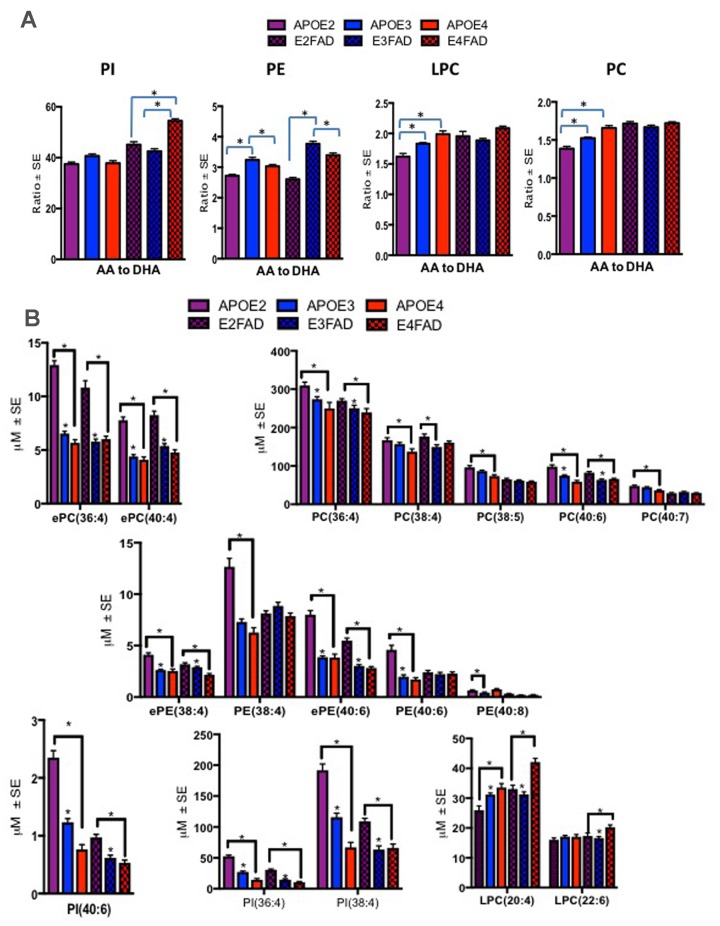
Figure 4. Ratios of AA to DHA and individual PL species stratified by APOE4-TR and E4FAD mice
Mean ± SE (n = 6 per genotype). (A) There was a main effect of APOE genotypes on LPC (F = 10.53, p < 0.001) and PC (F = 33.73, p < 0.001). Relative to APOE2 and APOE3, ratio of AA to DHA containing species within PC and LPC were higher in APOE4 mice. There was also a main effect of the APOE genotypes in PE (F = 89.95, p < 0.001), ratios of AA to DHA were lower in APOE2 and APOE4 relative to APOE3 and ratios of AA to DHA were lowest in E2 FAD followed by E4FAD relative to E3FAD mice. There was also a main effect of the APOE genotypes for PI (F = 99.71, p < 0.001), where ratios were higher in E4 relative to E2 and E3FAD. (B) There were significant differences in various AA and DHA containing PL between the APOE genotypes for the APOE-TR and EFAD mice. While PL species, such as ePC(36:4), PC(38:4), ePE(38:4) and PI(36:4) were decreased in E4 relative to the other isoforms in APOE-TR and EFAD mice. LPC(20:4) and LPC(22:6) were increased in E4 mice relative to the other isoforms in APOE-TR and EFAD mice. *p < 0.05 for the post-hoc analyses.

References

    1. Crean S, Ward A, Mercaldi CJ, Collins JM, Cook MN, Baker NL, Arrighi HM. Apolipoprotein E ε4 prevalence in Alzheimer's disease patients varies across global populations: a systematic literature review and meta-analysis. Dement Geriatr Cogn Disord. 2011;31:20–30. doi: 10.1159/000321984. - DOI - PubMed
    1. Jansen WJ, Ossenkoppele R, Knol DL, Tijms BM, Scheltens P, Verhey FR, Visser PJ, Aalten P, Aarsland D, Alcolea D, Alexander M, Almdahl IS, Arnold SE, et al. Amyloid Biomarker Study Group Prevalence of cerebral amyloid pathology in persons without dementia: a meta-analysis. JAMA. 2015;313:1924–38. doi: 10.1001/jama.2015.4668. - DOI - PMC - PubMed
    1. Mahley RW. Central nervous system lipoproteins: ApoE and regulation of cholesterol metabolism. Arterioscler Thromb Vasc Biol. 2016;36:1305–15. doi: 10.1161/ATVBAHA.116.307023. - DOI - PMC - PubMed
    1. Bazinet RP, Layé S. Polyunsaturated fatty acids and their metabolites in brain function and disease. Nat Rev Neurosci. 2014;15:771–85. doi: 10.1038/nrn3820. - DOI - PubMed
    1. Salem N, Jr, Vandal M, Calon F. The benefit of docosahexaenoic acid for the adult brain in aging and dementia. Prostaglandins Leukot Essent Fatty Acids. 2015;92:15–22. doi: 10.1016/j.plefa.2014.10.003. - DOI - PubMed

Publication types