


Intra-individual purifying selection on mitochondrial DNA variants during human oogenesis
- PMID: 28333293
- PMCID: PMC5850138
- DOI: 10.1093/humrep/dex051
Intra-individual purifying selection on mitochondrial DNA variants during human oogenesis
Abstract
Study question: Does selection for mtDNA mutations occur in human oocytes?
Summary answer: We provide statistical evidence in favor of the existence of purifying selection for mtDNA mutations in human oocytes acting between the expulsion of the first and second polar bodies (PBs).
What is known already: Several lines of evidence in Metazoa, including humans, indicate that variation within the germline of mitochondrial genomes is under purifying selection. The presence of this internal selection filter in the germline has important consequences for the evolutionary trajectory of mtDNA. However, the nature and localization of this internal filter are still unclear while several hypotheses are proposed in the literature.
Study design, size, duration: In this study, 60 mitochondrial genomes were sequenced from 17 sets of oocytes, first and second PBs, and peripheral blood taken from nine women between 38 and 43 years of age.
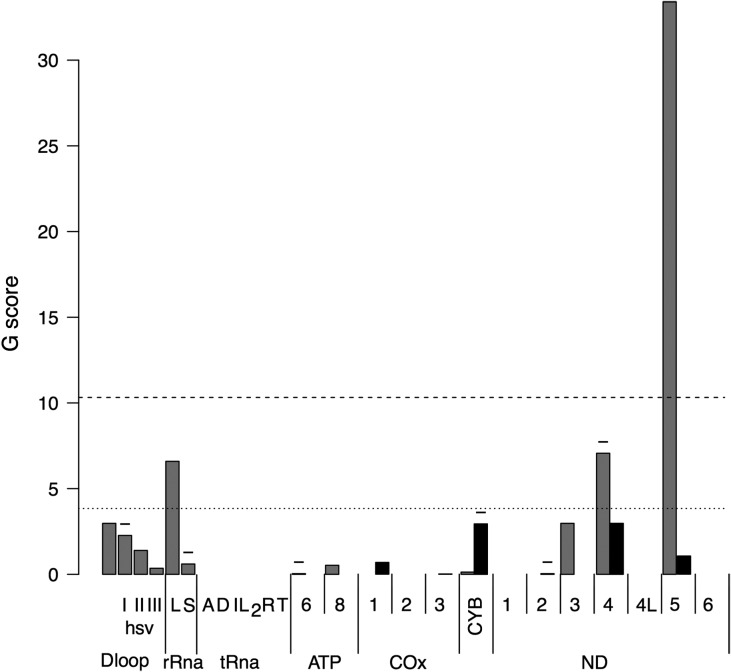
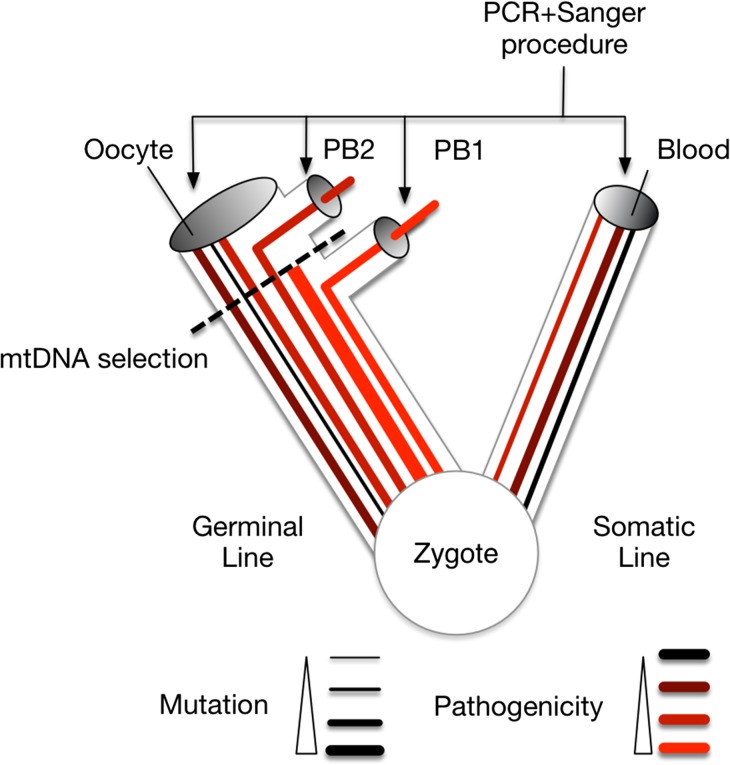
Participants/materials, setting, methods: Whole genome amplification was performed only on the single cell samples and Sanger sequencing was performed on amplicons. The comparison of variant profiles between first and second PB sequences showed no difference in substitution rates but displayed instead a sharp difference in pathogenicity scores of protein-coding sequences using three different metrics (MutPred, Polyphen and SNPs&GO).
Main results and the role of chance: Unlike the first, second PBs showed no significant differences in pathogenic scores with blood and oocyte sequences. This suggests that a filtering mechanism for disadvantageous variants operates during oocyte development between the expulsion of the first and second PB.
Large scale data: N/A.
Limitations, reasons for caution: The sample size is small and further studies are needed before this approach can be used in clinical practice. Studies on a model organism would allow the sample size to be increased.
Wider implications of the findings: This work opens the way to the study of the correlation between mtDNA mutations, mitochondrial capacity and viability of oocytes.
Study funding/competing interest(s): This work was supported by a SISMER grant. Laboratory facilities and skills were freely provided by SISMER, and by the Alma Mater Studiorum, University of Bologna. The authors have no conflict of interest to disclose.
Keywords: first and second polar body; heteroplasmy; human oocytes; mtDNA variants; purifying selection.
© The Author 2017. Published by Oxford University Press on behalf of the European Society of Human Reproduction and Embryology. All rights reserved. For Permissions, please email: journals.permissions@oup.com
Figures
Comment in
-
Purifying selection on mitochondrial DNA in maturing oocytes: implication for mitochondrial replacement therapy.Hum Reprod. 2017 Sep 1;32(9):1948-1950. doi: 10.1093/humrep/dex254. Hum Reprod. 2017. PMID: 28854729 No abstract available.
-
Reply: Purifying selection on mitochondrial DNA: a strategy for the oocyte to preserve competence.Hum Reprod. 2017 Sep 1;32(9):1949-1950. doi: 10.1093/humrep/dex255. Hum Reprod. 2017. PMID: 28854730 No abstract available.
References
-
- Calabrese C, Simone D, Diroma MA, Santorsola M, Guttà C, Gasparre G, Picardi E, Pesole G, Attimonelli M. MToolBox: a highly automated pipeline for heteroplasmy annotation and prioritization analysis of human mitochondrial variants in high-throughput sequencing. Bioinformatics 2014;30:3115–3117. - PMC - PubMed
-
- Calabrese R, Capriotti E, Fariselli P, Martelli PL, Casadio R. Functional annotations improve the predictive score of human disease-related mutations in proteins. Hum Mutat 2009;30:1237–1244. - PubMed
Publication types
MeSH terms
Substances
LinkOut - more resources
Full Text Sources
Other Literature Sources
Medical
Research Materials
