


WGS to predict antibiotic MICs for Neisseria gonorrhoeae
- PMID: 28333355
- PMCID: PMC5890716
- DOI: 10.1093/jac/dkx067
WGS to predict antibiotic MICs for Neisseria gonorrhoeae
Abstract
Background: Tracking the spread of antimicrobial-resistant Neisseria gonorrhoeae is a major priority for national surveillance programmes.
Objectives: We investigate whether WGS and simultaneous analysis of multiple resistance determinants can be used to predict antimicrobial susceptibilities to the level of MICs in N. gonorrhoeae.
Methods: WGS was used to identify previously reported potential resistance determinants in 681 N. gonorrhoeae isolates, from England, the USA and Canada, with phenotypes for cefixime, penicillin, azithromycin, ciprofloxacin and tetracycline determined as part of national surveillance programmes. Multivariate linear regression models were used to identify genetic predictors of MIC. Model performance was assessed using leave-one-out cross-validation.
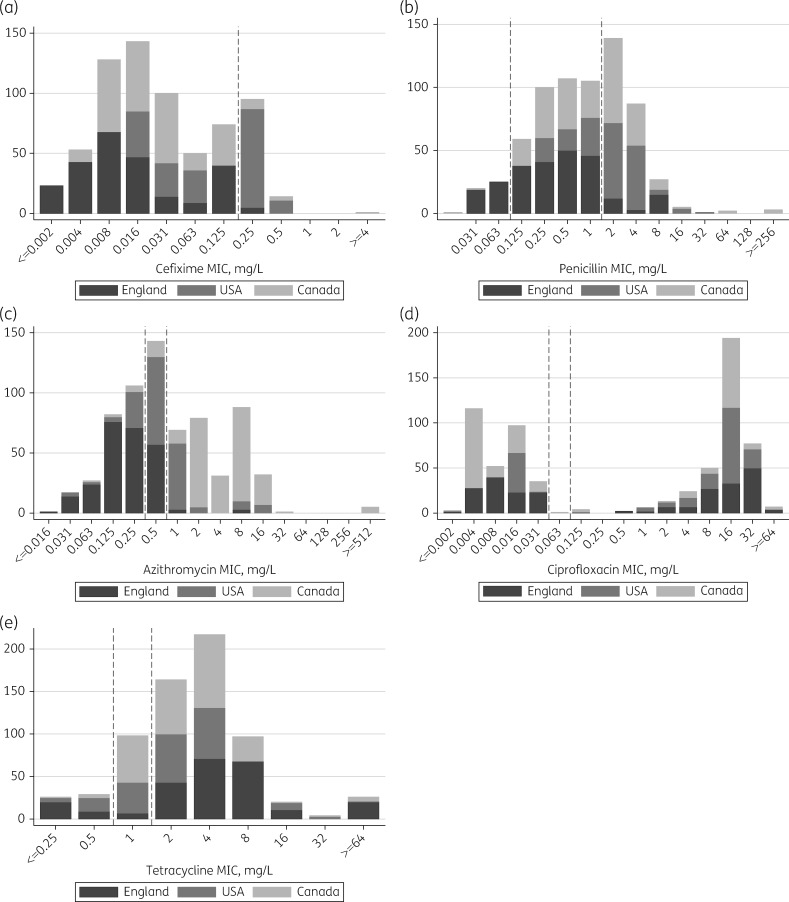
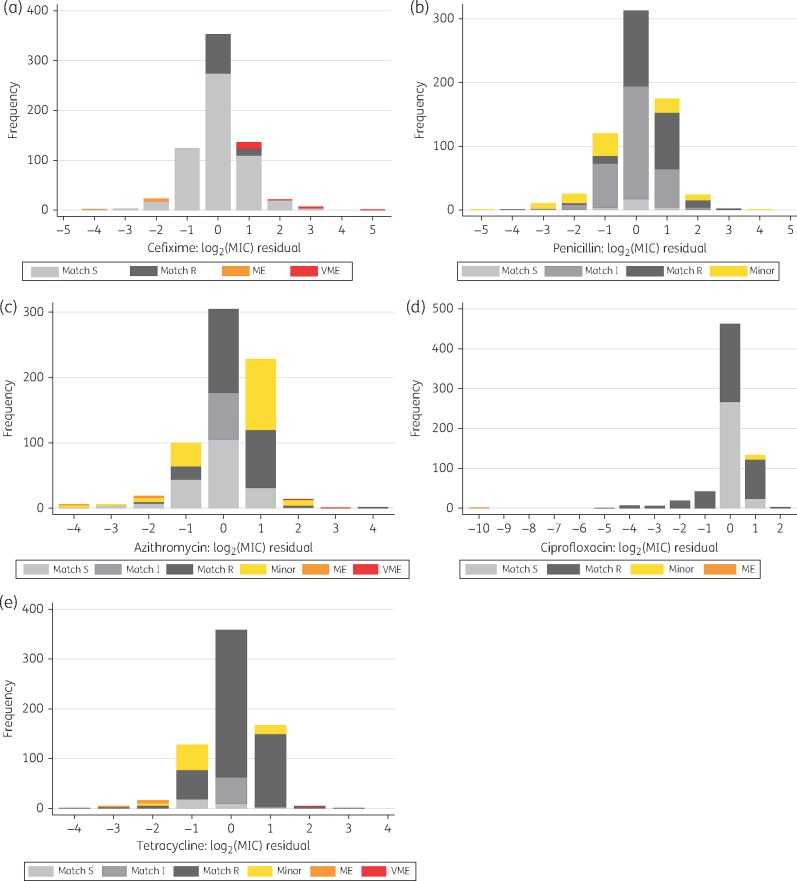
Results: Overall 1785/3380 (53%) MIC values were predicted to the nearest doubling dilution and 3147 (93%) within ±1 doubling dilution and 3314 (98%) within ±2 doubling dilutions. MIC prediction performance was similar across the five antimicrobials tested. Prediction models included the majority of previously reported resistance determinants. Applying EUCAST breakpoints to MIC predictions, the overall very major error (VME; phenotypically resistant, WGS-prediction susceptible) rate was 21/1577 (1.3%, 95% CI 0.8%-2.0%) and the major error (ME; phenotypically susceptible, WGS-prediction resistant) rate was 20/1186 (1.7%, 1.0%-2.6%). VME rates met regulatory thresholds for all antimicrobials except cefixime and ME rates for all antimicrobials except tetracycline. Country of testing was a strongly significant predictor of MIC for all five antimicrobials.
Conclusions: We demonstrate a WGS-based MIC prediction approach that allows reliable MIC prediction for five gonorrhoea antimicrobials. Our approach should allow reasonably precise prediction of MICs for a range of bacterial species.
© The Author 2017. Published by Oxford University Press on behalf of the British Society for Antimicrobial Chemotherapy.
Figures
References
-
- PHE. Surveillance of Antimicrobial Resistance in Neisseria gonorrhoeae: Key Findings from the ‘Gonococcal Resistance to Antimicrobials Surveillance Programme’ (GRASP) and Related Surveillance Data, 2014 2015. https://www.gov.uk/government/uploads/system/uploads/attachment_data/fil....
-
- ECDC. Gonococcal Antimicrobial Susceptibility Surveillance in Europe 2014 2016. http://ecdc.europa.eu/en/publications/Publications/gonococcal-antimicrob....
-
- Kirkcaldy RD, Harvey A, Papp JR. et al. Neisseria gonorrhoeae Antimicrobial Susceptibility Surveillance—The Gonococcal Isolate Surveillance Project, 27 sites, United States, 2014. MMWR CDC Surveill Summ 2016; 65: 1–19. - PubMed
-
- Public Health Agency of Canada. National Surveillance of Antimicrobial Susceptibilities of Neisseria gonorrhoeae Annual Summary 2014 2015. http://healthycanadians.gc.ca/publications/drugs-products-medicaments-pr....
MeSH terms
Substances
Grants and funding
LinkOut - more resources
Full Text Sources
Other Literature Sources
Medical
Molecular Biology Databases
Miscellaneous
