


Immune response of rats vaccinated orally with various plant-expressed recombinant cysteine proteinase constructs when challenged with Fasciola hepatica metacercariae
- PMID: 28333957
- PMCID: PMC5383346
- DOI: 10.1371/journal.pntd.0005451
Immune response of rats vaccinated orally with various plant-expressed recombinant cysteine proteinase constructs when challenged with Fasciola hepatica metacercariae
Abstract
Background: Cysteine proteinases of Fasciola hepatica are important candidates for vaccine antigens because of their role in fluke biology and host-parasite relationships. In our previous experiments, we found that a recombinant cysteine proteinase cloned from adult F. hepatica (CPFhW) can protect rats against liver fluke infections when it is administered intramuscularly or intranasally in the form of cDNA. We also observed considerable protection upon challenge following mucosal vaccination with inclusion bodies containing recombinant CPFhW produced in Escherichia coli. In this study, we explore oral vaccination, which may be the desired method of delivery and is potentially capable of preventing infections at the site of helminth entry. To provide antigen encapsulation and to protect the vaccine antigen from degradation in the intestinal tract, transgenic plant-based systems are used.
Methodology: In the present study, we aimed to evaluate the protective ability of mucosal vaccinations of 12-week-old rats with CPFhW produced in a transgenic-plant-based system. To avoid inducing tolerance and to maximise the immune response induced by oral immunisation, we used the hepatitis B virus (HBV) core protein (HBcAg) as a carrier. Animals were immunised with two doses of the antigen and challenged with 25 or 30 metacercariae of F. hepatica.
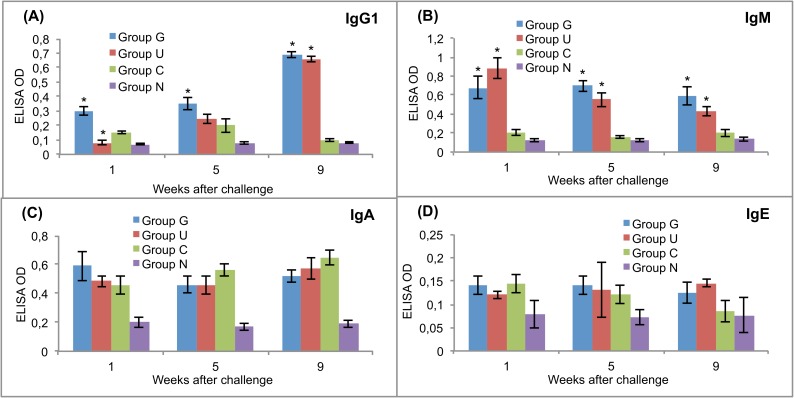
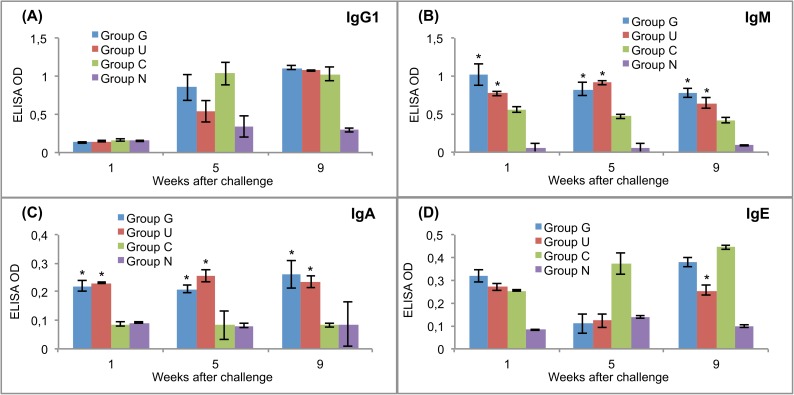
Conclusions: We obtained substantial protection after oral administration of the plant-produced hybrids of CPFhW and HBcAg. The highest level of protection (65.4%) was observed in animals immunised with transgenic plants expressing the mature CPFhW enzyme flanked by Gly-rich linkers and inserted into c/e1 epitope of truncated HBcAg. The immunised rats showed clear IgG1 and IgM responses to CPFhW for 4 consecutive weeks after the challenge.
Conflict of interest statement
The authors have declared that no competing interests exist.
Figures



References
-
- Spithill TW, Carmona C, Piedrafita D, Smooker PM. Prospects for Immunoprophylaxis Against Fasciola hepatica (Liver Fluke) In: Caffrey CR, Selzer CM, editors. Parasitic Helminths: Targets, Screens, Drugs and Vaccines. Wiley-VCH Verlag GmbH & Co. KGaA; 2012. pp. 465–484.
-
- Fox NJ, White PC, McClean CJ, Marion G, Evans A, Hutchings MR. Predicting impacts of climate change on Fasciola hepatica risk. PLoS ONE. 2011;10 Available: http://www.plosone.org/article/info%3Adoi%2F10.1371%2Fjournal.pone.0016126. - PMC - PubMed
Publication types
MeSH terms
Substances
LinkOut - more resources
Full Text Sources
Other Literature Sources
