


Distribution of antimicrobial resistance determinants, virulence-associated factors and clustered regularly interspaced palindromic repeats loci in isolates of Enterococcus faecalis from various settings and genetic lineages
- PMID: 28334141
- PMCID: PMC5827583
- DOI: 10.1093/femspd/ftx021
Distribution of antimicrobial resistance determinants, virulence-associated factors and clustered regularly interspaced palindromic repeats loci in isolates of Enterococcus faecalis from various settings and genetic lineages
Abstract
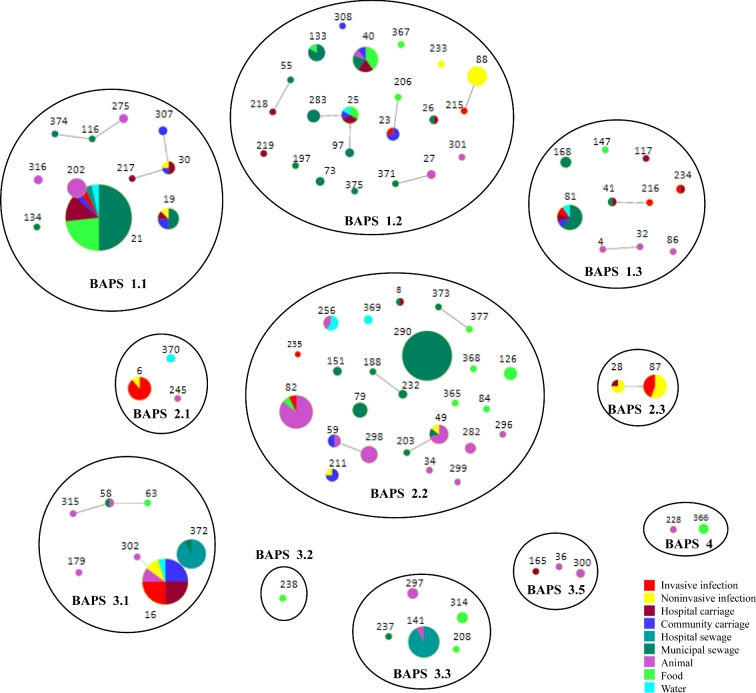
Enterococcus faecalis represents an important factor of hospital-associated infections (HAIs). The knowledge on its evolution from a commensal to an opportunistic pathogen is still limited; thus, we performed a study to characterise distribution of factors that may contribute to this adaptation. Using a collection obtained from various settings (hospitalised patients, community carriers, animals, fresh food, sewage, water), we investigated differences in antimicrobial susceptibility, distribution of antimicrobial resistance genes, virulence-associated determinants and phenotypes, and CRISPR loci in the context of the clonal relatedness of isolates. Bayesian Analysis of Population Structure revealed the presence of three major groups; two subgroups comprised almost exclusively HAI isolates, belonging to previously proposed enterococcal high-risk clonal complexes (HiRECCs) 6 and 28. Isolates of these two subgroups were significantly enriched in antimicrobial resistance genes, presumably produced a polysaccharide capsule and often carried the aggregation substance asa1; distribution of other virulence-associated genes, such as esp and cyl, formation of a biofilm and gelatinase production were more variable. Moreover, both subgroups showed a low prevalence of CRISPR-Cas 1 and 3 and presence of small CRISPR2 variants. Our study confirms the importance of HiRECCs in the population of E. faecalis and their confinement to the hospital settings.
Keywords: BAPS; CRISPR; Enterococcus faecalis; high-risk clones; resistance; virulence.
© FEMS 2017. All rights reserved. For permissions, please e-mail: journals.permissions@oup.com.
Figures
References
-
- Agersø Y, Pedersen AG, Aarestrup FM. Identification of Tn5397-like and Tn916-like transposons and diversity of the tetracycline resistance gene tet(M) in enterococci from humans, pigs and poultry. J Antimicrob Chemoth 2006;57:832–9. - PubMed
-
- Baldassarri L, Cecchini R, Bertuccini L et al. Enterococcus spp. produces slime and survives in rat peritoneal macrophages. Med Microbiol Immun 2001;190:113–20. - PubMed
-
- Chouchani C, El Salabi A, Marrakchi R et al. First report of mefA and msrA/msrB multidrug efflux pumps associated with blaTEM-1 β-lactamase in Enterococcus faecalis. Int J Infect Dis 2012;16:e104–9. - PubMed
-
- Chow JW. Aminoglycoside resistance in enterococci. Clin Infect Dis 2000;31:586–9. - PubMed
Publication types
MeSH terms
Substances
Grants and funding
LinkOut - more resources
Full Text Sources
Other Literature Sources
Medical
