


Guided Bayesian imputation to adjust for confounding when combining heterogeneous data sources in comparative effectiveness research
- PMID: 28334230
- PMCID: PMC5862356
- DOI: 10.1093/biostatistics/kxx003
Guided Bayesian imputation to adjust for confounding when combining heterogeneous data sources in comparative effectiveness research
Abstract
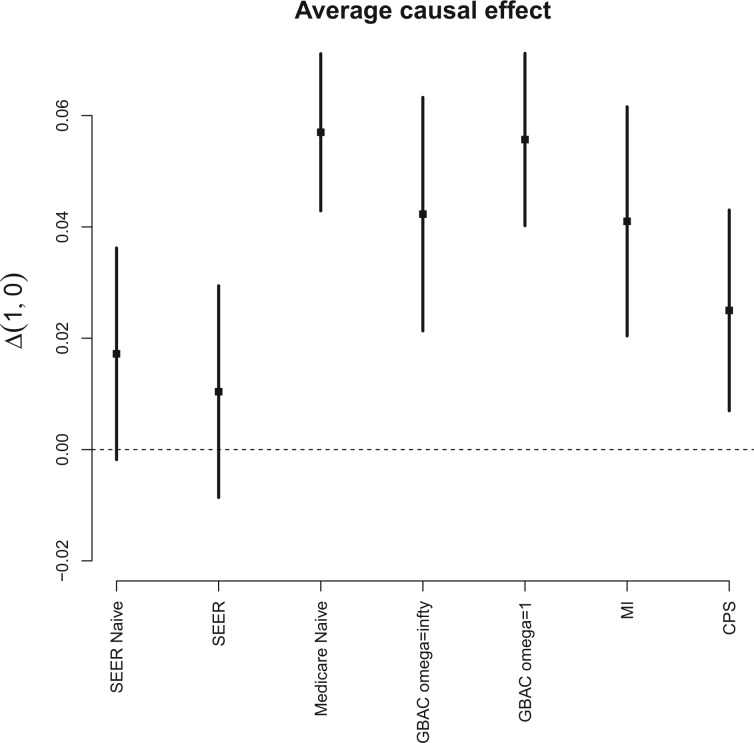
In comparative effectiveness research, we are often interested in the estimation of an average causal effect from large observational data (the main study). Often this data does not measure all the necessary confounders. In many occasions, an extensive set of additional covariates is measured for a smaller and non-representative population (the validation study). In this setting, standard approaches for missing data imputation might not be adequate due to the large number of missing covariates in the main data relative to the smaller sample size of the validation data. We propose a Bayesian approach to estimate the average causal effect in the main study that borrows information from the validation study to improve confounding adjustment. Our approach combines ideas of Bayesian model averaging, confounder selection, and missing data imputation into a single framework. It allows for different treatment effects in the main study and in the validation study, and propagates the uncertainty due to the missing data imputation and confounder selection when estimating the average causal effect (ACE) in the main study. We compare our method to several existing approaches via simulation. We apply our method to a study examining the effect of surgical resection on survival among 10 396 Medicare beneficiaries with a brain tumor when additional covariate information is available on 2220 patients in SEER-Medicare. We find that the estimated ACE decreases by 30% when incorporating additional information from SEER-Medicare.
Keywords: Bayesian adjustment for confounding; Bayesian data augmentation; Confounder selection; Missing data; Model averaging.
The Author 2017. Published by Oxford University Press. All rights reserved. For permissions, please e-mail: journals.permissions@oup.com.
Figures
References
-
- Albert, J. H. and Chib, S. (1993). Bayesian analysis of binary and polychotomous response data.. Journal of the American Statistical Association, 88, 669–679.
-
- Carroll, R. J, Ruppert, D., Stefanski, L. A and Crainiceanu, C. M. (2006). Measurement Error in Nonlinear Models: A Modern Perspective. Boca Raton, Florida: CRC Press.
MeSH terms
Grants and funding
LinkOut - more resources
Full Text Sources
Other Literature Sources
Miscellaneous
