. 2017 Apr 25;116(9):1177-1185.
doi: 10.1038/bjc.2017.76. Epub 2017 Mar 23.

High STMN1 level is associated with chemo-resistance and poor prognosis in gastric cancer patients

Affiliations

High STMN1 level is associated with chemo-resistance and poor prognosis in gastric cancer patients

Tuya Bai et al. Br J Cancer. .

Abstract

Background: Stathmin1 (STMN1) is a cytosolic phosphoprotein that regulates cellular microtubule dynamics and is known to have oncogenic activity. Despite several reports, its roles in gastric cancer (GC) remain unclear owing to a lack of analyses of highly metastatic cases. This study aimed to investigate STMN1 as a prognostic and predictive indicator of response to paclitaxel therapy in patients with GC, including inoperable cases.

Methods: Immunohistochemical analysis of STMN1 was performed on both operable (n=95) and inoperable GC (n=61) samples. The roles of STMN1 in cancer cell proliferation and sensitivity to a microtubule-targeting drug, paclitaxel, were confirmed by knockdown experiments using GC cell lines.

Results: Multivariate and Kaplan-Meier analyses demonstrated that high STMN1 was predictive of poor prognosis in both the groups. In the operable cohort, STMN1 expression correlated with cancer curability, recurrence, and resistance to adjuvant therapy. A correlation with paclitaxel resistance was observed in inoperable cases. Knockdown of STMN1 in GC cell lines inhibited proliferation and sensitised the cells to paclitaxel by enhancing apoptosis.

Conclusions: STMN1 is a possible biomarker for paclitaxel sensitivity and poor prognosis in GC and could be a novel therapeutic target in metastatic GC.


Conflict of interest statement

Masahiko Nishiyama received a research grant from Yakult Honsha Co. Ltd. Grants-in-Aid for Scientific Research from the Japan Society for the Promotion of Science (JSPS): grant numbers 26461969, 15K10129, and 15K10085. The work was supported in part by Uehara Zaidan, and Gunma University Initiative for Advanced Research (GIAR).

Figures
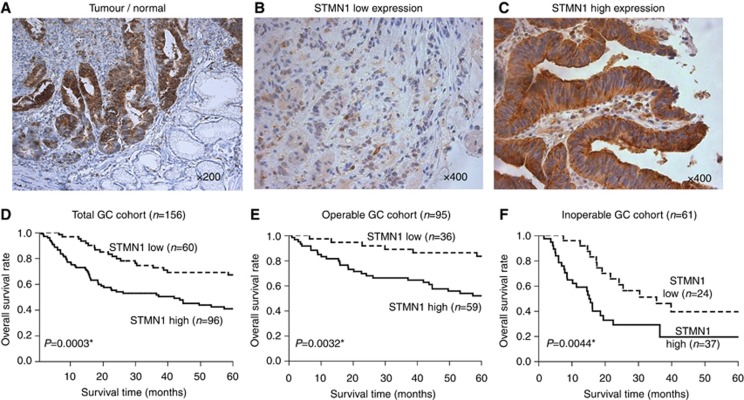
Figure 1
Figure 1
Immunohistochemical staining of STMN1 in GC samples. (A) Representative immunohistochemical staining of STMN1 in GC tissues (tumour) and normal gastric mucosa (normal; original magnification, × 200). The expression level of STMN1 was stronger in GC tissues than in normal gastric mucosa. (B and C) Low and high expression of STMN1 in GC specimens (original magnification, × 400). Sixty GC specimens (38.5%) were classified into the low-STMN1-expression group and 96 (61.5%) were assigned to the high-STMN1-expression group. (D) Kaplan–Meier overall survival in total GC cohort (n=156); analyses were based on the expression of STMN1 (P=0.0003). (E) Kaplan–Meier overall survival analyses of the operable GC cohort (n=95) according to the expression level of STMN1 (P=0.0032). (F) Kaplan–Meier overall survival analyses of the inoperable GC cohort (n=61) according to the expression level of STMN1 (P=0.0044). Kaplan–Meier overall survival rate in the high-STMN1-expression group was significantly lower than that in the low-STMN1-expression group.
Figure 2
Figure 2
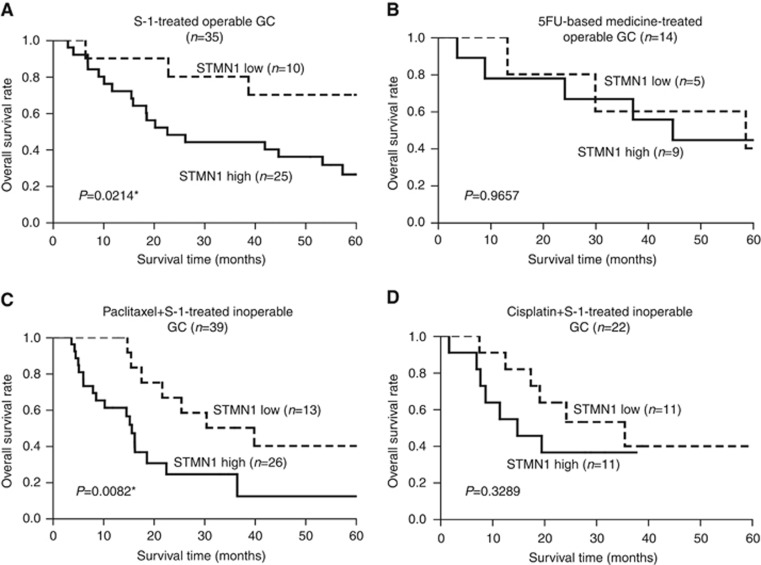
Overall survival curves of GC patients according to expression of STMN1. (A and B) Kaplan–Meier overall survival analyses of GC patients with operable tumours treated with S-1 and 5-FU-based medicine as adjuvant therapies after surgery. High STMN1 expression was significantly associated with poor prognosis in patients treated with S-1 after surgery (P=0.0214). However, this relationship was not observed in patients treated with 5-FU-based adjuvant therapy (P=0.9657). (C and D) Kaplan–Meier overall survival analyses in patients with inoperable tumours treated with paclitaxel+S-1 (P=0.0082) and cisplatin+S-1 (P=0.3289) as first-line chemotherapy. High STMN1 expression correlated with poor survival in the paclitaxel+S-1-treated group (P=0.0082), but not in the cisplatin+S-1-treated group (P=0.3289).
Figure 3
Figure 3
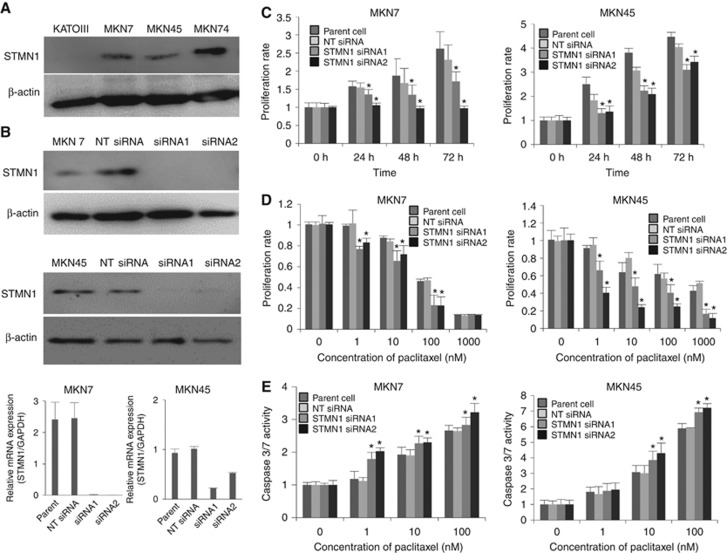
Functional analysis of human GC cell lines treated with STMN1 siRNA. (A) Expression of STMN1 was evaluated in GC cell lines KATOIII, MKN7, MKN45, and MKN74 by Western blotting. β-Actin was used as the loading control. (B) STMN1 expression in MKN7 and MKN45 cells treated with STMN1 siRNA1 or siRNA2 was detected by western blotting and RT-qPCR. STMN1 expression was suppressed in both STMN1 siRNA1 and siRNA2 groups. (C) Proliferation of MKN7 and MKN45 cells after STMN1 siRNA treatment was evaluated using Cell Counting Kit-8 kit. Cell proliferation in the STMN1 siRNA groups was significantly suppressed compared to that in the NT siRNA groups. (D) Paclitaxel sensitivity of MKN7 and MKN45 cells treated with STMN1 siRNA1 and siRNA2 was evaluated using Cell Counting Kit-8 kit. Cell viability in the STMN1 siRNA group decreased significantly following paclitaxel treatment compared to the NT siRNA group. (E) Paclitaxel-induced apoptosis in MKN7 and MKN45 cells treated with STMN1 siRNA1 and siRNA2 was evaluated by Amplite fluorometric Caspase-3/7 Assay Kit. Paclitaxel-induced apoptosis in the STMN1 siRNA group was enhanced more than that of the NT siRNA group.

References

    1. Akhtar J, Wang Z, Yu C, Li CS, Shi YL, Liu HJ (2014. a) STMN-1 is a potential marker of lymph node metastasis in distal esophageal adenocarcinomas and silencing its expression can reverse malignant phenotype of tumor cells. BMC Cancer 14: 28. - PMC - PubMed
    1. Akhtar J, Wang Z, Yu C, Zhang ZP, Bi MM (2014. b) STMN-1 gene: a predictor of survival in stage iia esophageal squamous cell carcinoma after Ivor-Lewis esophagectomy? Ann Surg Oncol 21(1): 315–321. - PubMed
    1. Alli E, Bash-Babula J, Yang JM, Hait WN (2002) Effect of stathmin on the sensitivity to antimicrotubule drugs in human breast cancer. Cancer Res 62(23): 6864–6869. - PubMed
    1. Altan B, Yokobori T, Mochiki E, Ohno T, Ogata K, Ogawa A, Yanai M, Kobayashi T, Luvsandagva B, Asao T, Kuwano H (2013) Nuclear karyopherin-alpha2 expression in primary lesions and metastatic lymph nodes was associated with poor prognosis and progression in gastric cancer. Carcinogenesis 34(10): 2314–2321. - PubMed
    1. Brenner H, Rothenbacher D, Arndt V (2009) Epidemiology of stomach cancer. Methods Mol Biol 472: 467–477. - PubMed