


Lactational Stage of Pasteurized Human Donor Milk Contributes to Nutrient Limitations for Infants
- PMID: 28335478
- PMCID: PMC5372965
- DOI: 10.3390/nu9030302
Lactational Stage of Pasteurized Human Donor Milk Contributes to Nutrient Limitations for Infants
Abstract
Background: Mother's own milk is the first choice for feeding preterm infants, but when not available, pasteurized human donor milk (PDM) is often used. Infants fed PDM have difficulties maintaining appropriate growth velocities. To assess the most basic elements of nutrition, we tested the hypotheses that fatty acid and amino acid composition of PDM is highly variable and standard pooling practices attenuate variability; however, total nutrients may be limiting without supplementation due to late lactational stage of the milk.
Methods: A prospective cross-sectional sampling of milk was obtained from five donor milk banks located in Ohio, Michigan, Colorado, Texas-Ft Worth, and California. Milk samples were collected after Institutional Review Board (#07-0035) approval and informed consent. Fatty acid and amino acid contents were measured in milk from individual donors and donor pools (pooled per Human Milk Banking Association of North America guidelines). Statistical comparisons were performed using Kruskal-Wallis, Spearman's, or Multivariate Regression analyses with center as the fixed factor and lactational stage as co-variate.
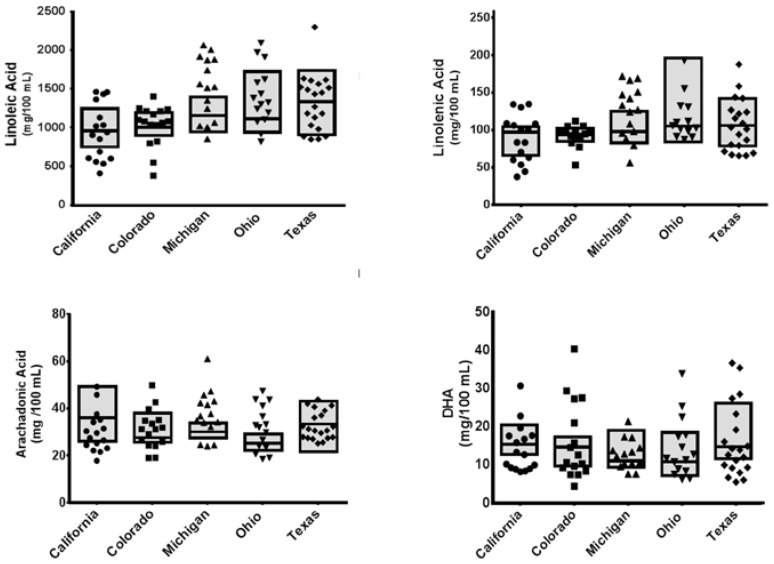
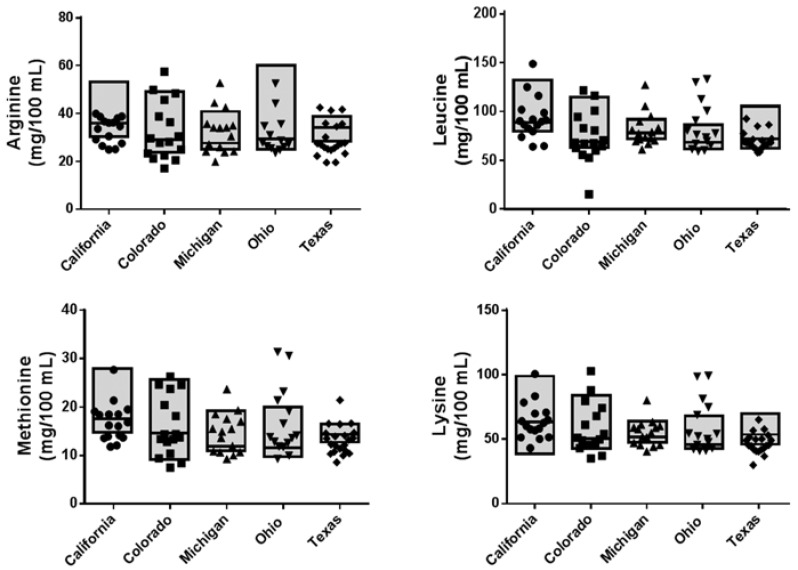
Results: Ten of the fourteen fatty acids and seventeen of the nineteen amino acids analyzed differed across Banks in the individual milk samples. Pooling minimized these differences in amino acid and fatty acid contents. Concentrations of lysine and docosahexaenoic acid (DHA) were not different across Banks, but concentrations were low compared to recommended levels.
Conclusions: Individual donor milk fatty acid and amino acid contents are highly variable. Standardized pooling practice reduces this variability. Lysine and DHA concentrations were consistently low across geographic regions in North America due to lactational stage of the milk, and thus not adequately addressed by pooling. Targeted supplementation is needed to optimize PDM, especially for the preterm or volume restricted infant.
Keywords: DHA; donor milk; human milk; lysine; nutrition; preterm infants.
Conflict of interest statement
The authors have no conflict of interest. Dr. Valentine is currently an Associate Professor at The University of Cincinnati, Cincinnati Ohio and Medical Director of Mead Johnson Nutrition, Evansville, IN, USA.
Figures
References
-
- Gartner L.M., Morton J., Lawrence R.A., Naylor A.J., O’Hare D., Schanler R.J., Eidelman A.I., American Academy of Pediatrics Section on Breastfeeding Breastfeeding and the use of human milk. Pediatrics. 2012;129:e827–e841.
-
- World Health Organization. United Nations Children’s Fund . Protecting, Promoting and Supporting Breast-Feeding. The Special Role of Maternity Services. World Health Organization and United Nations Children’s Fund; Geneva, Switzerland: 1989. p. 32.
-
- Sullivan S., Schanler R.J., Kim J.H., Patel A.L., Trawoger R., Kiechl-Kohlendorfer U., Chan G.M., Blanco C.L., Abrams S., Cotten C.M., et al. An exclusively human milk-based diet is associated with a lower rate of necrotizing enterocolitis than a diet of human milk and bovine milk-based products. J. Pediatr. 2010;156:562–567, e561. doi: 10.1016/j.jpeds.2009.10.040. - DOI - PubMed
MeSH terms
Substances
Grants and funding
LinkOut - more resources
Full Text Sources
Other Literature Sources
Medical
