


Abundance of Pathogenic Escherichia coli Virulence-Associated Genes in Well and Borehole Water Used for Domestic Purposes in a Peri-Urban Community of South Africa
- PMID: 28335539
- PMCID: PMC5369156
- DOI: 10.3390/ijerph14030320
Abundance of Pathogenic Escherichia coli Virulence-Associated Genes in Well and Borehole Water Used for Domestic Purposes in a Peri-Urban Community of South Africa
Abstract
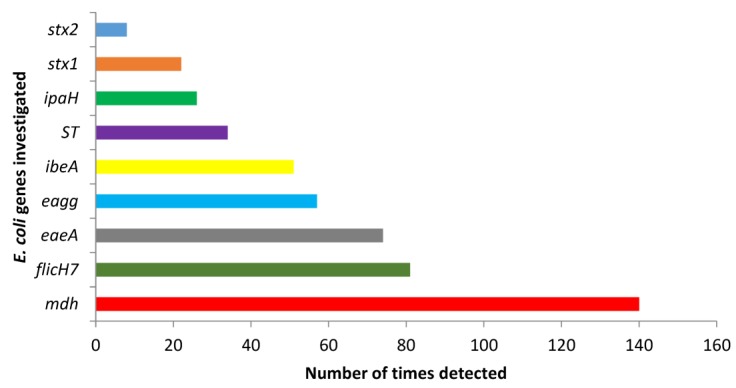
In the absence of pipe-borne water, many people in Africa, especially in rural communities, depend on alternative water sources such as wells, boreholes and rivers for household and personal hygiene. Poor maintenance and nearby pit latrines, however, lead to microbial pollution of these sources. We evaluated the abundance of Escherichia coli and the prevalence of pathogenic E. coli virulence genes in water from wells, boreholes and a river in a South African peri-urban community. Monthly samples were collected between August 2015 and November 2016. In all, 144 water samples were analysed for E. coli using the Colilert 18 system. Virulence genes (eagg, eaeA, stx1, stx2, flichH7, ST, ipaH, ibeA) were investigated using real-time polymerase chain reaction. Mean E. coli counts ranged between 0 and 443.1 Most Probable Number (MPN)/100 mL of water sample. Overall, 99.3% of samples were positive for at least one virulence gene studied, with flicH7 being the most detected gene (81/140; 57.6%) and the stx2 gene the least detected gene (8/140; 5.7%). Both intestinal and extraintestinal pathogenic E. coli genes were detected. The detection of virulence genes in these water sources suggests the presence of potentially pathogenic E. coli strains and is a public health concern.
Keywords: boreholes; microbial quality; pathogenic Escherichia coli; public health; virulence genes; wells.
Conflict of interest statement
The authors declare no conflict of interest.
Figures
References
-
- World Health Organization . Health in 2015: From MDGs, Millennium Development Goals to SDGs, Sustainable Development Goals. World Healh Organization Press; Geneva, Switzerland: 2015.
-
- Samie A., Mashao M.B., Bessong P.O., Nkgau T.F., Momba M.N.B., Obi C.L. Diversity and antibiograms of bacterial organisms isolated from samples of household drinking-water consumed by HIV-positive individuals in rural settings, South Africa. J. Health Popul. Nutr. 2012;30:241–249. doi: 10.3329/jhpn.v30i3.12286. - DOI - PMC - PubMed
-
- Paulse A., Jackson V., Khan S., Khan W. Isolation and identification of bacterial pollutants from the Berg and Plankenburg Rivers in the Western Cape, South Africa. Water SA. 2012;38:819–824. doi: 10.4314/wsa.v38i5.23. - DOI
MeSH terms
Substances
LinkOut - more resources
Full Text Sources
Other Literature Sources
