


We need to include bystander first aid in trauma research
- PMID: 28335785
- PMCID: PMC5364713
- DOI: 10.1186/s13049-017-0372-2
We need to include bystander first aid in trauma research
Abstract
Background: The chain of trauma survival is a concept that originated in the area of out-of-hospital cardiac arrest (OHCA) and was adapted to the treatment of trauma. In out-of-hospital cardiac arrest research into bystander first aid has resulted in improved outcome. Whereas, in trauma research the first link of the chain of survival is almost ignored.
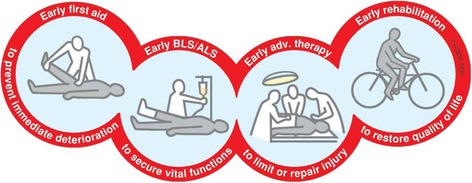
Methods: In OHCA, cardiopulmonary resuscitation (CPR) from bystanders has been subject of a vast amount of research, as well as measures and programs to raise the rate of bystander CPR to cardiac arrest victims. These efforts have resulted in improved survival. The research effort has been well grounded in the research community, as demonstrated by its natural inclusion in the uniform reporting template (Utstein) for the treatment of OHCA. In trauma the bystander may contribute by providing an open airway, staunch bleedings, or prevent hypothermia. In trauma however, while the chain of survival has been adopted along with it distinct links, including bystander first aid, the consensus-based uniform reporting template for trauma (the Utstein template) does not include the bystander first aid efforts. There is extremely little research on what first aid measures bystanders provide to trauma victims, and on what impact such measures have on outcome. An important step to improve research on bystander first aid in trauma would be to include this as part of the uniform reporting template for trauma CONCLUSION: The lack of research on bystander first aid makes the first link in the trauma chain of survival the weakest link. We, the trauma research community, should either improve our research and knowledge in this area, or remove the link from the chain of survival.
Figures
References
-
- Wissenberg M, Lippert FK, Folke F, Weeke P, Hansen CM, Christensen EF, et al. Association of National Initiatives to Improve Cardiac Arrest Management With Rates of Bystander Intervention and Patient Survival After Out-of-Hospital Cardiac Arrest. JAMA. 2013;310:1377–1378. doi: 10.1001/jama.2013.278483. - DOI - PubMed
MeSH terms
LinkOut - more resources
Full Text Sources
Other Literature Sources
Medical
