Review
. 2017:124:161-195.
doi: 10.1016/bs.ctdb.2016.11.012. Epub 2017 Jan 17.

Making It New Again: Insight Into Liver Development, Regeneration, and Disease From Zebrafish Research

Affiliations
Review

Making It New Again: Insight Into Liver Development, Regeneration, and Disease From Zebrafish Research

Shuang Wang et al. Curr Top Dev Biol. 2017.

Abstract

The adult liver of most vertebrates is predominantly comprised of hepatocytes. However, these cells must work in concert with biliary, stellate, vascular, and immune cells to accomplish the vast array of hepatic functions required for physiological homeostasis. Our understanding of liver development was accelerated as zebrafish emerged as an ideal vertebrate system to study embryogenesis. Through work in zebrafish and other models, it is now clear that the cells in the liver develop in a coordinated fashion during embryogenesis through a complex yet incompletely understood set of molecular guidelines. Zebrafish research has uncovered many key players that govern the acquisition of hepatic potential, cell fate, and plasticity. Although rare, some hepatobiliary diseases-especially biliary atresia-are caused by developmental defects; we discuss how research using zebrafish to study liver development has informed our understanding of and approaches to liver disease. The liver can be injured in response to an array of stressors including viral, mechanical/surgical, toxin-induced, immune-mediated, or inborn defects in metabolism. The liver has thus evolved the capacity to efficiently repair and regenerate. We discuss the emerging field of using zebrafish to study liver regeneration and highlight recent advances where zebrafish genetics and imaging approaches have provided novel insights into how cell plasticity contributes to liver regeneration.

Keywords: Biliary atresia; Biliary development; Hepatogenesis; Liver development; Liver regeneration; Zebrafish.


Figures

Figure 1:
Figure 1:
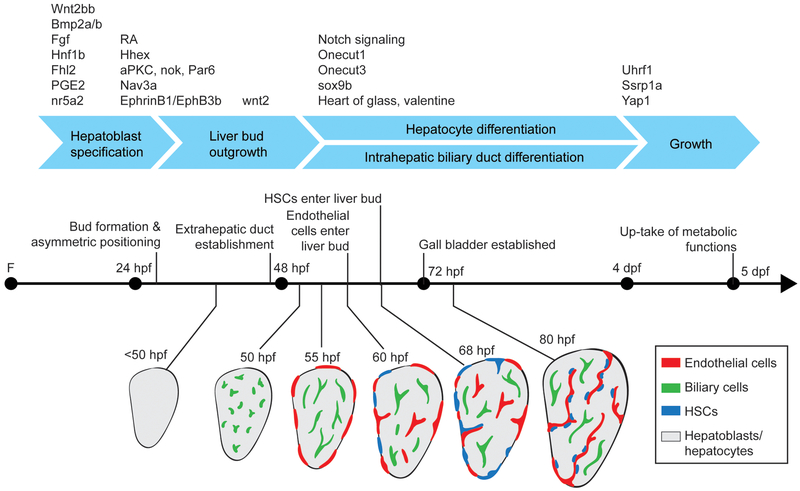
Zebrafish develop a functional liver within 4 days. Detailed timeline and schematics of the key cellular process driving the differentiation of liver architecture are indicated below the phase-line. Molecular regulators mentioned in the text are listed above the developmental phase they are associated with; for a detailed review of the molecular mechanisms controlling liver development see (Goessling and Stainier, 2016; Wilkins and Pack, 2013b). “hpf” = hours-post-fertilization. “dpf” = days-post-fertilization.
Figure 2:
Figure 2:
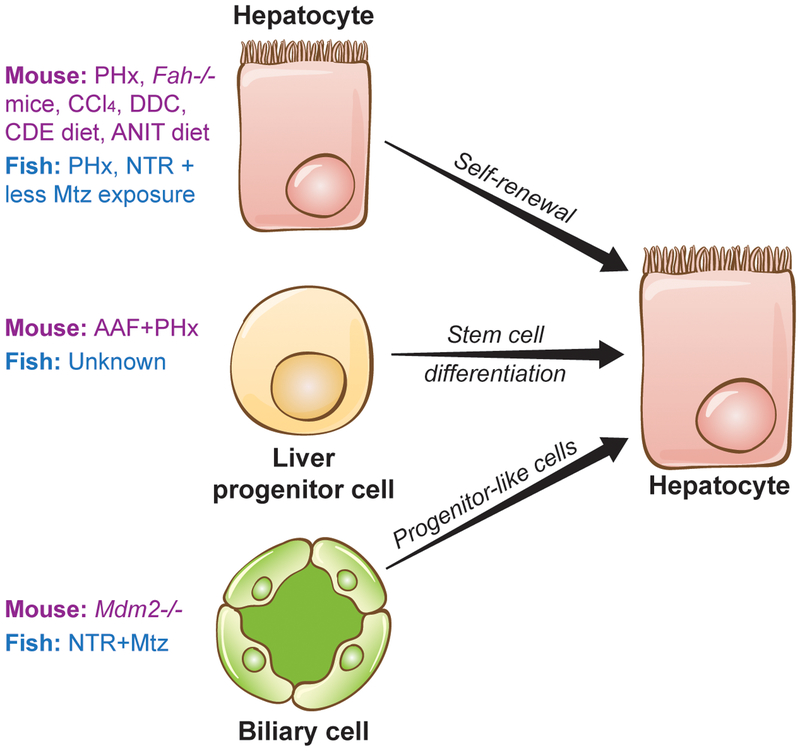
The liver regenerate itself through three possible mechanisms. Under physiological conditions or mild liver injury, mature hepatocytes proliferate to replace lost hepatocytes. Under severe stress that inhibited or exhausted the proliferative capacity of hepatocyte, progenitor-like cells, which may be derived from the biliary lineage, proliferate and differentiate into mature hepatocytes. “Fah−/−” = FAH deficient mice. “Mdm2−/−” = MDM2 deficient mice. “PHx” = partial hepatectomy. “PH+AAF” = partial hepatectomy followed by 2-acetylaminofluorene treatment. “CCl4” = Carbon tetrachloride. “DDC” = 3,5-diethoxycarbonyl-1,4-dihydrocollidine. “CDE” = choline-deficient, ethionine-supplemented. “ANIT” = alpha-naphthyl-isothiocyanate. “NTR + Mtz” = nitroreductase transgenic zebrafish treated with metronidazole.
Figure 3:
Figure 3:
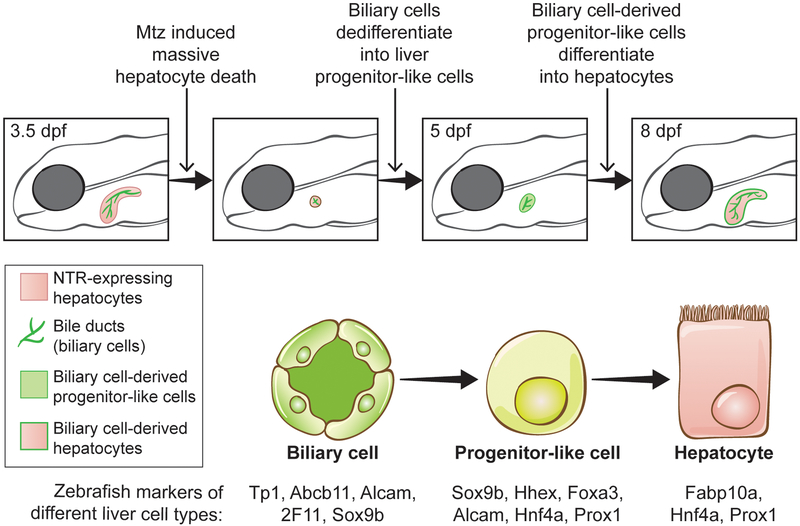
Biliary cells as a potential source of hepatocytes in zebrafish with total hepatocyte loss. Molecular markers used in these studies are listed on the bottom (Choi et al., 2014; He et al., 2014). “Mtz” = metronidazole. “NTR” = nitroreductase. “dpf” = days-post-fertilization.

References

    1. Anderson RM, Bosch JA, Goll MG, Hesselson D, Dong PD, Shin D, Chi NC, Shin CH, Schlegel A, Halpern M, Stainier DY, 2009. Loss of Dnmt1 catalytic activity reveals multiple roles for DNA methylation during pancreas development and regeneration. Developmental Biology 334, 213–223. - PMC - PubMed
    1. Asahina K, Tsai SY, Li P, Ishii M, Maxson RE, Sucov HM, Tsukamoto H, 2009. Mesenchymal origin of hepatic stellate cells, submesothelial cells, and perivascular mesenchymal cells during mouse liver development. Hepatology 49, 998–1011. - PMC - PubMed
    1. Asai A, Miethke A, Bezerra JA, 2015. Pathogenesis of biliary atresia: defining biology to understand clinical phenotypes. Nat Rev Gastroenterol Hepatol 12, 342–352. - PMC - PubMed
    1. Bostick M, Kim JK, Esteve PO, Clark A, Pradhan S, Jacobsen SE, 2007. UHRF1 plays a role in maintaining DNA methylation in mammalian cells. Science 317, 1760–1764. - PubMed
    1. Cayuso J, Dzementsei A., Fischer, Johanna C, Karemore G, Caviglia S, Bartholdson J., Wright, Gavin J., Ober, Elke A, 2016. EphrinB1/EphB3b Coordinate Bidirectional Epithelial-Mesenchymal Interactions Controlling Liver Morphogenesis and Laterality. Developmental Cell 39, 316–328. - PMC - PubMed