


Mortality-Associated Characteristics of Patients with Traumatic Brain Injury at the University Teaching Hospital of Kigali, Rwanda
- PMID: 28336445
- PMCID: PMC5681277
- DOI: 10.1016/j.wneu.2017.03.001
Mortality-Associated Characteristics of Patients with Traumatic Brain Injury at the University Teaching Hospital of Kigali, Rwanda
Erratum in
-
Erratum to "Mortality-Associated Characteristics of Patients with Traumatic Brain Injury at the University Teaching Hospital of Kigali, Rwanda" [World Neurosurgery 102 (2017) 571-582].World Neurosurg. 2017 Oct;106:1047. doi: 10.1016/j.wneu.2017.07.148. Epub 2017 Aug 10. World Neurosurg. 2017. PMID: 28803734 No abstract available.
Abstract
Objective: Traumatic brain injury (TBI) is a leading cause of death and disability. Patients with TBI in low and middle-income countries have worse outcomes than patients in high-income countries. We evaluated important clinical indicators associated with mortality for patients with TBI at University Teaching Hospital of Kigali, Kigali, Rwanda.
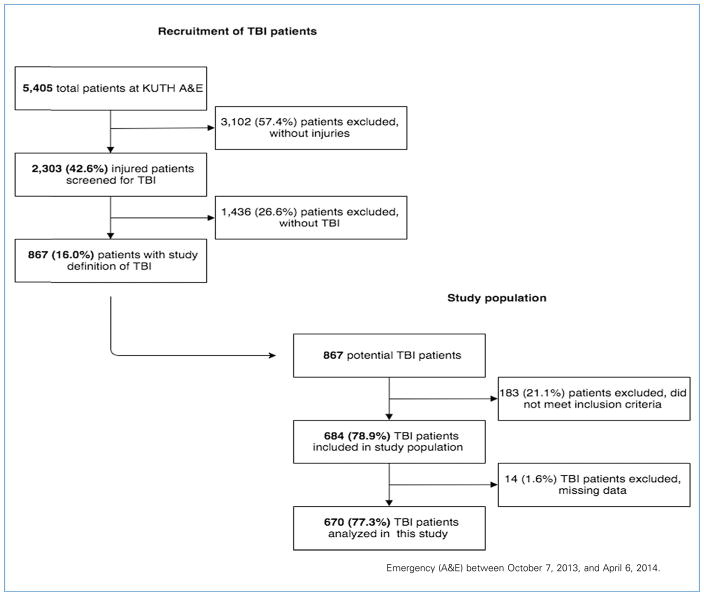
Methods: A prospective consecutive sampling of patients with TBI presenting to University Teaching Hospital of Kigali Accident and Emergency Department was screened for inclusion criteria: reported head trauma, alteration in consciousness, headache, and visible head trauma. Exclusion criteria were age <10 years, >48 hours after injury, and repeat visit. Data were assessed for association with death using logistic regression. Significant variables were included in a multivariate logistic regression model and refined via backward elimination.
Results: Between October 7, 2013, and April 6, 2014, 684 patients were enrolled; 14 (2%) were excluded because of incomplete data. Of patients, 81% were male with mean age of 31 years (range, 10-89 years; SD 11.8). Most patients (80%) had mild TBI (Glasgow Coma Scale [GCS] score 13-15); 10% had moderate (GCS score 9-12) and 10% had severe (GCS score 3-8) TBI. Multivariate logistic regression determined that GCS score <13, hypoxia, bradycardia, tachycardia, and age >50 years were significantly associated with death.
Conclusions: GCS score <13, hypoxia, bradycardia, tachycardia, and age >50 years were associated with mortality. These findings inform future research that may guide clinicians in prioritizing care for patients at highest risk of mortality.
Keywords: Rwanda; Traumatic brain injury.
Copyright © 2017 Elsevier Inc. All rights reserved.
Conflict of interest statement
Conflict of interest statement: The authors declare that the article content was composed in the absence of any commercial or financial relationships that could be construed as a potential conflict of interest.
Figures
References
-
- Georgoff P, Meghan S, Mirza K, Stein SC. Geographic variation in outcomes from severe traumatic brain injury. World Neurosurg. 2010;74:331–345. - PubMed
-
- Hyder AA, Wunderlich CA, Puvanachandra P, Gururaj G, Kobusingye OC. The impact of traumatic brain injuries: a global perspective. Neuro-Rehabilitation. 2007;22:341–353. - PubMed
-
- Razzak JA, Sasser SM, Kellermann AL. Injury prevention and other international public health initiatives. Emerg Med Clin North Am. 2005;23:85–98. - PubMed
Publication types
MeSH terms
Grants and funding
LinkOut - more resources
Full Text Sources
Other Literature Sources
Medical
Miscellaneous
