. 2017 Jun 1;312(6):L873-L881.
doi: 10.1152/ajplung.00568.2016. Epub 2017 Mar 23.

Airway smooth muscle dysfunction in Pompe (Gaa-/- ) mice

Affiliations

Airway smooth muscle dysfunction in Pompe (Gaa-/- ) mice

Allison M Keeler et al. Am J Physiol Lung Cell Mol Physiol. .

Abstract

Pompe disease is an autosomal recessive disorder caused by a deficiency of acid α-glucosidase (GAA), an enzyme responsible for hydrolyzing lysosomal glycogen. Deficiency of GAA leads to systemic glycogen accumulation in the lysosomes of skeletal muscle, motor neurons, and smooth muscle. Skeletal muscle and motor neuron pathology are known to contribute to respiratory insufficiency in Pompe disease, but the role of airway pathology has not been evaluated. Here we propose that GAA enzyme deficiency disrupts the function of the trachea and bronchi and this lower airway pathology contributes to respiratory insufficiency in Pompe disease. Using an established mouse model of Pompe disease, the Gaa-/- mouse, we compared histology, pulmonary mechanics, airway smooth muscle (ASM) function, and calcium signaling between Gaa-/- and age-matched wild-type (WT) mice. Lysosomal glycogen accumulation was observed in the smooth muscle of both the bronchi and the trachea in Gaa-/- but not WT mice. Furthermore, Gaa-/- mice had hyporesponsive airway resistance and bronchial ring contraction to the bronchoconstrictive agents methacholine (MCh) and potassium chloride (KCl) and to a bronchodilator (albuterol). Finally, calcium signaling during bronchiolar smooth muscle contraction was impaired in Gaa-/- mice indicating impaired extracellular calcium influx. We conclude that GAA enzyme deficiency leads to glycogen accumulation in the trachea and bronchi and impairs the ability of lower ASM to regulate calcium and respond appropriately to bronchodilator or constrictors. Accordingly, ASM dysfunction may contribute to respiratory impairments in Pompe disease.

Keywords: Pompe disease; airway smooth muscle; glycogen storing disease; pulmonary mechanics.


Figures

Fig. 1.
Fig. 1.
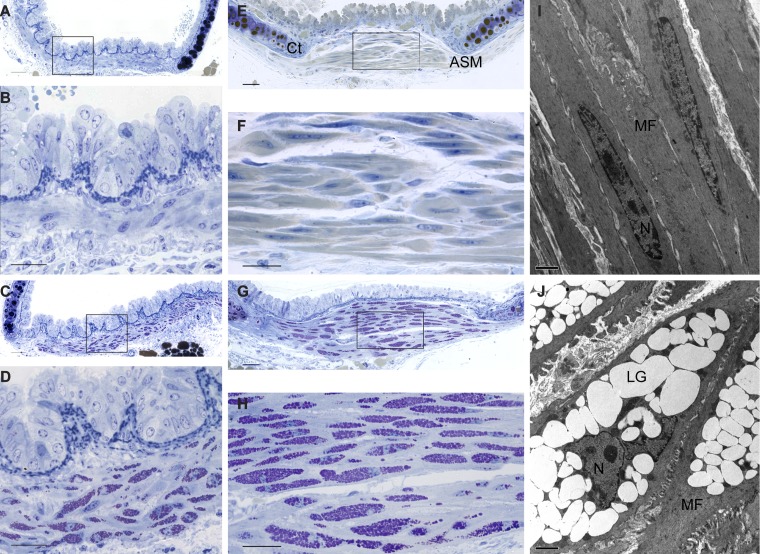
Glycogen accumulation in airway smooth muscle of Gaa−/− mice. A–H: representative plastic-embedded 2-µm cross sections stained using the periodic acid Schiff (PAS) method (purple) and counterstained with toluidine blue. Shown are illustratrations of wild-type (WT) bronchi (A and B) and trachea (E and F) (B and F are enlargements of A and E, respectively). Shown are Gaa−/− bronchi (C and D) and trachea (G and H) (D and H are enlargements of C and G, respectively). I and J: low-magnification electron micrographs of airway smooth muscle of WT (I) and Gaa−/− (J) mouse trachealis muscle cells. C, cartilage; ASM, airway smooth muscle cells; MF, myofilaments; LG, lysosomal glycogen; N, nuclei. Scale bar = 50 µm (A, C, E, and G), 25 µm (B, D, F, and H), and 2 µm (I and J).
Fig. 2.
Fig. 2.
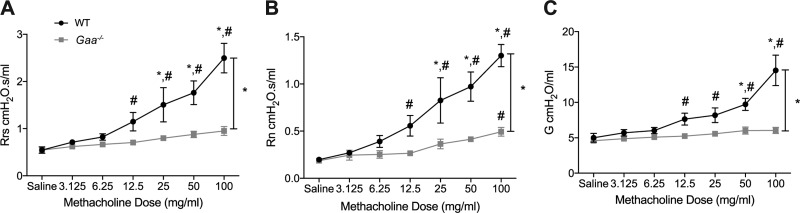
Airways of Gaa−/− mice are hyporesponsive to methacholine (MCh) in vivo. Forced oscillometry measures of respiratory and airway resistance in anesthetized and mechanically ventilated Gaa−/− and WT mice are shown. Measurements were taken following incremental doses of nebulized MCh from 3.123 to 100 mg/ml. A: overall respiratory resistance (Rrs) in WT (n = 4) and Gaa−/− (n = 6) mice. Initially, during saline administration no differences in overall resistance were appreciated between WT and Gaa−/− mice, but with increasing doses, the resistance showed a more robust increase in WT mice compared with Gaa−/− mice. B: Gaa−/− mice have a central airway resistance (Rn) that is hyporesponsive to higher doses of MCh in compared with WT mice. C: finally, tissue damping (G), which is reflection of the smallest airways and tissue resistance, was also hyporesponsive to MCh in Gaa−/− mice. *P ≤ 0.05, pair-wise comparison; #P ≤ 0.05, baseline comparison.
Fig. 3.
Fig. 3.
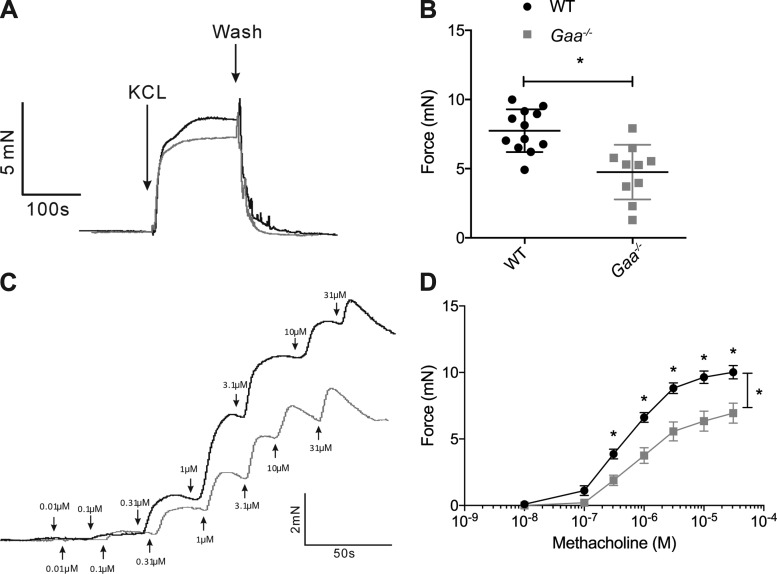
Gaa−/− bronchial rings have reduced contractile force upon exposure to MCh and potassium chloride (KCl). A and B: representative traces (A) and summary data (B) confirm that KCl induced bronchial ring contraction is more robust in WT (n = 12) than in Gaa−/− (n = 9) bronchi. C: representative traces of MCh-induced bronchial ring force of contraction at incremental increases in concentrations in WT (n = 11) and Gaa−/− (n = 9) mice. D: bronchial ring contraction in response to increasing doses of MCh confirmed that Gaa−/− bronchi had a reduced force of contraction compared with WT bronchi. *P ≤ 0.05, pair-wise comparison.
Fig. 4.
Fig. 4.
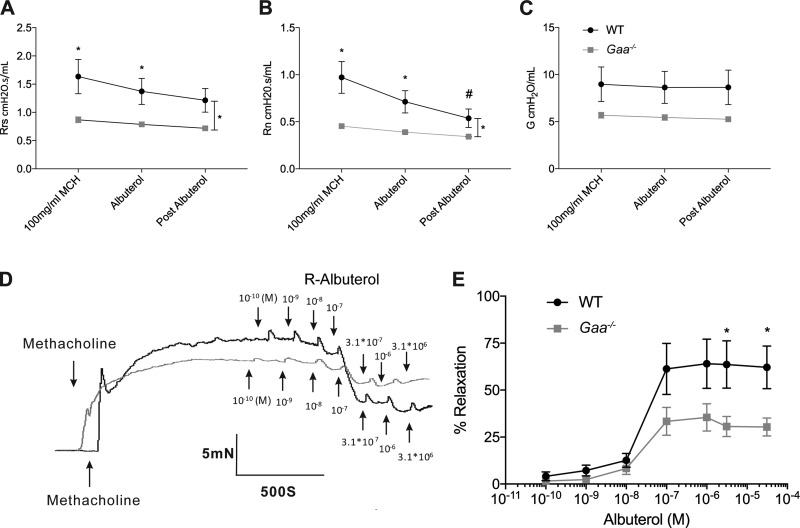
Airways and bronchial rings of Gaa−/− mice have an attenuated response to albuterol. A–C: after MCh dosage response, R-albuterol was nebulized and measurement cycle was taken, and then an additional measurement was taken postalbuterol. A and B: Gaa−/− mice have a decreased response to albuterol in vivo compared with WT controls as evidenced by a lack of response in overall pulmonary resistance (Rrs; A) and central airway resistance (Rn; B). WT (n = 4) and Gaa−/− (n = 5) mice. C: tissue resistance (G) did not respond to R-albuterol in WT or Gaa−/− animals. D and E: ex vivo Gaa−/− bronchial rings have a blunted response to the bronchodilator effects of R-albuterol compared with WT bronchial rings. D: representative tracing of bronchial ring force as a response to R-albuterol administration following MCh-induced contraction. E: summary data of R-albuterol inhibitory effects on MCh-induced tone as percent relaxation. The values were normalized to the max effect of MCh on smooth muscle tone in both WT (n = 6) and Gaa−/− (n = 7) mice. *P ≤ 0.05, pair-wise comparison. #P ≤ 0.05, baseline comparison.
Fig. 5.
Fig. 5.
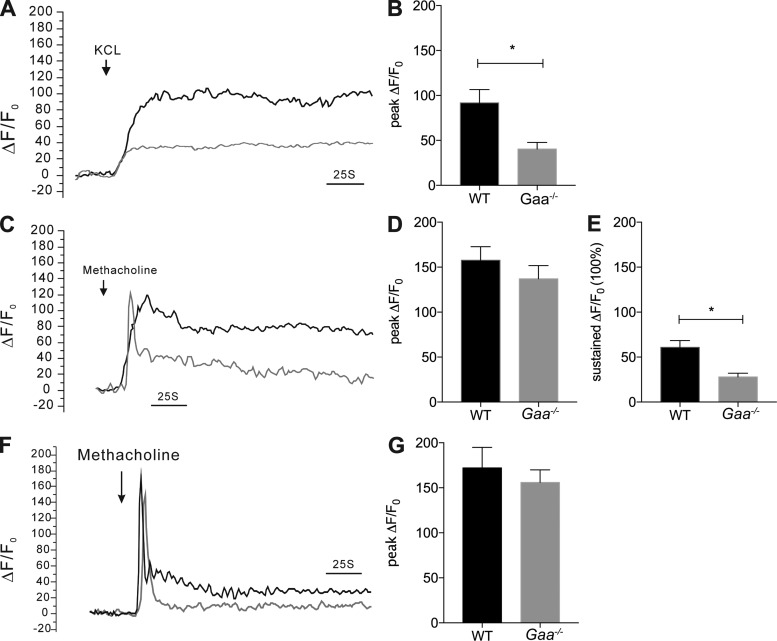
Deficient extracellular calcium influx in response to KCl and MCh in Gaa−/− mouse airway smooth muscle cells. A and B: the change in calcium global intracellular calcium concentration ([Ca2+]i) (ΔF/F0) induced by 60 mM KCl is more robust in WT (n = 25 cells) compared with Gaa−/− (20 cells) smooth muscle cells (A: representative trace; B: mean data). C–E: in response to MCh, the initial calcium release in WT and Gaa−/− animals is similar (C and D), but the sustained response is more robust in WT animals (n = 46 cells) compared with Gaa−/− (48 cells) airway smooth muscle cells (C and E). F and G: change in [Ca2+]i (represented as ΔF/F0) was raised by MCh (10−4 M) in Ca2+-free solution in WT (n = 23 cells) and Gaa−/− (n = 26 cells) animals and confirms that the initial rise in in [Ca2+]i is due to intracellular Ca2+ release. The peak value was measured as the peak component of calcium signal, and the average values of last 50 s were measured as the sustained component. *P ≤ 0.05.

References

    1. Ay B, Iyanoye A, Sieck GC, Prakash YS, Pabelick CM. Cyclic nucleotide regulation of store-operated Ca2+ influx in airway smooth muscle. Am J Physiol Lung Cell Mol Physiol 290: L278–L283, 2006. doi:10.1152/ajplung.00188.2005. - DOI - PubMed
    1. Ay B, Prakash YS, Pabelick CM, Sieck GC. Store-operated Ca2+ entry in porcine airway smooth muscle. Am J Physiol Lung Cell Mol Physiol 286: L909–L917, 2004. doi:10.1152/ajplung.00317.2003. - DOI - PubMed
    1. Bai Y, Zhang M, Sanderson MJ. Contractility and Ca2+ signaling of smooth muscle cells in different generations of mouse airways. Am J Respir Cell Mol Biol 36: 122–130, 2007. doi:10.1165/rcmb.2006-0036OC. - DOI - PMC - PubMed
    1. Ballabio A, Gieselmann V. Lysosomal disorders: from storage to cellular damage. Biochim Biophys Acta 1793: 684–696, 2009. doi:10.1016/j.bbamcr.2008.12.001. - DOI - PubMed
    1. Braunsdorf WE. Fusiform aneurysm of basilar artery and ectatic internal carotid arteries associated with glycogenosis type 2 (Pompe’s disease). Neurosurgery 21: 748–749, 1987. doi:10.1227/00006123-198711000-00030. - DOI - PubMed

Publication types

MeSH terms

LinkOut - more resources