Review
. 2017 Feb 22;7(2):49.
doi: 10.3390/nano7020049.

Evaluating Adverse Effects of Inhaled Nanoparticles by Realistic In Vitro Technology

Affiliations
Review

Evaluating Adverse Effects of Inhaled Nanoparticles by Realistic In Vitro Technology

Marianne Geiser et al. Nanomaterials (Basel). .

Abstract

The number of daily products containing nanoparticles (NP) is rapidly increasing. NP in powders, dispersions, or sprays are a yet unknown risk for incidental exposure, especially at workplaces during NP production and processing, and for consumers of any health status and age using NP containing sprays. We developed the nano aerosol chamber for in vitro toxicity (NACIVT), a portable instrument for realistic safety testing of inhaled NP in vitro and evaluated effects of silver (Ag) and carbon (C) NP-which belong to the most widely used nanomaterials-on normal and compromised airway epithelia. We review the development, physical performance, and suitability of NACIVT for short and long-term exposures with air-liquid interface (ALI) cell cultures in regard to the prerequisites of a realistic in vitro test system for inhalation toxicology and in comparison to other commercially available, well characterized systems. We also review doses applied to cell cultures in vitro and acknowledge that a single exposure to realistic doses of spark generated 20-nm Ag- or CNP results in small, similar cellular responses to both NP types and that cytokine release generally increased with increasing NP dose.

Keywords: 3R; NACIVT; aerosol; air-liquid interface; airway epithelia; electrostatic deposition; engineered nanoparticles; in vitro; nanoparticles; toxicology.


Conflict of interest statement

The authors declare no conflict of interest.

Figures
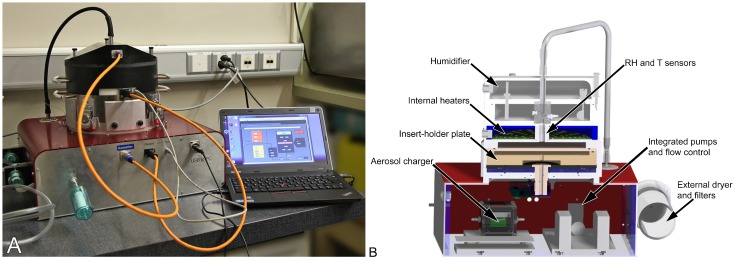
Figure 1
Figure 1
Nano Aerosol Chamber for In Vitro Toxicity (NACIVT). (A) Picture of chamber with dedicated laptop and LabVIEW software; (B) schematic section showing and describing the main parts of the chamber.
Figure 2
Figure 2
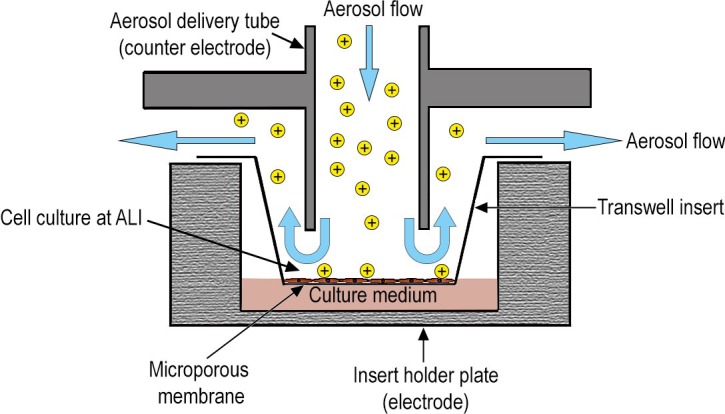
Particle delivery by electrostatic precipitation. Schematic section of an aerosol delivery tube, its Transwell® insert and the insert-holder plate, demonstrating the aerosol flow and particle deposition on the cell culture. In this schematic, particles are previously charged by a unipolar diffusion charger.
Figure 3
Figure 3
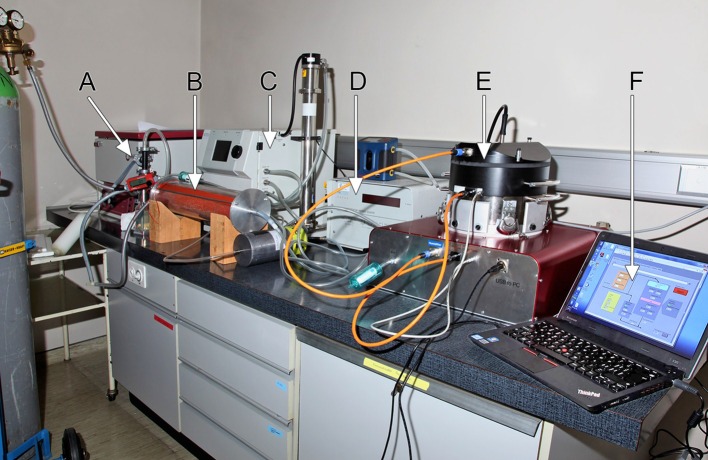
Experimental setup for deposition efficiency measurements with fluorescent polystyrene latex particles (PSL) [38]. (A) Nebulizer and (B) silica gel dryer for aerosol generation; (C,D) Instruments for SMPS—particle sizing; (E) NACIVT chamber for cell exposure at air-liquid interface; and (F) chamber-controlling laptop with a LabVIEW based program (National Instruments Switzerland GmbH, Ennetbaden, Switzerland).
Figure 4
Figure 4
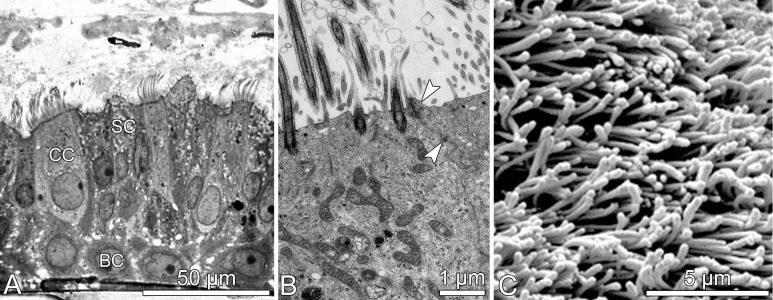
Morphology of in vitro differentiated human bronchial epithelia. (A) Light microscopic image exhibiting pseudostratified epithelium with basal (BC), ciliated (CC), and secretory (SC) cells; (B) transmission; and (C) scanning electron micrographs showing apical cell differentiations (cilia and microvilli) and junctional complexes (arrow heads in B).

References

    1. Pope C.A., III Epidemiology of fine particulate air pollution and human health: Biologic mechanisms and who’s at risk? Environ. Health Perspect. 2000;108:713–723. doi: 10.2307/3454408. - DOI - PMC - PubMed
    1. Liu L.J., Box M., Kalman D., Kaufman J., Koenig J., Larson T., Lumley T., Sheppard L., Wallace L. Exposure assessment of particulate matter for susceptible populations in Seattle. Environ. Health Perspect. 2003;111:909–918. doi: 10.1289/ehp.6011. - DOI - PMC - PubMed
    1. Goss C.H., Newsom S.A., Schildcrout J.S., Sheppard L., Kaufman J.D. Effect of ambient air pollution on pulmonary exacerbations and lung function in cystic fibrosis. Am. J. Respir. Crit. Care Med. 2004;169:816–821. doi: 10.1164/rccm.200306-779OC. - DOI - PubMed
    1. Trasande L., Thurston G.D. The role of air pollution in asthma and other pediatric morbidities. J. Allergy Clin. Immunol. 2005;115:689–699. doi: 10.1016/j.jaci.2005.01.056. - DOI - PubMed
    1. Kreyling W.G., Semmler-Behnke M., Moller W. Ultrafine particle-lung interactions: Does size matter? J. Aerosol Med. 2006;19:74–83. doi: 10.1089/jam.2006.19.74. - DOI - PubMed