


Microbial community composition is related to soil biological and chemical properties and bacterial wilt outbreak
- PMID: 28336973
- PMCID: PMC5428506
- DOI: 10.1038/s41598-017-00472-6
Microbial community composition is related to soil biological and chemical properties and bacterial wilt outbreak
Abstract
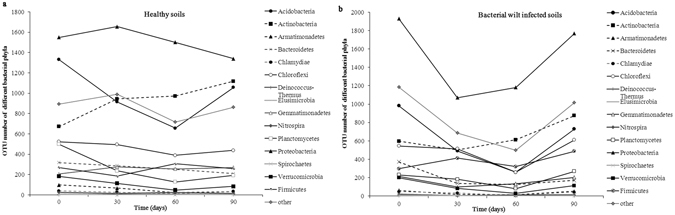
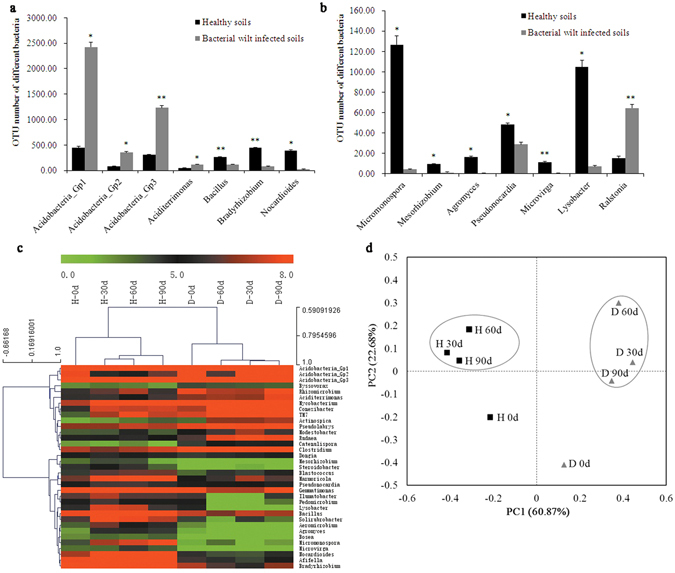
Soil microbes play important roles in plant growth and health. Little is known about the differences of soil microbes between healthy and bacterial wilt infected soils with Ralstonia solanacearum. By Illumina-MiSeq sequencing of 16S rRNA and 18S rRNA gene amplicons, we found the soil microbial composition and diversity were distinct between healthy and bacterial wilt infected soils. Soil microbial community varied at different plant growth stages due to changes of root exudates composition and soil pH. Healthy soils exhibited higher microbial diversity than the bacterial wilt infected soils. More abundant beneficial microbes including Bacillus, Agromyces, Micromonospora, Pseudonocardia, Acremonium, Lysobacter, Mesorhizobium, Microvirga, Bradyrhizobium, Acremonium and Chaetomium were found in the healthy soils rather than the bacterial wilt infected soils. Compared to bacterial wilt infected soils, the activities of catalase, invertase and urease, as well as soil pH, available phosphorous and potassium content, were all significantly increased in the healthy soils. In a conclusion, the higher abundance of beneficial microbes are positively related the higher soil quality, including better plant growth, lower disease incidence, and higher nutrient contents, soil enzyme activities and soil pH.
Conflict of interest statement
The authors declare that they have no competing interests.
Figures


References
-
- Gamliel A, Austerweil M, Kritzman G. Non-chemical approach to soilborne pest management-organic amendments. Crop Prot. 2000;19:847–853. doi: 10.1016/S0261-2194(00)00112-5. - DOI
-
- Liu Y, et al. Tobacco bacterial wilt can be biologically controlled by the application of antagonistic strains in combination with organic fertilizer. Biol Fert Soils. 2012;49:447–464. doi: 10.1007/s00374-012-0740-z. - DOI
-
- Janvier C, et al. Soil health through soil disease suppression: which strategy from descriptors to indicators? Soil Biol Biochem. 2007;39:1–23. doi: 10.1016/j.soilbio.2006.07.001. - DOI
MeSH terms
Substances
LinkOut - more resources
Full Text Sources
Other Literature Sources
Medical
