Review
. 2017 Mar 8:8:239.
doi: 10.3389/fimmu.2017.00239. eCollection 2017.

Role of Metallic Nanoparticles in Vaccinology: Implications for Infectious Disease Vaccine Development

Affiliations
Review

Role of Metallic Nanoparticles in Vaccinology: Implications for Infectious Disease Vaccine Development

Lázaro Moreira Marques Neto et al. Front Immunol. .

Abstract

Subunit vaccines are safer but less immunogenic than live-attenuated vaccines or whole cell inactivated vaccines. Adjuvants are used to enhance and modulate antigen (Ag) immunogenicity, aiming to induce a protective and long-lasting immune response. Several molecules and formulations have been studied for their adjuvanticity, but only seven have been approved to formulate human vaccines. Metallic nanoparticles (MeNPs), particularly those containing gold and iron oxides, are widely used in medicine for diagnosis and therapy and have been used as carriers for drugs and vaccines. However, little is known about the immune response elicited by MeNPs or about their importance in the development of new vaccines. There is evidence that these particles display adjuvant characteristics, promoting cell recruitment, antigen-presenting cell activation, cytokine production, and inducing a humoral immune response. This review focuses on the characteristics of MeNPs that could facilitate the induction of a cellular immune response, particularly T-helper 1 and T-helper 17, and their potential functions as adjuvants for subunit vaccines.

Keywords: Th1; Th17; adjuvant; immune response; particulate vaccine.


Figures
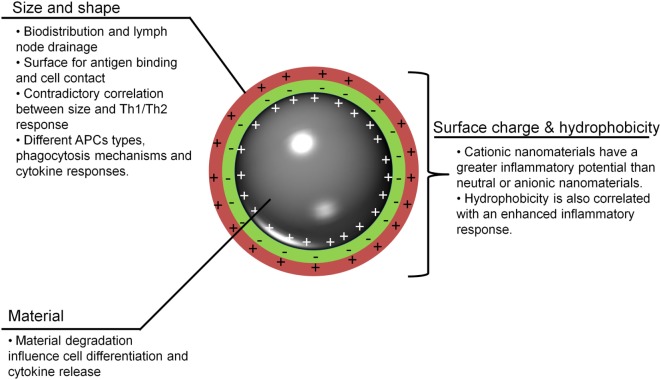
Figure 1
Figure 1
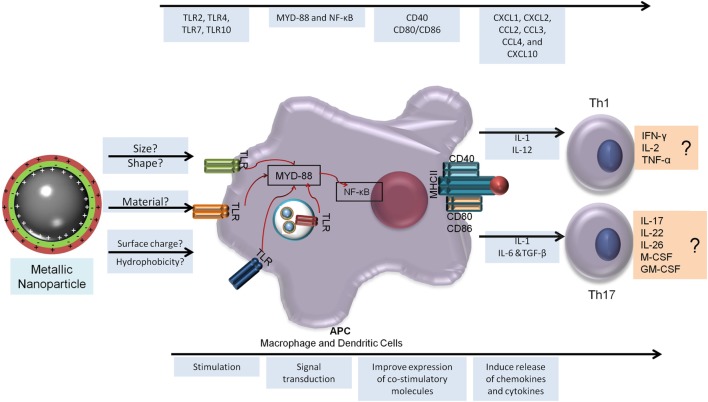
Important nanoparticle characteristics for adjuvanticity. To be recognized and to stimulate innate immunity, metallic nanoparticles (MeNPs) must have some physicochemical traits that allow for interactions with host cells and lead to the generation of a response. APCs, antigen-presenting cells; MeNPs, metallic nanoparticles; Th, T-helper cell.
Figure 2
Figure 2
Metallic nanoparticles adjuvanticity and its prediction capacity to generate T-helper 1 (Th1) and Th17 responses. To generate a cellular immune response, the NP must be able to be recognized by the host innate immune response and stimulate a sequence of events that will lead to the release of a specific milieu of cytokines and better antigen presentation (bottom arrow). In the top arrow is the immune response elicited by metallic nanoparticles to aid Th1 and Th17 generation. NF-κB, nuclear factor kappa B; CCL, chemokine ligand; CXCL, chemokine (C-X-C motif) ligand; GM-CSF, granulocyte macrophage colony-stimulating factor; IFN, interferon; IL, interleukin; M-CSF, macrophage colony-stimulating factor; MYD, myeloid differentiation factor; TCR, T cell receptor; Th, T-helper cell; TLR, Toll-like receptor; TNF, tumor necrosis factor.

References

    1. Reed SG, Orr MT, Fox CB. Key roles of adjuvants in modern vaccines. Nat Med (2013) 19:1597–608.10.1038/nm.3409 - DOI - PubMed
    1. Agger EM. Novel adjuvant formulations for delivery of anti-tuberculosis vaccine candidates. Adv Drug Deliv Rev (2016) 102:73–82.10.1016/j.addr.2015.11.012 - DOI - PMC - PubMed
    1. Morrison C. Landmark green light for Mosquirix malaria vaccine. Nat Biotechnol (2015) 33:1015–6.10.1038/nbt1015-1015 - DOI - PubMed
    1. Didierlaurent AM, Laupeze B, Di Pasquale A, Hergli N, Collignon C, Garcon N. Adjuvant system AS01: helping to overcome the challenges of modern vaccines. Expert Rev Vaccines (2017) 16:55–63.10.1080/14760584.2016.1213632 - DOI - PubMed
    1. Di Pasquale A, Preiss S, Tavares Da Silva F, Garcon N. Vaccine adjuvants: from 1920 to 2015 and beyond. Vaccines (Basel) (2015) 3:320–43.10.3390/vaccines3020320 - DOI - PMC - PubMed

LinkOut - more resources