. 2017:2017:5750897.
doi: 10.1155/2017/5750897. Epub 2017 Feb 27.

Small Interfering RNA Targeting Mitochondrial Calcium Uniporter Improves Cardiomyocyte Cell Viability in Hypoxia/Reoxygenation Injury by Reducing Calcium Overload

Affiliations

Small Interfering RNA Targeting Mitochondrial Calcium Uniporter Improves Cardiomyocyte Cell Viability in Hypoxia/Reoxygenation Injury by Reducing Calcium Overload

Yuriana Oropeza-Almazán et al. Oxid Med Cell Longev. 2017.

Abstract

Intracellular Ca2+ mishandling is an underlying mechanism in hypoxia/reoxygenation (H/R) injury that results in mitochondrial dysfunction and cardiomyocytes death. These events are mediated by mitochondrial Ca2+ (mCa2+) overload that is facilitated by the mitochondrial calcium uniporter (MCU) channel. Along this line, we evaluated the effect of siRNA-targeting MCU in cardiomyocytes subjected to H/R injury. First, cardiomyocytes treated with siRNA demonstrated a reduction of MCU expression by 67%, which resulted in significant decrease in mitochondrial Ca2+ transport. siRNA treated cardiomyocytes showed decreased mitochondrial permeability pore opening and oxidative stress trigger by Ca2+ overload. Furthermore, after H/R injury MCU silencing decreased necrosis and apoptosis levels by 30% and 50%, respectively, and resulted in reduction in caspases 3/7, 9, and 8 activity. Our findings are consistent with previous conclusions that demonstrate that MCU activity is partly responsible for cellular injury induced by H/R and support the concept of utilizing siRNA-targeting MCU as a potential therapeutic strategy.


Conflict of interest statement

The authors declare that they have no competing interests.

Figures
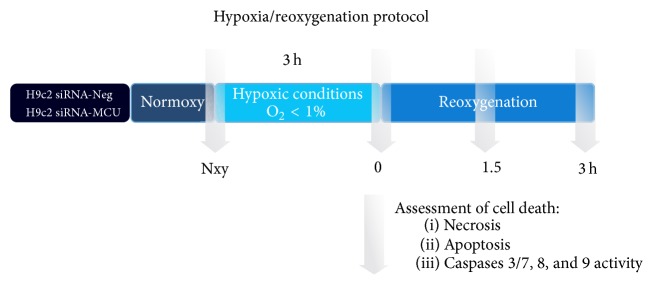
Figure 1
Figure 1
Schematic representation showing the hypoxia/reoxygenation (H/R) protocol applied to each experimental group. At normoxic conditions, siRNA-Neg (control group) and siRNA-MCU cardiomyocytes were subjected to 3 h of normothermic hypoxia (H) with an ischemic Tyrode solution (IT) followed by 3 h of reoxygenation (R). Transfected cardiomyocytes were harvested when indicated by arrows: measurements of necrosis and apoptosis by flow cytometry were performed and caspases 3 and 7 and caspases 9 and 8 activity were determined as described in Materials and Methods. Nxy, normoxy.
Figure 2
Figure 2
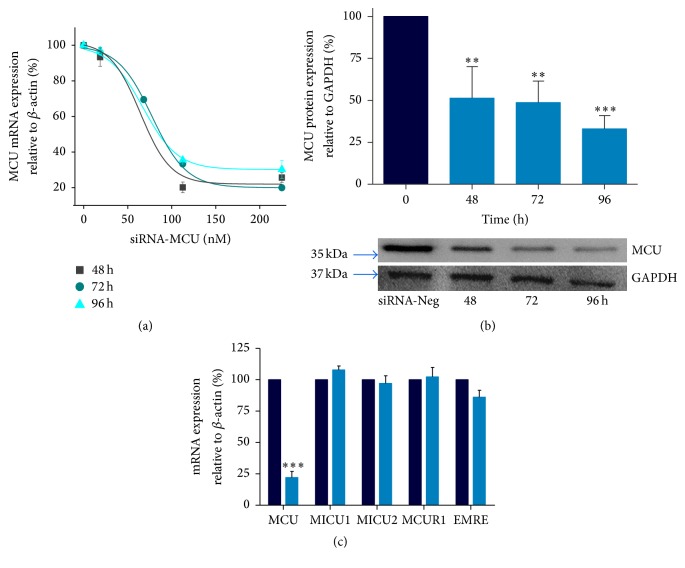
Dose-response analysis of MCU expression in cardiomyocytes transfected with a specific siRNA designed targeting MCU (siRNA-MCU). (a) MCU mRNA expression by qRT-PCR normalized versus β-actin using 18.7, 112.5, or 225 nM of siRNA at 0, 48, 72, and 96 h of transfection. We obtained EC50 ∼67.2 nM at 96 h of transfection, mean ± SEM, n = 3. (b) Representative protein expression analysis of MCU in cardiomyocytes silenced with 225 nM of siRNA-MCU at 48 h (∗∗P < 0.01); at 72 h (∗∗P < 0.01); and at 96 h of transfection. GAPDH served as a loading control (∗∗∗P < 0.001), mean ± SEM, n = 3–6. (c) Relative mRNA abundance of associated regulatory genes in MCU-silenced cardiomyocytes using 225 nM of siRNA-MCU at 96 h of transfection, mean ± SEM, n = 4. MICU1, mitochondrial calcium uptake 1; MICU2, mitochondrial calcium uptake 2; MCUR1, mitochondrial calcium uniporter regulator 1; EMRE, essential mitochondrial calcium uniporter regulator.
Figure 3
Figure 3
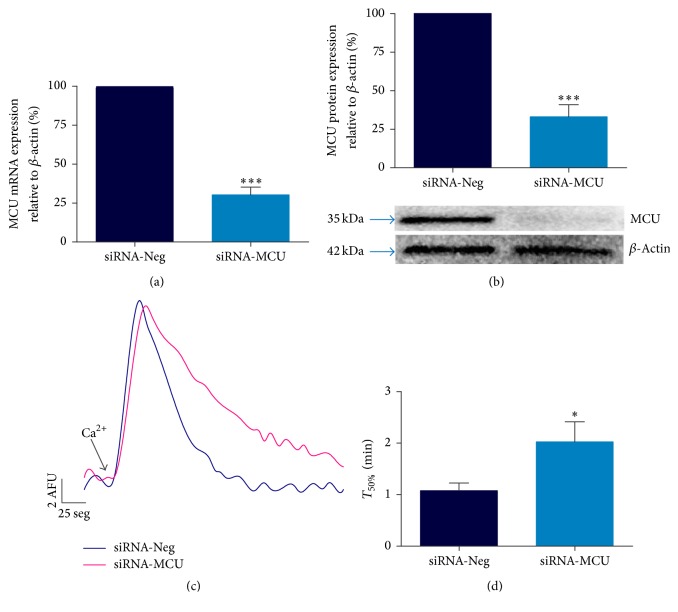
MCU silencing reduces mitochondrial Ca2+ transport. (a) MCU mRNA expression by semiquantitative qRT-PCR in silenced cardiomyocytes, ∗∗∗P < 0.001 versus siRNA-Neg, mean ± SEM, n = 7. (b) MCU protein expression, with β-actin used as a loading control. ∗∗∗P < 0.001 versus siRNA-Neg, mean ± SEM, n = 6. (c) Representative traces of mitochondrial Ca2+ uptake in permeabilized MCU-silenced cardiomyocytes using CG-5N Ca2+ indicator after 15 μM Ca2+ addition. The experiment was performed in the presence of 1 μM CsA. AFU, arbitrary fluorescence units. (d) Time to 50% decay analysis (T50%) of mitochondrial Ca2+ transport. P < 0.05 versus siRNA-Neg, mean ± SEM, n = 6. MCU silencing conditions were using 225 nM of siRNA-MCU at 96 h of transfection.
Figure 4
Figure 4
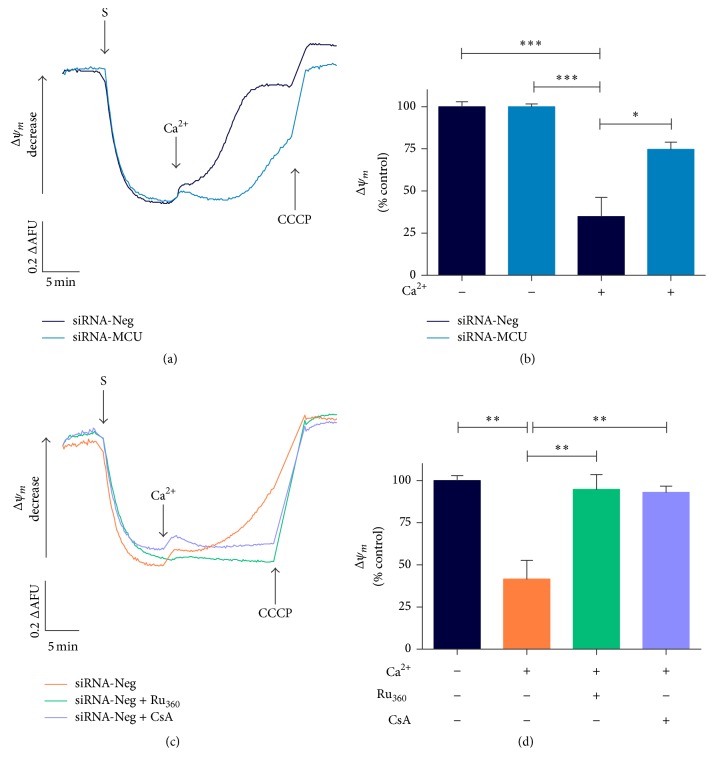
MCU silencing reduces significantly mitochondrial permeability transition by calcium overload. (a) Representative mitochondrial Δψm traces in permeabilized MCU-silenced cardiomyocytes using 2 μM safranin, after 7.5 μM Ca2+ addition. siRNA-Neg cardiomyocytes show no difference in Δψm compared to MCU-silenced cells at baseline. MCU-silenced cardiomyocytes were able to maintain significantly Δψm after 7.5 μM Ca2+ addition. Upon completion of the traces, 20 μM CCCP was added as uncoupling. (b) Semiquantitative analysis of Δψm after Ca2+ addition in transfected cardiomyocytes. P < 0.05 versus siRNA-Neg, mean ± SEM, n = 3. (c) Representative mitochondrial safranin Δψ recordings in siRNA-Neg cardiomyocytes treated with 5 μM Ru360 or 1 μM CsA before 7.5 μM Ca2+ pulse. (d) Semiquantitative analysis of Δψm in siRNA-Neg cardiomyocytes treated with Ru360 or CsA. ∗∗P < 0.01 versus siRNA-Neg, mean ± SEM, n = 5-4. Upon completion of the registers, 20 μM CCCP was added as uncoupling. All semiquantitative data is normalized to 100% of untreated siRNA-Neg cardiomyocytes at basal conditions. AFU, arbitrary fluorescence units. ∗∗∗P < 0.001 versus siRNA-Neg.
Figure 5
Figure 5
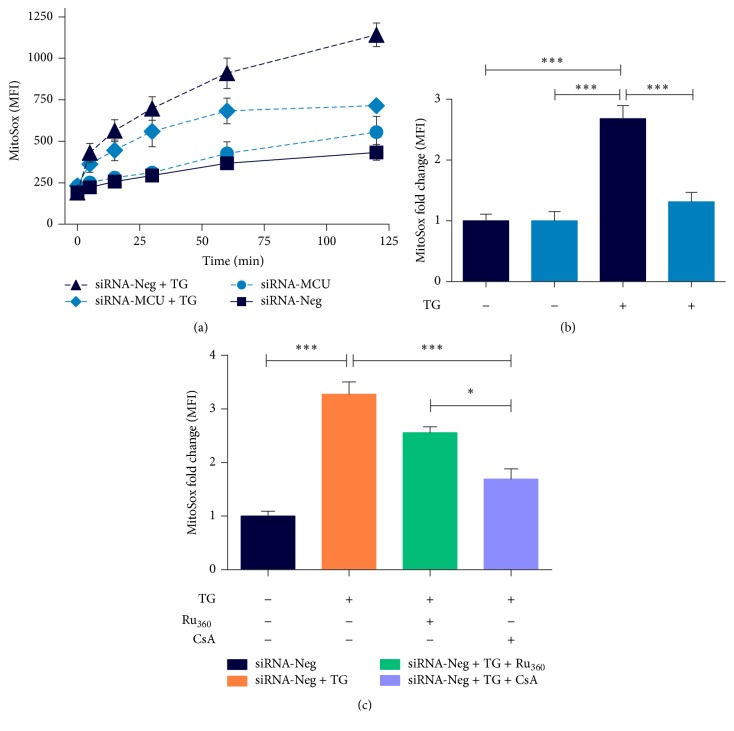
MCU silencing reduces mitochondrial oxidative stress. (a) Time-response curve of mitochondrial ROS (superoxide) production evoked by cytosolic Ca2+ overload with 5 μM TG in transfected cardiomyocytes. Measurements were realized over 120 min of TG treatment and ROS was detected with MitoSOX Red by flow cytometry. (b) ROS levels at 120 min of TG addition is presented as FMI fold change with respect to TG untreated cardiomyocytes. ROS production in siRNA-Neg cardiomyocytes was twofold greater than that in MCU-silenced cardiomyocytes after TG addition, ∗∗∗P < 0.001, mean ± SEM, n = 5. (c) ROS production in siRNA-Neg cardiomyocytes pretreated with 5 μM Ru360 or 1 μM CsA, measured after 120 min of 5 μM TG addition. Data are presented as described previously. P < 0.05 and ∗∗∗P < 0.001; mean ± SEM and n = 6–8.
Figure 6
Figure 6
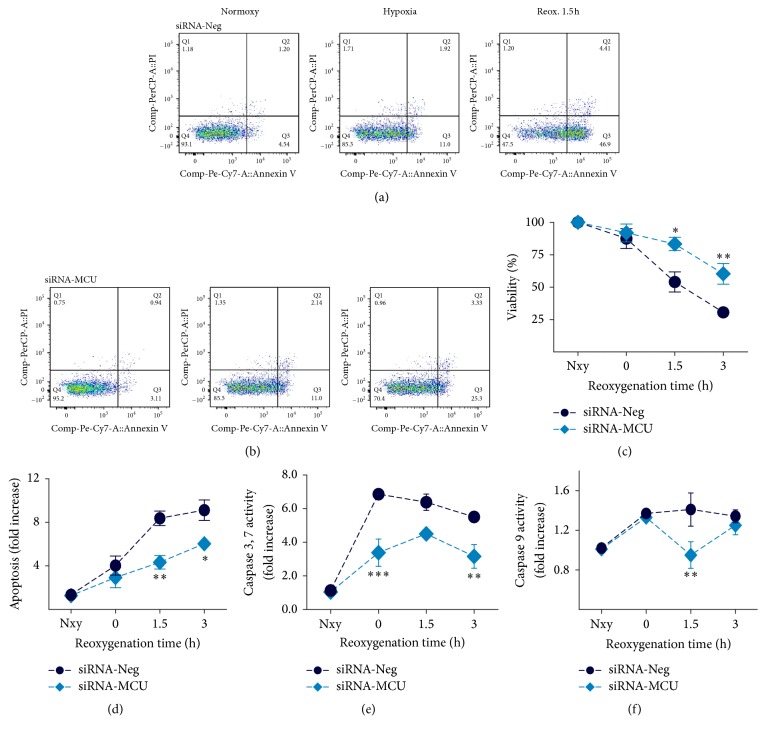
MCU silencing markedly reduced cardiomyocyte cell death in hypoxia/reoxygenation injury. (a and b) Representative dot-plot diagrams of flow cytometry viability/apoptosis analysis of siRNA-Neg and MCU-silenced cardiomyocytes in Nxy, after hypoxia and 1.5 h reoxygenation time. Viability and apoptosis were determined by PI and Annexin V PE-Cy7 conjugated staining, respectively. Q4 quadrant represents the viable cells, Q2 and Q3 represent the apoptotic cells, while Q1 and Q2 are the necrotic population. (c and d) Reoxygenation-time dependent cardiomyocyte viability and apoptosis at 0, 1.5, and 3 h reoxygenation, respectively. ∗∗P < 0.01; mean ± SEM; n = 7. Data is presented as percentage of Nxy conditions. (d) Apoptosis was ∼twofold and 1.5-fold increase in siRNA-Neg cardiomyocytes with respect to MCU-silenced cells at 1.5 and 3 h reoxygenation, respectively. Apoptosis is normalized to Nxy and expressed as fold change. P < 0.05, ∗∗P < 0.01, versus siRNA-Neg cardiomyocytes, mean ± SEM, n = 7. (e) Time-dependent activation of caspases 3 and 7 and (f) caspase 9 during reoxygenation. ∗∗P < 0.01, ∗∗∗P < 0.001, versus siRNA-Neg cells, mean ± SEM, and n = 7; Nxy, normoxic conditions.

References

    1. Hausenloy D. J., Boston-Griffiths E. A., Yellon D. M. Cyclosporin A and cardioprotection: from investigative tool to therapeutic agent. British Journal of Pharmacology. 2012;165(5):1235–1245. doi: 10.1111/j.1476-5381.2011.01700.x. - DOI - PMC - PubMed
    1. Yellon D. M., Hausenloy D. J. Myocardial reperfusion injury. The New England Journal of Medicine. 2007;357(11):1121–1135. doi: 10.1056/nejmra071667. - DOI - PubMed
    1. Kang S.-M., Lim S., Song H., et al. Allopurinol modulates reactive oxygen species generation and Ca 2+ overload in ischemia-reperfused heart and hypoxia-reoxygenated cardiomyocytes. European Journal of Pharmacology. 2006;535(1-3):212–219. doi: 10.1016/j.apcata.2005.10.038. - DOI - PubMed
    1. Halestrap A. P. Mitochondria and reperfusion injury of the heart—a holey death but not beyond salvation. Journal of Bioenergetics and Biomembranes. 2009;41(2):113–121. doi: 10.1007/s10863-009-9206-x. - DOI - PubMed
    1. Halestrap A. P. What is the mitochondrial permeability transition pore? Journal of Molecular and Cellular Cardiology. 2009;46(6):821–831. doi: 10.1016/j.yjmcc.2009.02.021. - DOI - PubMed

MeSH terms

LinkOut - more resources