. 2017 Mar 1;3(1):28-40.
doi: 10.1089/aivt.2016.0030.

Inflammatory Response and Barrier Dysfunction by Different e-Cigarette Flavoring Chemicals Identified by Gas Chromatography-Mass Spectrometry in e-Liquids and e-Vapors on Human Lung Epithelial Cells and Fibroblasts

Affiliations

Inflammatory Response and Barrier Dysfunction by Different e-Cigarette Flavoring Chemicals Identified by Gas Chromatography-Mass Spectrometry in e-Liquids and e-Vapors on Human Lung Epithelial Cells and Fibroblasts

Janice Gerloff et al. Appl In Vitro Toxicol. .

Abstract

Recent studies suggest that electronic cigarette (e-cig) flavors can be harmful to lung tissue by imposing oxidative stress and inflammatory responses. The potential inflammatory response by lung epithelial cells and fibroblasts exposed to e-cig flavoring chemicals in addition to other risk-anticipated flavor enhancers inhaled by e-cig users is not known. The goal of this study was to evaluate the release of the proinflammatory cytokine (interleukin-8 [IL-8]) and epithelial barrier function in response to different e-cig flavoring chemicals identified in various e-cig e-liquid flavorings and vapors by chemical characterization using gas chromatography-mass spectrometry analysis. Flavorings, such as acetoin (butter), diacetyl, pentanedione, maltol (malt), ortho-vanillin (vanilla), coumarin, and cinnamaldehyde in comparison with tumor necrosis factor alpha (TNFα), were used in this study. Human bronchial epithelial cells (Beas2B), human mucoepidermoid carcinoma epithelial cells (H292), and human lung fibroblasts (HFL-1) were treated with each flavoring chemical for 24 hours. The cells and conditioned media were then collected and analyzed for toxicity (viability %), lung epithelial barrier function, and proinflammatory cytokine IL-8 release. Cell viability was not significantly affected by any of the flavoring chemicals tested at a concentration of 10 μM to 1 mM. Acetoin and diacetyl treatment induced IL-8 release in Beas2B cells. Acetoin- and pentanedione-treated HFL-1 cells produced a differential, but significant response for IL-8 release compared to controls and TNFα. Flavorings, such as ortho-vanillin and maltol, induced IL-8 release in Beas2B cells, but not in H292 cells. Of all the flavoring chemicals tested, acetoin and maltol were more potent inducers of IL-8 release than TNFα in Beas2B and HFL-1 cells. Flavoring chemicals rapidly impaired epithelial barrier function in human bronchial epithelial cells (16-HBE) as measured by electric cell surface impedance sensing. Our findings suggest that some of the e-cig liquids/aerosols containing flavoring chemicals can cause significant loss of epithelial barrier function and proinflammatory response in lung cells.

Keywords: barrier function; diacetyl; electronic cigarettes; flavors; inflammation; interleukin-8.


Conflict of interest statement

No competing financial interests exist.

Figures
<b>FIG. 1.</b>
FIG. 1.
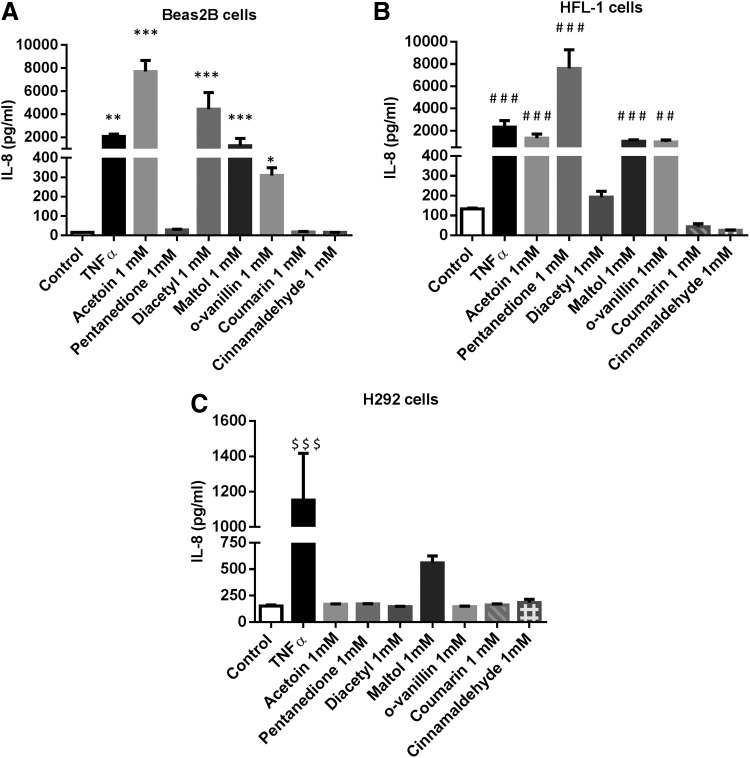
Comparative and differential effects of e-cig flavoring chemicals induced proinflammatory response in human lung epithelial cells and fibroblasts. Human bronchial epithelial cells (Beas2B), human lung fibroblasts (HFL-1), and human transformed lung epithelial cells (H292) were treated with different flavoring chemicals at 1 mM concentration and then incubated at 37°C and 5% CO2 for 24 hours. Levels of IL-8 release in culture media were determined by ELISA from control (untreated) and different flavoring chemical-treated (A) Beas2B, (B) HFL-1, and (C) H292 cells. Data are expressed as mean ± SEM (n = 3/group), and significance determined using one-way ANOVA (Tukey's multiple comparisons test). *p < 0.05, **p < 0.01, ***p < 0.001, ##p < 0.01, ###p < 0.001, $$$p < 0.001 versus untreated control Beas2B or HFL-1 or H292. e-cig, electronic cigarette; ELISA, enzyme-linked immunosorbent assay; IL-8, interleukin-8; SEM, standard error of the mean.
<b>FIG. 2.</b>
FIG. 2.
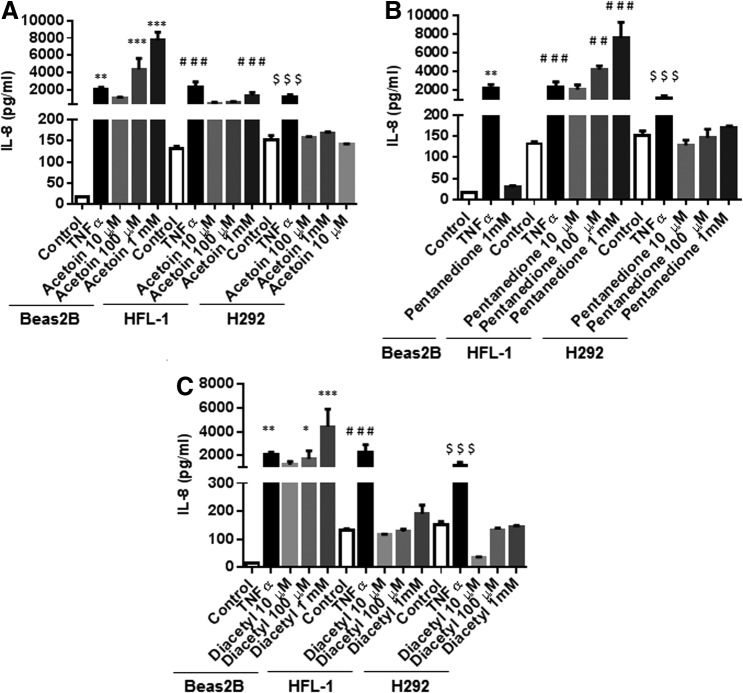
E-cig flavorings acetoin, pentanedione, and diacetyl caused dose-dependent proinflammatory response in human lung epithelial cells and fibroblasts. Human bronchial epithelial cells (Beas2B), human lung fibroblasts (HFL-1), and human transformed lung epithelial cells (H292) were treated with different doses of flavoring chemicals (10 μM, 100 μM, and 1 mM) and then incubated at 37°C and 5% CO2 for 24 hours. Levels of IL-8 release in culture media were determined by ELISA from control (untreated) and (A) acetoin-, (B) pentanedione-, and (C) diacetyl-treated Beas2B, HFL-1, and H292 cells. Data are expressed as mean ± SEM (n = 3/group), and significance determined using one-way ANOVA (Tukey's multiple comparisons test). *p < 0.05, **p < 0.01, ***p < 0.001, ##p < 0.01, ###p < 0.001, $$$p < 0.001 versus untreated control Beas2B or HFL-1 or H292.
<b>FIG. 3.</b>
FIG. 3.
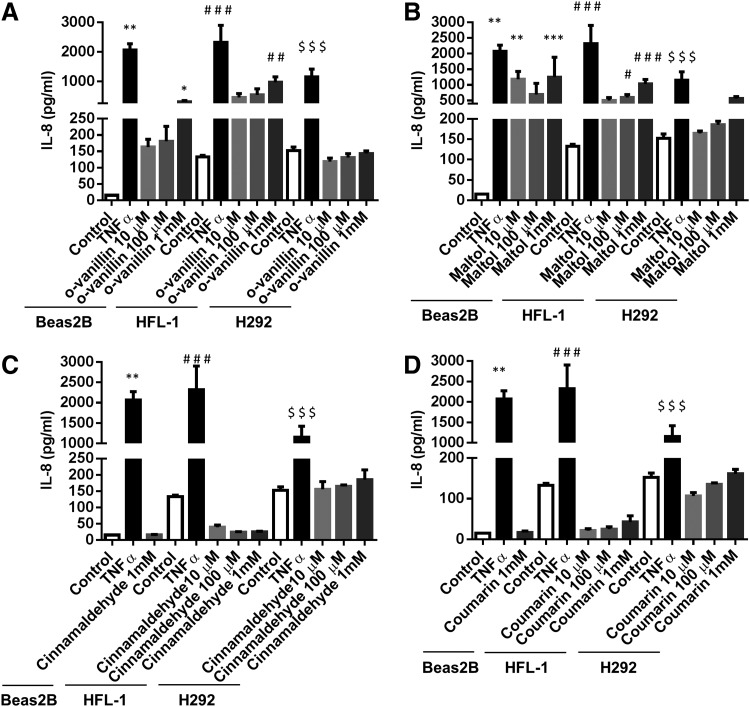
E-cig flavorings ortho-vanillin, maltol, cinnamaldehyde, and coumarin caused dose-dependent proinflammatory response in human lung epithelial cells and fibroblasts. Human bronchial epithelial cells (Beas2B), human lung fibroblasts (HFL-1) and human transformed lung epithelial cells (H292) were treated with different doses of flavoring chemicals (10 μM, 100 μM, and 1 mM) and then incubated at 37°C and 5% CO2 for 24 hours. Levels of IL-8 release in culture media were determined by ELISA from control (untreated) and (A) ortho-vanillin-, (B) maltol-, (C) cinnamaldehyde-, and (D) coumarin-treated Beas2B, HFL-1, and H292 cells. Data are expressed as mean ± SEM (n = 3/group), and significance determined using one-way ANOVA (Tukey's multiple comparisons test). *p < 0.05, **p < 0.01, ***p < 0.001; #p < 0.05, ##p < 0.01, ###p < 0.001, $$$p < 0.001 versus untreated control Beas2B or HFL-1 or H292.
<b>FIG. 4.</b>
FIG. 4.
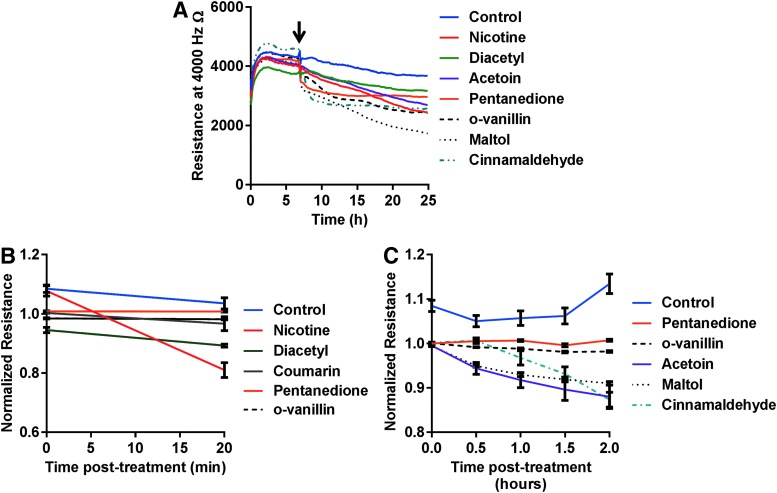
Effects of nicotine and flavoring chemicals on electrical resistance in 16-HBE cells. 16-HBE cells were seeded in ECIS array/cultureware. Cells were grown for 2 days in complete medium with 10% FBS, then placed in medium containing low serum (1% FBS) and treated with nicotine or different flavoring chemicals (1 mM) and monitored for 16–24 hours. Resistance was measured at 4000 Hz using ECIS. (A) Representative data showing absolute resistance for control (no treatment), nicotine, and different flavoring chemicals. Black color arrow indicates the exact time of treatment. (B) Normalized resistance values for control, nicotine, and treatment with different flavoring chemicals (0 vs. 20 minutes post-treatment). **p < 0.01 coumarin versus control; ***p < 0.001 diacetyl versus control. (C) Normalized resistance values for control and different flavoring chemicals 2 hours post-treatment. Statistical analysis of significance for normalized resistance values was compared between control vs. different flavoring chemicals at only 2-hour time point. Data are expressed as mean ± SEM (n = 6–8/group), and significance determined using two-way ANOVA (Sidak's multiple comparisons test). *p < 0.05 cinnamaldehyde versus control; ***p < 0.001, acetoin and maltol versus control. ECIS, electric cell-surface impedance sensing; FBS, fetal bovine serum.

References

    1. Barrington-Trimis JL, Samet JM, McConnell R. Flavorings in electronic cigarettes: An unrecognized respiratory health hazard? JAMA 2014:312;2493–2494 - PMC - PubMed
    1. McMillen RC, Gottlieb MA, Shaefer RM, et al. Trends in electronic cigarette use among U.S. adults: Use is increasing in both smokers and nonsmokers. Nicotine Tob Res 2015:17;1195–1202 - PubMed
    1. Feirman SP, Lock D, Cohen JE, et al. Flavored tobacco products in the United States: A systematic review assessing use and attitudes. Nicotine Tob Res 2016:18;739–749 - PubMed
    1. Schoenborn CA, Gindi RM. Electronic cigarette use among adults: United States, 2014. NCHS Data Brief 2015:217;1–8 - PubMed
    1. Allen JG, Flanigan SS, LeBlanc M, et al. Flavoring chemicals in e-cigarettes: diacetyl, 2,3-pentanedione, and acetoin in a sample of 51 products, including fruit-, candy-, and cocktail-flavored e-cigarettes. Environ Health Perspect 2016:124;733–739 - PMC - PubMed