


Using Active Choice Within the Electronic Health Record to Increase Influenza Vaccination Rates
- PMID: 28337690
- PMCID: PMC5481246
- DOI: 10.1007/s11606-017-4046-6
Using Active Choice Within the Electronic Health Record to Increase Influenza Vaccination Rates
Abstract
Background: Despite the benefits of influenza vaccination, each year more than half of adults in the United States do not receive it.
Objective: To evaluate the association between an active choice intervention in the electronic health record (EHR) and changes in influenza vaccination rates.
Design: Observational study.
Patients: Adults eligible for influenza vaccination with a clinic visit at one of three internal medicine practices at the University of Pennsylvania Health System between September 2010 and March 2013.
Intervention: The EHR confirmed patient eligibility during the clinic visit and, upon accessing the patient chart, prompted the physician and their medical assistant to actively choose to "accept" or "cancel" an order for the influenza vaccine.
Main measures: Change in influenza vaccination order rates at the intervention practice compared to two control practices for the 2012-2013 flu season, comparing trends during the prior two flu seasons adjusting for time trends and patient and clinic visit characteristics.
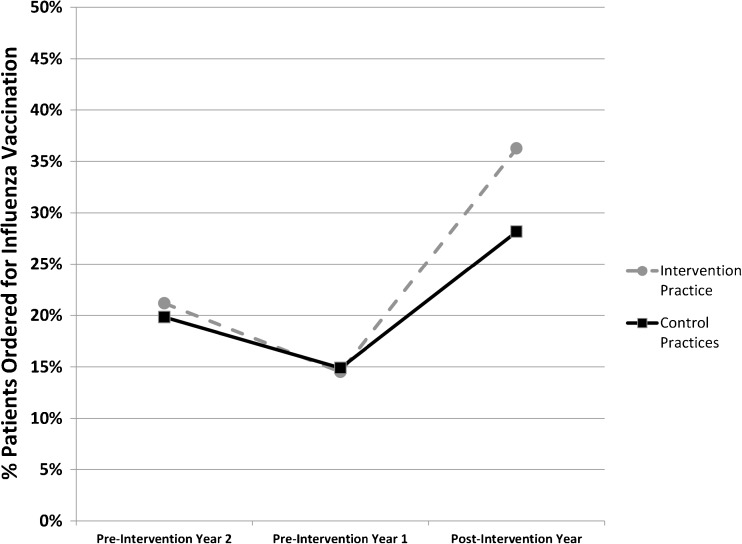
Key results: The sample (n = 45,926 patients) was 62.9% female, 35.9% white, and 54.4% black, with a mean age of 50.2 years. Trends were similar between practices during the 2 years in the pre-intervention period. Vaccination rates increased in both groups in the post-intervention year, but the intervention practice using active choice had a significantly greater increase than the control (adjusted difference-in-difference: 6.6 percentage points; 95% CI, 5.1-8.1; P < 0.001), representing a 37.3% relative increase compared to the pre-intervention period. More than 99.9% (9938/9941) of orders placed during the study period resulted in vaccination.
Conclusions: Active choice through the EHR was associated with a significant increase in influenza vaccination rates.
Keywords: active choice; behavioral economics; choice architecture; electronic health record; influenza vaccination; nudge; physician behavior.
Conflict of interest statement
Dr. Patel is a principal at Catalyst Health, a behavior change and technology consulting firm. Dr. Volpp is a principal at VAL Health, a behavioral economics consulting firm. Dr. Volpp has also received consulting income from CVS Caremark and research funding from Humana, CVS Caremark, Discovery (South Africa), Hawaii Medical Services Association, and Merck, none of which is related to the work described in this manuscript. All other authors declare no conflict of interest.
Figures
Comment in
-
Capsule Commentary on Patel el al., Using Active Choice Within the Electronic Health Record to Increase Influenza Vaccination Rates.J Gen Intern Med. 2017 Jul;32(7):800. doi: 10.1007/s11606-017-4057-3. J Gen Intern Med. 2017. PMID: 28424980 Free PMC article. No abstract available.
References
-
- Disease Burden of Influenza. Available online at: http://www.cdc.gov/flu/about/disease/burden.htm. Accessed September 15, 2016.
-
- FluVaxView. Centers for Disease Control and Prevention. Available online at: http://www.cdc.gov/flu/fluvaxview/. Accessed September 15, 2016.
Publication types
MeSH terms
Substances
Grants and funding
LinkOut - more resources
Full Text Sources
Other Literature Sources
Medical
