


The relationship between cognitive impairment, mortality and discharge characteristics in a large cohort of older adults with unscheduled admissions to an acute hospital: a retrospective observational study
- PMID: 28338808
- PMCID: PMC5860577
- DOI: 10.1093/ageing/afx022
The relationship between cognitive impairment, mortality and discharge characteristics in a large cohort of older adults with unscheduled admissions to an acute hospital: a retrospective observational study
Abstract
Background: older people with dementia admitted to hospital for acute illness have higher mortality and longer hospital stays compared to those without dementia. Cognitive impairment (CI) is common in older people, and they may also be at increased risk of poor outcomes.
Methods: retrospective observational study of unscheduled admissions aged ≥75 years. Admission characteristics, mortality rates and discharge outcomes were compared between three groups: (i) known dementia diagnosis (DD), (ii) CI but no diagnosis of dementia and (iii) no CI.
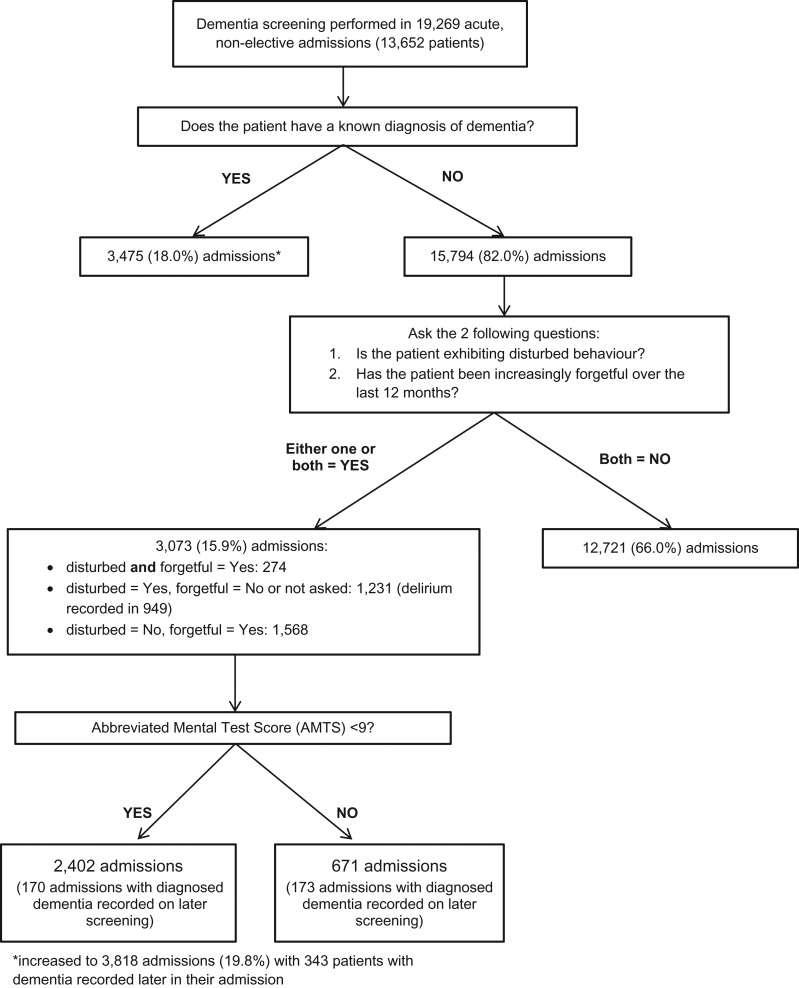
Results: of 19,269 admissions (13,652 patients), 19.8% had a DD, 11.6% had CI and 68.6% had neither. Admissions with CI or DD were older and had more females than those with no CI, and were more likely to be admitted through the Emergency Department (88.4% and 90.7%, versus 82.0%) and to medical wards (89.4% and 84.4%, versus 76.8%). Acuity levels at admission were similar between the groups. Patients with CI or DD had more admissions at 'high risk' from malnutrition than patients with no CI (28.0% and 33.7% versus 17.5%), and a higher risk of dying in hospital (11.8% [10.5-13.3] and 10.8% [9.8-11.9] versus (6.6% [6.2-7.0])).
Conclusions: the admission characteristics, mortality and length of stay of patients with CI resemble those of patients with diagnosed dementia. Whilst attention has been focussed on the need for additional support for people with dementia, patients with CI, which may include those with undiagnosed dementia or delirium, appear to have equally bad outcomes from hospitalisation.
Keywords: Cognitive impairment; dementia; hospital admission; mortality; older adults.
© The Author 2017. Published by Oxford University Press on behalf of the British Geriatrics Society.
Figures
References
-
- Dowrick A, Southern A. Dementia 2014: Opportunity for Change. London: Alzheimer's Society, 2014.
-
- Toot S, Devine M, Akporobaro A, Orrell M. Causes of hospital admission for people with dementia: a systematic review and meta-analysis. J Am Med Dir Assoc 2013; 14: 463–70. - PubMed
-
- Sampson EL, Leurent B, Blanchard MR, Jones L, King M. Survival of people with dementia after unplanned acute hospital admission: a prospective cohort study. Int J Geriatr Psychiatry 2013; 28: 1015–22. - PubMed
-
- Zekry D, Herrmann FR, Grandjean R et al. Does dementia predict adverse hospitalization outcomes? A prospective study in aged inpatients. Int J Geriatr Psychiatry 2009; 24: 283–91. - PubMed
Publication types
MeSH terms
LinkOut - more resources
Full Text Sources
Other Literature Sources
Medical
Research Materials
