. 2017 Apr 1;9(4):855-868.
doi: 10.1093/gbe/evx052.

RNA Editing During Sexual Development Occurs in Distantly Related Filamentous Ascomycetes

Affiliations

RNA Editing During Sexual Development Occurs in Distantly Related Filamentous Ascomycetes

Ines Teichert et al. Genome Biol Evol. .

Abstract

RNA editing is a post-transcriptional process that modifies RNA molecules leading to transcript sequences that differ from their template DNA. A-to-I editing was found to be widely distributed in nuclear transcripts of metazoa, but was detected in fungi only recently in a study of the filamentous ascomycete Fusarium graminearum that revealed extensive A-to-I editing of mRNAs in sexual structures (fruiting bodies). Here, we searched for putative RNA editing events in RNA-seq data from Sordaria macrospora and Pyronema confluens, two distantly related filamentous ascomycetes, and in data from the Taphrinomycete Schizosaccharomyces pombe. Like F. graminearum, S. macrospora is a member of the Sordariomycetes, whereas P. confluens belongs to the early-diverging group of Pezizomycetes. We found extensive A-to-I editing in RNA-seq data from sexual mycelium from both filamentous ascomycetes, but not in vegetative structures. A-to-I editing was not detected in different stages of meiosis of S. pombe. A comparison of A-to-I editing in S. macrospora with F. graminearum and P. confluens, respectively, revealed little conservation of individual editing sites. An analysis of RNA-seq data from two sterile developmental mutants of S. macrospora showed that A-to-I editing is strongly reduced in these strains. Sequencing of cDNA fragments containing more than one editing site from P. confluens showed that at the beginning of sexual development, transcripts were incompletely edited or unedited, whereas in later stages transcripts were more extensively edited. Taken together, these data suggest that A-to-I RNA editing is an evolutionary conserved feature during fruiting body development in filamentous ascomycetes.

Keywords: A-to-I RNA editing; Pyronema confluens; Sordaria macrospora; fruiting body; protoperithecia; sexual development.


Figures

F<sc>ig</sc>. 1.—
Fig. 1.—
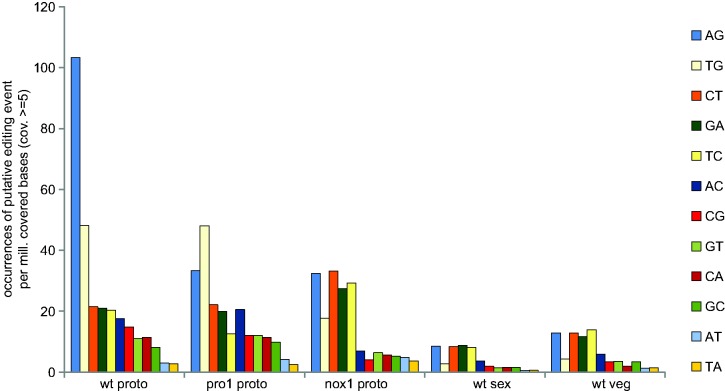
Analysis of putative RNA editing events in Sordaria macrospora. RNA-seq data from five conditions or strains were analyzed (Teichert et al. 2012, Dirschnabel et al. 2014). The occurrence of base changes in annotated genes compared with genomic DNA is given as putative RNA editing events per million covered bases, the coverage threshold was set to ≥5. Only base changes detected in two independent samples for each condition were counted. wt = wild type, nox1 and pro1 denote the corresponding mutants; proto, protoperithecia (young fruiting bodies); sex, total sexual mycelium; veg, total vegetative mycelium.
F<sc>ig</sc>. 2.—
Fig. 2.—
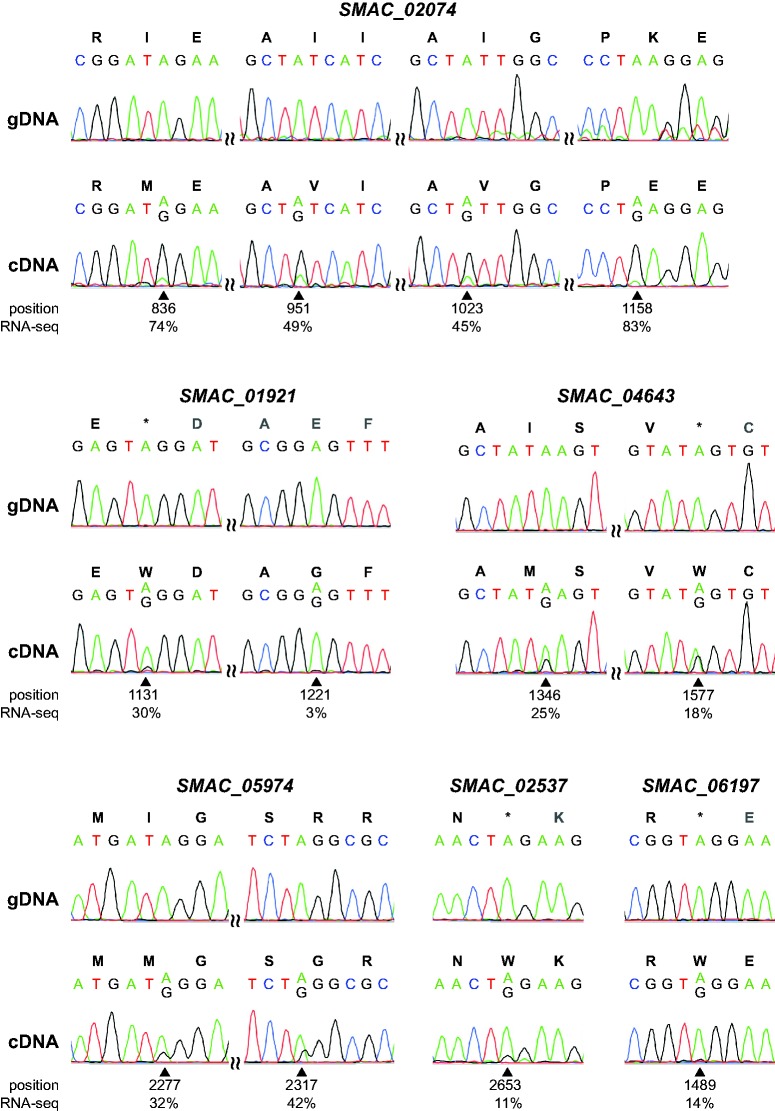
Verification of selected A-to-I RNA editing sites in the S. macrospora wild type. PCR fragments derived from genomic DNA (gDNA) or cDNA from samples grown for 6 d under conditions allowing sexual development were sequenced by Sanger sequencing. Chromatograms from sequences around edited sites are shown for gDNA and cDNA of 12 editing sites in six genes. Below each site, the position within the gene and the percentage of edited sequence reads in the RNA-seq data from wild type protoperithecia are given.
F<sc>ig</sc>. 3.—
Fig. 3.—
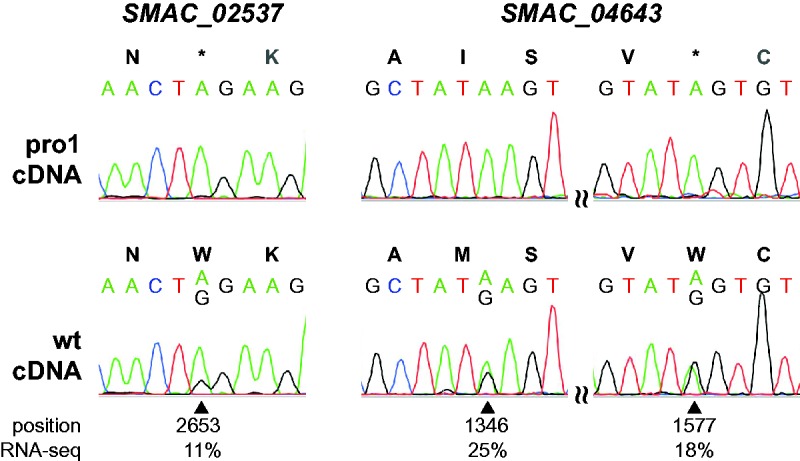
A-to-I editing in the genes SMAC_02537 and SMAC_04643 can be detected in the wild type, but not in developmental mutant pro1. PCR fragments derived from cDNA from samples grown for 5d under conditions allowing sexual development were sequenced by Sanger sequencing. Chromatograms from sequences around edited sites are shown for wild type and developmental mutant pro1. Below each site, the position within the gene and the percentage of edited sequence reads in the RNA-seq data from wild type protoperithecia are given. Editing of these sites was not observed in RNA-seq data from pro1 protoperithecia.
F<sc>ig</sc>. 4.—
Fig. 4.—
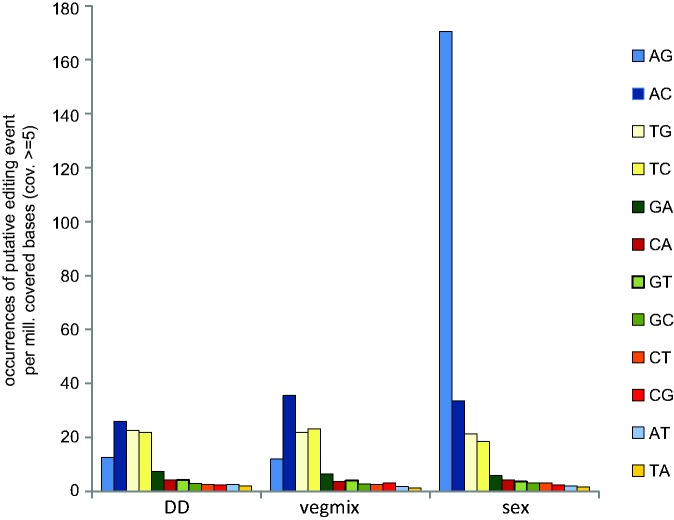
Analysis of putative RNA editing events in P. confluens. RNA-seq data from three conditions were analyzed (Traeger et al. 2013). The occurrence of base changes in annotated genes compared with genomic DNA is given as putative RNA editing events per million covered bases, the coverage threshold was set to ≥5. Only base changes detected in two independent samples for each condition were counted. Abbreviations: DD, growth in darkness (P. confluens does not form fruiting bodies without light); vegmix, pooled RNA from growth in light but under conditions that do not allow fruiting body formation (submerged growth or growth on complete medium); sex, growth under conditions that allow fruiting body formation (surface cultures in minimal medium in the light).
F<sc>ig</sc>. 5.—
Fig. 5.—
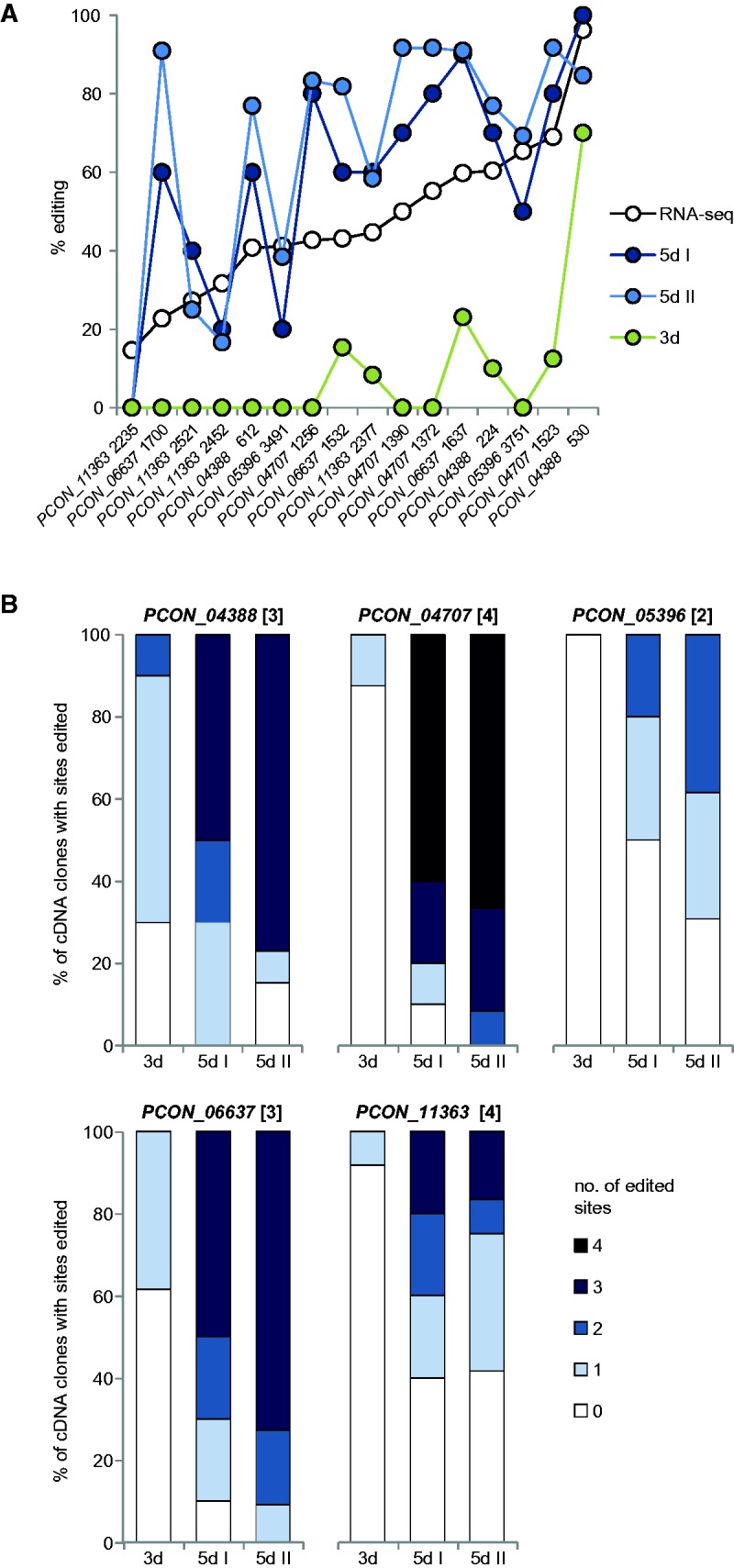
Verification of RNA editing in P. confluens. Sixteen putative editing sites in five genes were analyzed by sequencing cDNA clones from sexually developing samples after 3d or 5d (8–14 cDNA clones for each sample). Genomic DNA was also sequenced and was found to be as expected in all cases (data not shown). (A) Editing sites were sorted from low to high editing frequency in the RNA-seq data, and the percentage of editing observed in the sequenced cDNA clones in the different samples is indicated for each site. (B) For each analyzed gene, the percentage of cDNAs with the indicated number of edited sites is shown for each of the conditions. The number of potential editing sites for each analyzed DNA fragment is given in square brackets after the gene name.
F<sc>ig</sc>. 6.—
Fig. 6.—
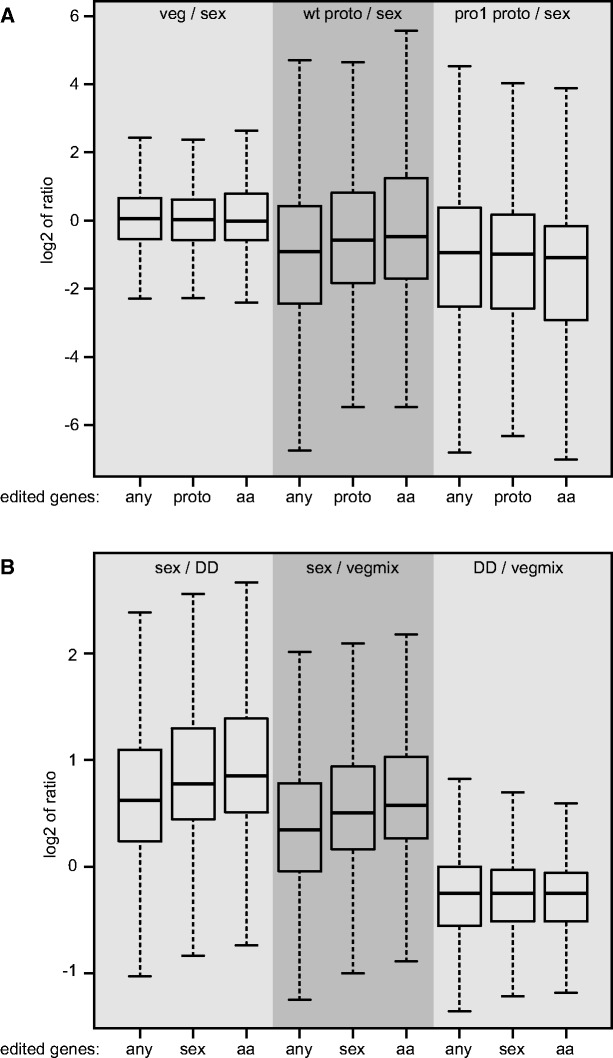
Analysis of expression of edited genes in S. macrospora and P. confluens. Boxplots showing the distribution of expression ratios of edited genes (outliers left out for better visibility) with the median value as a horizontal line in the box between the first and third quartiles. (A) Sordaria macrospora genes with any type of putative editing site (any), genes with A-to-I editing only in wild type protoperithecia (proto), and genes with A-to-I editing only in wild type protoperithecia with editing in at least 10% of observed transcripts and where editing leads to an amino acid change (aa) were analyzed for expression in three different conditions based on published RNA-seq data (Teichert et al. 2012). The conditions analyzed are expression ratios of vegetative vs. sexual mycelium (veg/sex), wild type protoperithecia vs. sexual mycelium (wt proto/sex), and pro1 protoperithecia vs. sexual mycelium (pro1 proto/sex). (B) Pyronema confluens genes with any type of putative editing site (any), genes with A-to-I editing only in sexual mycelium (sex), and genes with A-to-I editing only in sexual mycelium with editing in at least 10% of observed transcripts and where editing leads to an amino acid change (aa) were analyzed for expression in three different conditions based on published RNA-seq data (Traeger et al. 2013). The conditions analyzed are expression ratios of sexual mycelium vs. vegetative mycelium grown in darkness (sex/DD), sexual mycelium vs. vegetative mycelium from several growth conditions (sex/vegmix), and a comparison of the two different growth conditions yielding only vegetative mycelium (DD/vegmix).

References

    1. Alon S, et al. 2015. The majority of transcripts in the squid nervous system are extensively recoded by A-to-I RNA editing. Elife 4:e05198. - PMC - PubMed
    1. Altschul SF, et al. 1997. Gapped BLAST and PSI-BLAST: a new generation of protein database search programs. Nucleic Acids Res. 25:3389–3402. - PMC - PubMed
    1. Ashburner M, et al. 2000. Gene ontology: tool for the unification of biology. Nat Genet. 25:25–29. - PMC - PubMed
    1. Bahn JH, et al. 2012. Accurate identification of A-to-I RNA editing in human by transcriptome sequencing. Genome Res. 22:142–150. - PMC - PubMed
    1. Basilio C, Wahba AJ, Lengyel P, Speyer JF, Ochoa S. 1962. Synthetic polynucleotides and the amino acid code. V. Proc. Natl. Acad. Sci. U S A. 48:613–616. - PMC - PubMed

MeSH terms