


Mapping global biodiversity connections with DNA barcodes: Lepidoptera of Pakistan
- PMID: 28339501
- PMCID: PMC5365146
- DOI: 10.1371/journal.pone.0174749
Mapping global biodiversity connections with DNA barcodes: Lepidoptera of Pakistan
Abstract
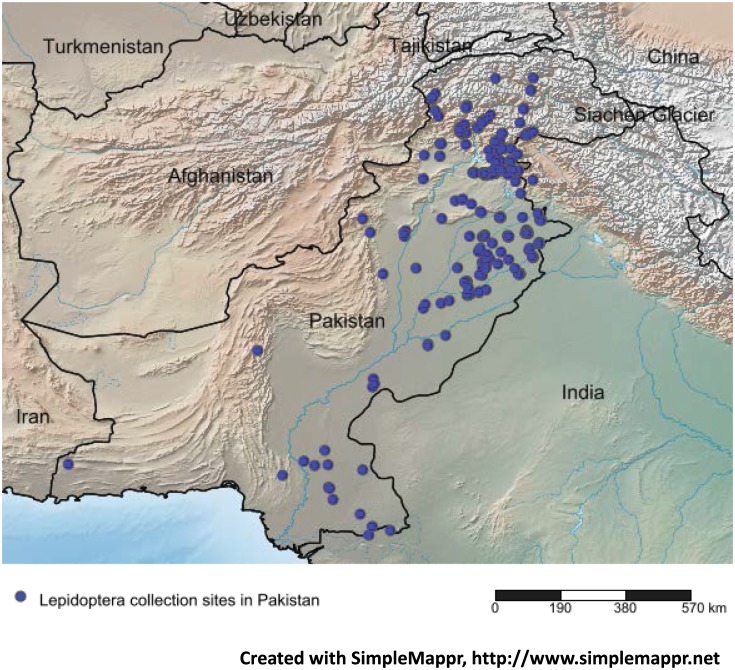
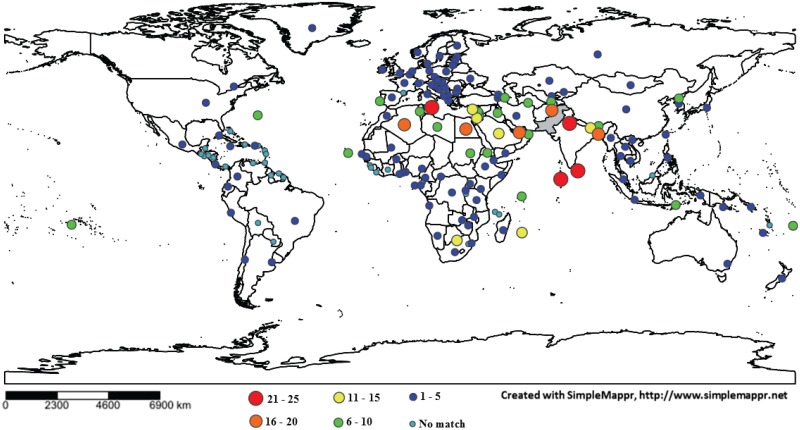
Sequences from the DNA barcode region of the mitochondrial COI gene are an effective tool for specimen identification and for the discovery of new species. The Barcode of Life Data Systems (BOLD) (www.boldsystems.org) currently hosts 4.5 million records from animals which have been assigned to more than 490,000 different Barcode Index Numbers (BINs), which serve as a proxy for species. Because a fourth of these BINs derive from Lepidoptera, BOLD has a strong capability to both identify specimens in this order and to support studies of faunal overlap. DNA barcode sequences were obtained from 4503 moths from 329 sites across Pakistan, specimens that represented 981 BINs from 52 families. Among 379 species with a Linnaean name assignment, all were represented by a single BIN excepting five species that showed a BIN split. Less than half (44%) of the 981 BINs had counterparts in other countries; the remaining BINs were unique to Pakistan. Another 218 BINs of Lepidoptera from Pakistan were coupled with the 981 from this study before being compared with all 116,768 BINs for this order. As expected, faunal overlap was highest with India (21%), Sri Lanka (21%), United Arab Emirates (20%) and with other Asian nations (2.1%), but it was very low with other continents including Africa (0.6%), Europe (1.3%), Australia (0.6%), Oceania (1.0%), North America (0.1%), and South America (0.1%). This study indicates the way in which DNA barcoding facilitates measures of faunal overlap even when taxa have not been assigned to a Linnean species.
Conflict of interest statement
Figures
References
-
- De Broyer C, Danis B. How many species in the Southern Ocean? Towards a dynamic inventory of the Antarctic marine species. Deep-Sea Res Pt II. 2011; 58: 5–17.
-
- Joschko M, Fox CA, Lentzsch P, Kiesel J, Hierold W, Kruck S, et al. Spatial analysis of earthworm biodiversity at the regional scale. Agr Ecosyst Environ. 2006; 112:367–380.
MeSH terms
LinkOut - more resources
Full Text Sources
Other Literature Sources
Research Materials
