


The utility of comprehensive autoantibody testing to differentiate connective tissue disease associated and idiopathic interstitial lung disease subgroup cases
- PMID: 28339528
- PMCID: PMC5850114
- DOI: 10.1093/rheumatology/kew320
The utility of comprehensive autoantibody testing to differentiate connective tissue disease associated and idiopathic interstitial lung disease subgroup cases
Abstract
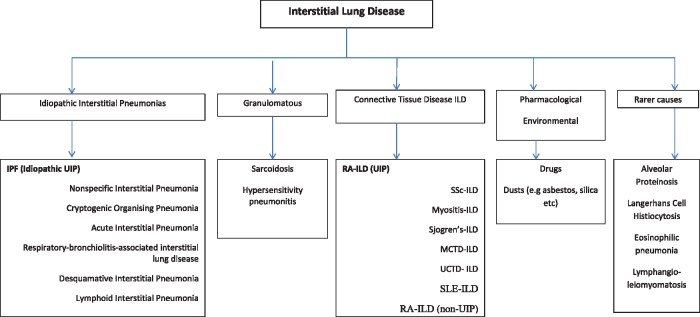
Interstitial lung disease (ILD) comprises many heterogeneous disease groups, the largest being CTD-associated and those labelled as idiopathic out of necessity. The mechanisms causing ILD are poorly understood, but most CTD- and idiopathic-ILD cases can respond to immunosuppression, clearly suggesting a pathological role for inflammation. By contrast, corticosteroid immunosuppression causes harm without benefit in the feared idiopathic pulmonary fibrosis, suggesting that inflammation plays little pathological role, and where ILD progresses rapidly to lethal outcome even with anti-fibrotic drug use. Given the treatment response differences apparent between ILD subgroups, and the dangers and costs of corticosteroid and anti-fibrotic drug use, respectively, it has become vital in every ILD patient to make an accurate subgroup diagnosis, to optimize treatment selections. This review discusses why differentiating CTD- and idiopathic-ILD subgroup cases remains so problematic, and why existing comprehensive CTD-specific serology would, if generally available, represent an ideal biomarker tool to enhance ILD subgroup diagnostic accuracy.
Keywords: anti-synthetase syndrome; antibodies; biomarkers; connective tissue disease; interstitial lung disease; myositis; serology.
© The Author 2016. Published by Oxford University Press on behalf of the British Society for Rheumatology. All rights reserved. For Permissions, please email: journals.permissions@oup.com.
Figures
References
-
- Wells AU, Hirani N on behalf of the British Thoracic Society Interstitial Lung Disease Group. Interstitial lung disease guideline: the British Thoracic Society in collaboration with the Thoracic Society of Australia and New Zealand and the Irish Thoracic Society. Thorax 2008;63:v1–v58. - PubMed
-
- Wells AU, Denton CP.. Interstitial lung disease in connective tissue disease-mechanisms and management. Nat Rev Rheumatol 2014;10:728–39. - PubMed
-
- King TE Jr, Pardo A, Selman M.. Idiopathic pulmonary fibrosis. Lancet 2011;378:1949–61. - PubMed
-
- Ryerson CJ, Collard HR.. Update on the diagnosis and classification of ILD. Curr Opin Pulm Med 2013;19:453–9. - PubMed
Publication types
MeSH terms
Substances
Grants and funding
LinkOut - more resources
Full Text Sources
Other Literature Sources
Medical
