


Markers of dietary protein intake are associated with successful weight loss in the POUNDS Lost trial
- PMID: 28340516
- PMCID: PMC5517018
- DOI: 10.1111/cob.12188
Markers of dietary protein intake are associated with successful weight loss in the POUNDS Lost trial
Abstract
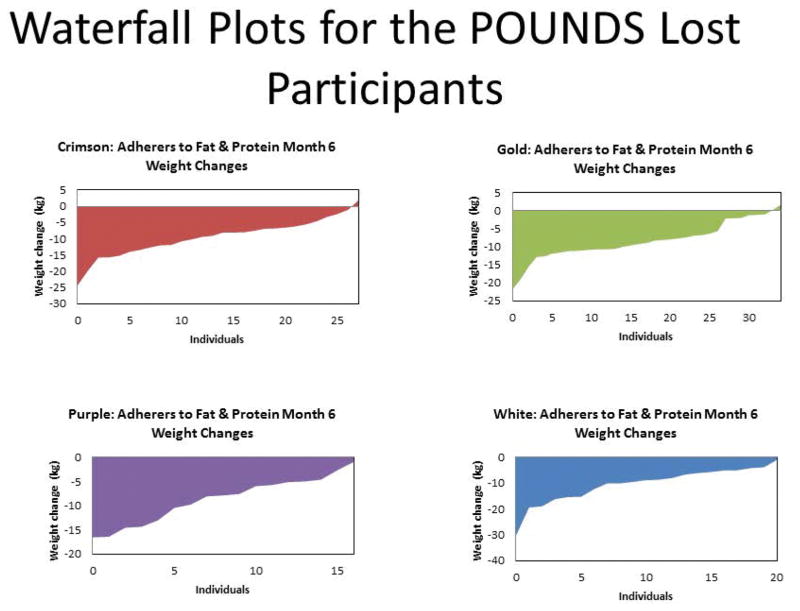
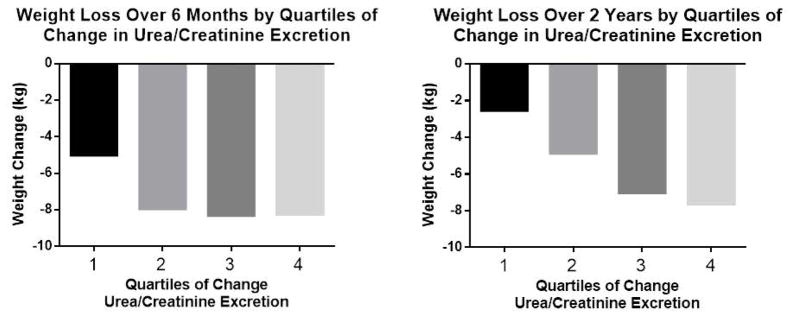
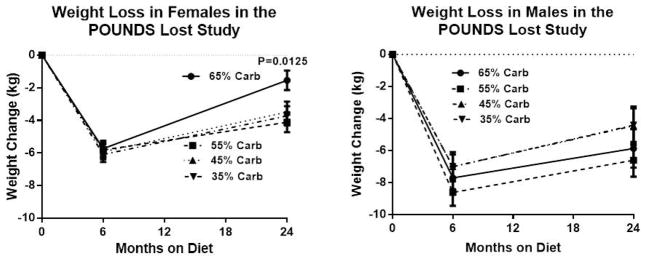
To assess the association of markers for dietary protein intake, measures of dietary adherence and demographic variables with weight loss in the POUNDS Lost study over the first 6 months and again between 6 and 24 months using data from those who completed each period. This is a secondary analysis of pooled data on completers assigned to one of four diets: 65%C/15%P/20%F (AP/LF), 55%C/25%P/20%F (HP/LF), 45%C/15%P/40%F (AP/HF) or 35%C/25%P40%F (HP/HF) in the POUNDS Lost study. Urinary nitrogen excretion, dietary adherence measured by 24-h recall and attendance at sessions, age (above and below 50 years), gender, race/ethnicity and activity by pedometry were analysed. Increased spread between protein intake at baseline and protein at 6 or 24 months, assessed by urinary nitrogen excretion, was associated with greater weight loss from baseline to 2 years. At 6 and 24 months, older age, male gender, body mass index > 30 kg m-2 and adherence to the fat and protein diets were associated with more weight loss. None of these variables was associated with a regain from 6 to 24 months. Weight regain for women in the highest carbohydrate (65%) group was significantly greater (-4.4 kg [95% CI: -5.9, -3.0]) than for women in the lowest carbohydrate group (-1.8 kg [95% CI: -3.2, -0.4 kg]) (P for interaction = 0.012). An increased spread in the difference between baseline and follow-up protein intake was associated with greater weight loss, consistent with the 'protein spread theory'. Women eating the highest carbohydrate diet regained more weight from 6 to 24 months.
Keywords: High protein diet; low-carbohydrate diet; randomized clinical trial; urinary nitrogen excretion.
© 2017 World Obesity Federation.
Conflict of interest statement
Conflicts of Interest: None of the authors reported relationships with industry or potential conflicts of interest in relationship to the work described in this manuscript.
Figures
References
-
- Banting W. Letter on corpulence, addressed to the public. 3 London: Harrison; 1864. - PubMed
-
- Foster GD, Wyatt HR, Hill JO, et al. A randomized trial of a low-carbohydrate diet for obesity. N Engl J Med. 2003;348:2082–90. - PubMed
-
- Samaha FF, Iqbal N, Seshadri P, et al. A low-carbohydrate as compared with a low-fat diet in severe obesity. N Engl J Med. 2003;324:2074–81. - PubMed
-
- Stern L, Iqbal N, Seshadri P, et al. The effects of a low-carbohydrate versus conventional weight loss diets in severely obese adults: one-year follow-up of a randomized trial. Ann Intern Med. 2004;140:778–85. - PubMed
Publication types
MeSH terms
Substances
Grants and funding
LinkOut - more resources
Full Text Sources
Other Literature Sources
Medical
Research Materials
Miscellaneous
