. 2017 Mar 24;18(1):193.
doi: 10.1186/s12859-017-1605-0.

Cross disease analysis of co-functional microRNA pairs on a reconstructed network of disease-gene-microRNA tripartite

Affiliations

Cross disease analysis of co-functional microRNA pairs on a reconstructed network of disease-gene-microRNA tripartite

Hui Peng et al. BMC Bioinformatics. .

Abstract

Background: MicroRNAs always function cooperatively in their regulation of gene expression. Dysfunctions of these co-functional microRNAs can play significant roles in disease development. We are interested in those multi-disease associated co-functional microRNAs that regulate their common dysfunctional target genes cooperatively in the development of multiple diseases. The research is potentially useful for human disease studies at the transcriptional level and for the study of multi-purpose microRNA therapeutics.

Methods and results: We designed a computational method to detect multi-disease associated co-functional microRNA pairs and conducted cross disease analysis on a reconstructed disease-gene-microRNA (DGR) tripartite network. The construction of the DGR tripartite network is by the integration of newly predicted disease-microRNA associations with those relationships of diseases, microRNAs and genes maintained by existing databases. The prediction method uses a set of reliable negative samples of disease-microRNA association and a pre-computed kernel matrix instead of kernel functions. From this reconstructed DGR tripartite network, multi-disease associated co-functional microRNA pairs are detected together with their common dysfunctional target genes and ranked by a novel scoring method. We also conducted proof-of-concept case studies on cancer-related co-functional microRNA pairs as well as on non-cancer disease-related microRNA pairs.

Conclusions: With the prioritization of the co-functional microRNAs that relate to a series of diseases, we found that the co-function phenomenon is not unusual. We also confirmed that the regulation of the microRNAs for the development of cancers is more complex and have more unique properties than those of non-cancer diseases.

Keywords: Co-functional microRNA pair; Cross-disease analysis; Disease-microRNA associations prediction.


Figures
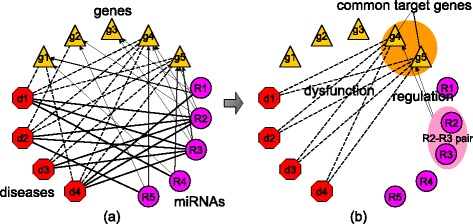
Fig. 1
Fig. 1
An example: From a DGR tripartite network to a co-functional miRNA pair. The network in panel a contains known associations between the genes g1, g2, g3, g4, and g5, the diseases d1, d2, d3, and d4, and the miRNAs R1, R2, R3, and R4. In this example, miRNAs R2 and R3 are both associated with all the four diseases. However, the other three miRNAs are each associated with only one of these diseases. All these four diseases are associated with two common genes g4 and g5. Meanwhile, both of g4 and g5 are the targets of miRNAs R2 and R3. It is believed that R2-R3-g4-g5 in panel b may form a functional module that associated with the development of all the four diseases
Fig. 2
Fig. 2
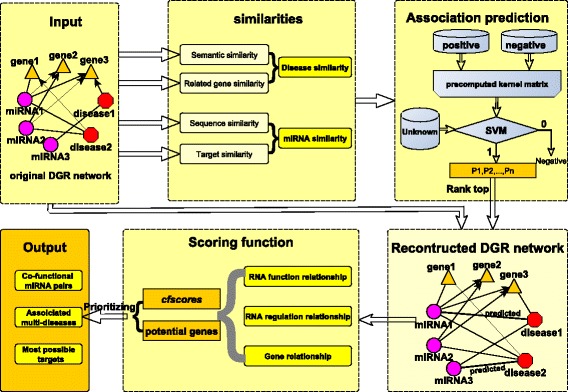
The flowchart of our prediction and scoring method. Our work includes the parts such as material collection, similarity computing, association prediction, network reconstruction, scoring and prioritization of the co-function miRNA pairs and result output
Fig. 3
Fig. 3
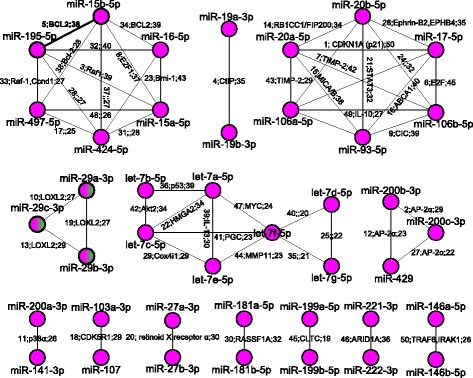
The 50 top-ranked co-functional miRNA pairs from the reconstructed cancer-miRNA-gene network. The labels along the edges illustrate the co-function information of the miRNAs. The first number of each label is the rank of the corresponding pair according to our prioritization method. The following gene symbols are the validated common targets during the co-functioning of the pair of miRNAs. The last number shows the potential diseases that related to this co-function pair
Fig. 4
Fig. 4
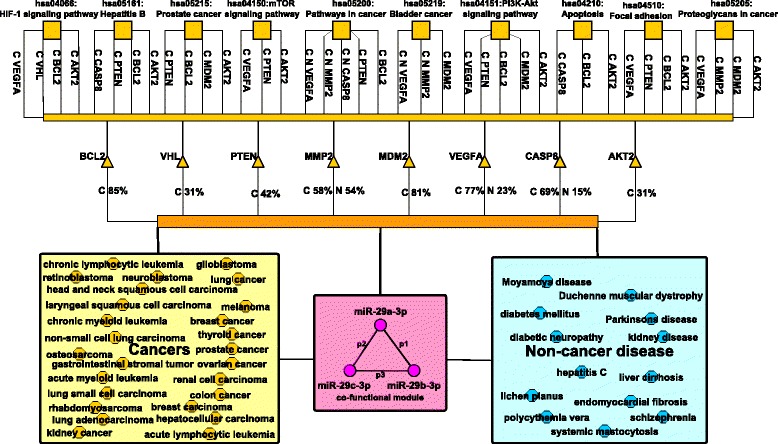
The miR-29a-miR-29b-miR-29c co-function module, their targets and the enrichment analysis of the KEGG pathways. The triangles are the potential common target genes of the miR-29a/b/c co-functional module. Those small squares are the genes enriched pathways. Those disease names in the big squares are the co-functional module related diseases according to our prioritization method
Fig. 5
Fig. 5
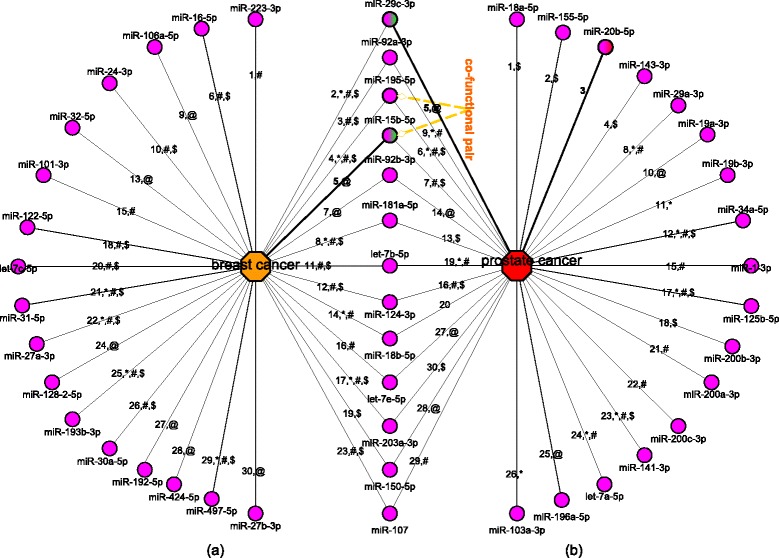
The top 30 predicted breast cancer-miRNA and prostate cancer-miRNA associations and the verification resources. The part a shows the predicted breast cancer related miRNAs and the part b gives the predict prostate cancer related miRNAs. The labels of the edges illustrate the rank of the predicted associations and the confirming types. The characters “*”, “#” or “$” stand for that the corresponding associations can be confirmed by the records in miR2Disease, HMDD or miRCancer respectively. The character “@” means that the association can be confirmed by other articles. A co-functional pair miR-195-5p-miR-15b-5p is highlighted
Fig. 6
Fig. 6
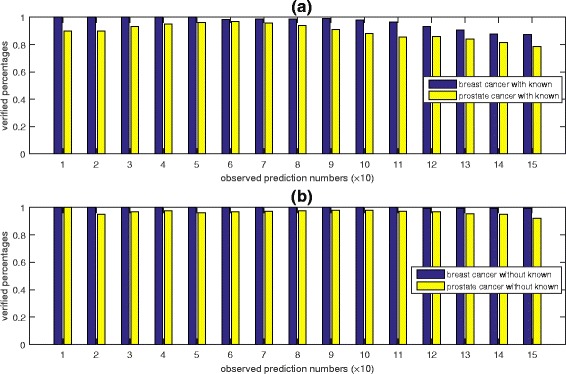
The percentages of the predicted disease-miRNA associations that can be verified. Panel a introduces the prediction performance of the model with the known cancer (breast and prostate cancer) related miRNAs. Panel b shows the prediction performance after the removal of the existing associations. The x-axis is the number of predictions (× 10) while the y-axis is the percentages of the verified predictions
Fig. 7
Fig. 7
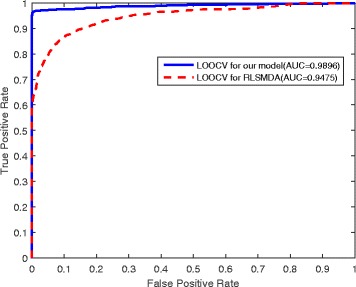
The ROC curves of our model compared with RLSMDA based on the same positive samples. The comparison is based on the same positive sample set and the different prediction model of RLSMDA and our newly designed model. The average AUC value of our model is 0.9896 while the RLSMDA obtains the lower value of 0.9475

References

    1. Zhou B, Wang S, Mayr C, Bartel DP, Lodish HF. mir-150, a microrna expressed in mature b and t cells, blocks early b cell development when expressed prematurely. Proc Nat Acad Sci. 2007;104(17):7080–5. doi: 10.1073/pnas.0702409104. - DOI - PMC - PubMed
    1. Brennecke J, Hipfner DR, Stark A, Russell RB, Cohen SM. bantam encodes a developmentally regulated microrna that controls cell proliferation and regulates the proapoptotic gene hid in drosophila. Cell. 2003;113(1):25–36. doi: 10.1016/S0092-8674(03)00231-9. - DOI - PubMed
    1. Yi R, Poy MN, Stoffel M, Fuchs E. A skin microrna promotes differentiation by repressing ‘stemness’. Nature. 2008;452(7184):225–9. doi: 10.1038/nature06642. - DOI - PMC - PubMed
    1. Tay Y, Zhang J, Thomson AM, Lim B, Rigoutsos I. Micrornas to nanog, oct4 and sox2 coding regions modulate embryonic stem cell differentiation. Nature. 2008;455(7216):1124–8. doi: 10.1038/nature07299. - DOI - PubMed
    1. Jovanovic M, Hengartner M. mirnas and apoptosis: Rnas to die for. Oncogene. 2006;25(46):6176–87. doi: 10.1038/sj.onc.1209912. - DOI - PubMed

LinkOut - more resources