


Changes in clinical symptoms and functional disability in patients with coexisting patellofemoral and tibiofemoral osteoarthritis: a 1-year prospective cohort study
- PMID: 28340623
- PMCID: PMC5364585
- DOI: 10.1186/s12891-017-1486-4
Changes in clinical symptoms and functional disability in patients with coexisting patellofemoral and tibiofemoral osteoarthritis: a 1-year prospective cohort study
Abstract
Background: This 1-year prospective cohort study aimed to compare the changes in clinical symptoms and functional disability between patients with coexisting patellofemoral (PF) and tibiofemoral (TF) osteoarthritis (OA) and those with isolated TFOA.
Methods: Seventy-two patients with medial knee OA were enrolled. Knee pain and functional disability were assessed at baseline and at 1-year follow-up using the Japanese Knee Osteoarthritis Measure (JKOM) and a visual analog scale (VAS). We performed two-way analysis of covariance for the clinical outcome variables to examine, time (baseline and follow-up), group (coexisting PFOA and isolated TFOA), and time-group interaction effects. Furthermore, we conducted post-hoc exploratory analysis to address the possibility that dividing patients according to location of PFOA (i.e., isolated lateral, isolated medial, and mixed [bilateral]) may identify a distinct subgroup with different changes in clinical outcomes at 1-year follow-up.
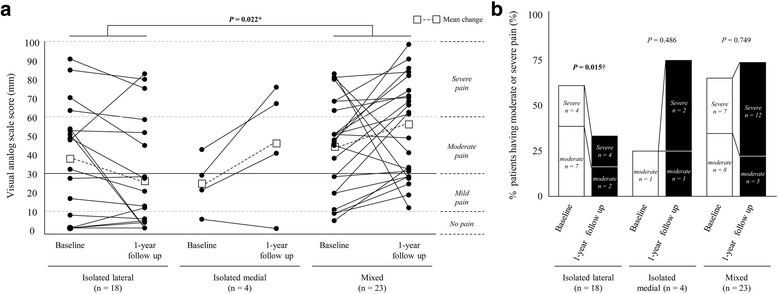
Results: We detected group effects only in scores of the JKOM pain subscale (P = 0.012) and VAS (P = 0.033), adjusted for age, sex, and body mass index. Patients with coexisting PFOA have stable moderate level knee pain and functional disability throughout the year which is significantly worse than that in those with isolated TFOA. Post-hoc subgroup analysis demonstrated that change of knee pain likely varied with location of PFOA. Patients with isolated lateral PFOA had mild/moderate level knee pain, and their VAS scores were likely to improve, whereas those with mixed PFOA exhibited stable to worsening moderate/severe knee pain.
Conclusions: Although we did not detect differences in changes in clinical symptoms and functional disability between patients with coexisting PFOA and those with isolated TFOA, our findings indicate that patients with coexisting PFOA had worse clinical symptoms and functional disability than those with isolated TFOA. The results of the exploratory analysis suggested that patients with coexisting PFOA might have heterogeneous clinical outcomes, and presence of mixed PFOA might be an indicator of severe clinical knee OA.
Keywords: Disability; Knee pain; Patellofemoral osteoarthritis; Tibiofemoral osteoarthritis.
Figures
References
-
- Vos T, Flaxman AD, Naghavi M, Lozano R, Michaud C, Ezzati M, Shibuya K, Salomon JA, Abdalla S, Aboyans V, et al. Years lived with disability (YLDs) for 1160 sequelae of 289 diseases and injuries 1990-2010: a systematic analysis for the Global Burden of Disease Study 2010. Lancet. 2012;380(9859):2163–2196. doi: 10.1016/S0140-6736(12)61729-2. - DOI - PMC - PubMed
-
- Pisters MF, Veenhof C, van Dijk GM, Heymans MW, Twisk JW, Dekker J. The course of limitations in activities over 5 years in patients with knee and hip osteoarthritis with moderate functional limitations: risk factors for future functional decline. Osteoarthritis Cartilage. 2012;20(6):503–510. doi: 10.1016/j.joca.2012.02.002. - DOI - PubMed
-
- Nicholls E, Thomas E, van der Windt DA, Croft PR, Peat G. Pain trajectory groups in persons with, or at high risk of, knee osteoarthritis: findings from the Knee Clinical Assessment Study and the Osteoarthritis Initiative. Osteoarthritis Cartilage. 2014;22(12):2041–2050. doi: 10.1016/j.joca.2014.09.026. - DOI - PMC - PubMed
Publication types
MeSH terms
LinkOut - more resources
Full Text Sources
Other Literature Sources
Medical
Miscellaneous
