


Review
doi: 10.1104/pp.16.01853.
Epub 2017 Mar 24.
Stomatal Defense a Decade Later
Affiliations
- PMID: 28341769
- PMCID: PMC5462020
- DOI: 10.1104/pp.16.01853
Item in Clipboard
Review
Stomatal Defense a Decade Later
Plant Physiol.
2017 Jun.
Abstract
A decade has passed since the discovery of stomatal defense, and the field has expanded considerably with significant understanding of the basic mechanisms underlying the process.
Figures
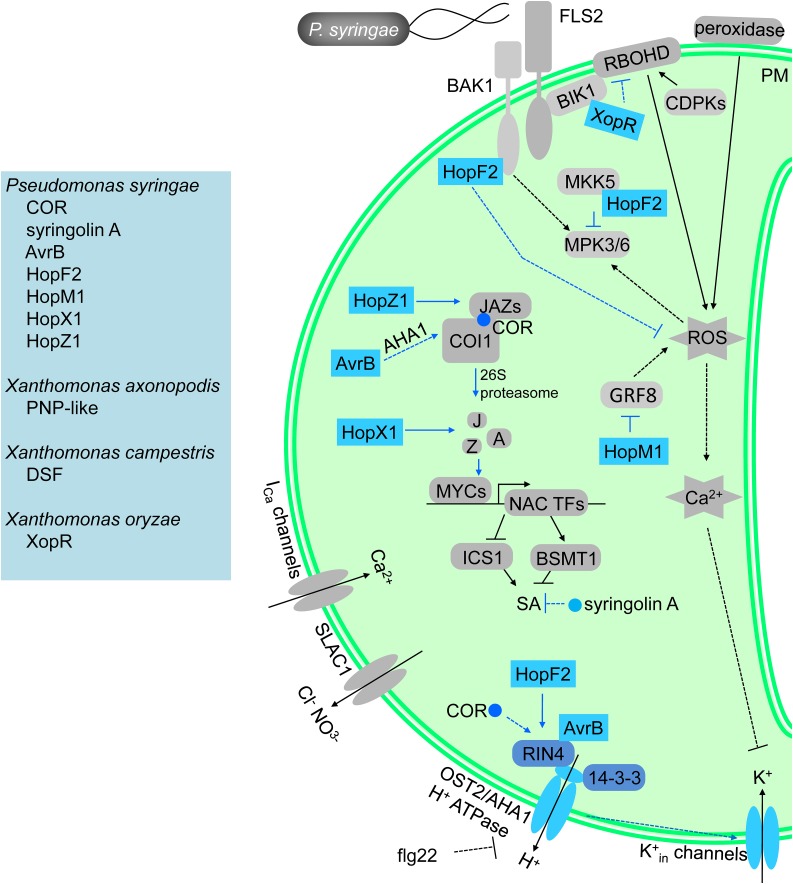
A simplified diagram of microbial virulence factors that manipulate MAMP-induced stomatal closure. NADPH oxidase RBOHD mediates flg22-induced ROS production and stomatal defense through BIK1-/CDPKs-regulated phosphorylation (Feng et al., 2012; Dubiella et al., 2013; Gao et al., 2013; Kadota et al., 2014; Li et al., 2014). Type III peroxidase also contributes to flg22-induced ROS production (Daudi et al., 2012; O’Brien et al., 2012). MAMP-induced stomatal closure includes accumulation of ROS and NO, cytosolic calcium oscillations, activation of S-type anion channels, and inhibition of K+in channels (Klüsener et al., 2002; Melotto et al., 2006; Desikan et al., 2008; Zhang et al., 2008; Zeng and He, 2010; Macho et al., 2012; Montillet et al., 2013). COR induces COI1-JAZ interaction, mediates JAZ degradation, and activates the expression of NAC TFs, which inhibit the expression of ICS1 and induce expression of BSMT1, thereby leading to decreased SA level (Chini et al., 2007; Thines et al., 2007; Yan et al., 2007, 2009; Katsir et al., 2008; Melotto et al., 2008; Sheard et al., 2010; Zheng et al., 2012; Gimenez-Ibanez et al., 2017). COR also may induce stomatal opening through RIN4, which interacts with H+-ATPase AHA1 and AHA2, resulting in induction of K+in channels (Zhang et al., 2008; Liu et al., 2009). Syringolin A inhibits SA signaling via its proteasome inhibitor activity (Misas-Villamil et al., 2013). Multiple bacterial effectors HopM1, HopF2, HopX1, AvrB, HopZ1, and XopR could disrupt stomatal defense. HopM1 disrupts the function of GRF8 (a 14-3-3 protein), resulting in reduction of MAMP-induced ROS production (Lozano- Durán et al., 2014). HopF2 directly targets BAK1, MKK5, and RIN4, resulting in inhibition of ROS production (Wang et al., 2010; Wilton et al., 2010; Hurley et al., 2014; Zhou et al., 2014). AvrB enhances the interaction of RIN4 and AHA1, which could promote the interaction between COI1 and JAZs, leading to stomatal opening (Zhou et al., 2015; Lee et al., 2015). HopX1 and HopZ1 induce stomatal opening after PTI-mediated stomatal closure, through a COI1-independent and COI1-dependent manner, respectively (Jiang et al., 2013; Gimenez-Ibanez et al., 2014; Ma et al., 2015). XopR interacts with BIK1 and suppresses stomatal closure possibly by inhibition of RBOHD (Wang et al., 2016).
References
-
- Allègre M, Daire X, Héloir M-C, Trouvelot S, Mercier L, Adrian M, Pugin A (2007) Stomatal deregulation in Plasmopara viticola-infected grapevine leaves. New Phytol 173: 832–840 - PubMed
-
- Arnaud D, Hwang I (2015) A sophisticated network of signaling pathways regulates stomatal defenses to bacterial pathogens. Mol Plant 8: 566–581 - PubMed
Publication types
MeSH terms
Substances
Grants and funding
LinkOut - more resources
Full Text Sources
Other Literature Sources
