


Investigating the physiological effects of 10.5 Tesla static field exposure on anesthetized swine
- PMID: 28342176
- PMCID: PMC5612859
- DOI: 10.1002/mrm.26672
Investigating the physiological effects of 10.5 Tesla static field exposure on anesthetized swine
Abstract
Purpose: In this work, we investigated the relative effects of static magnetic field exposure (10.5 Tesla [T]) on two physiological parameters; blood pressure (BP) and heart rate (HR).
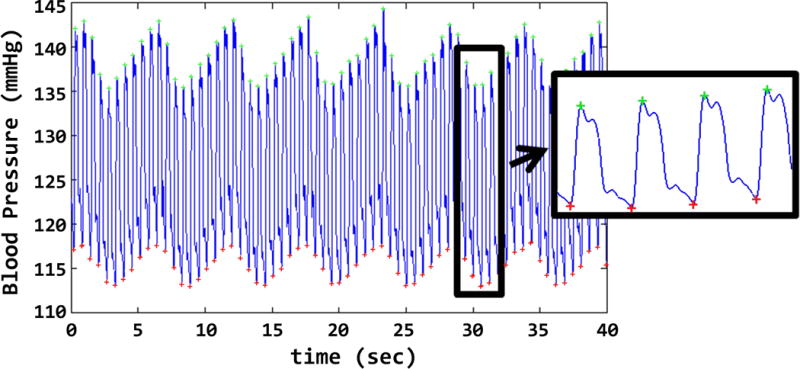
Methods: In vivo, we recorded both BP and HR in 4 swine (3 female, 1 male) while they were positioned within a 10.5T magnet. All measurements were performed invasively within these anesthetized animals by the placement of pressure catheters into their carotid arteries.
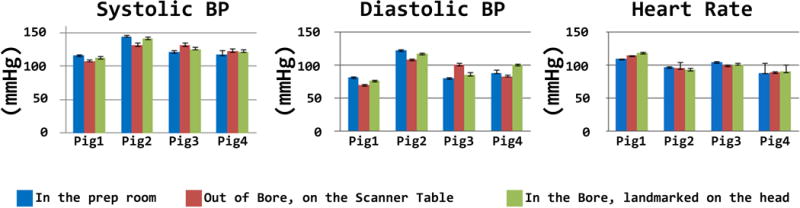
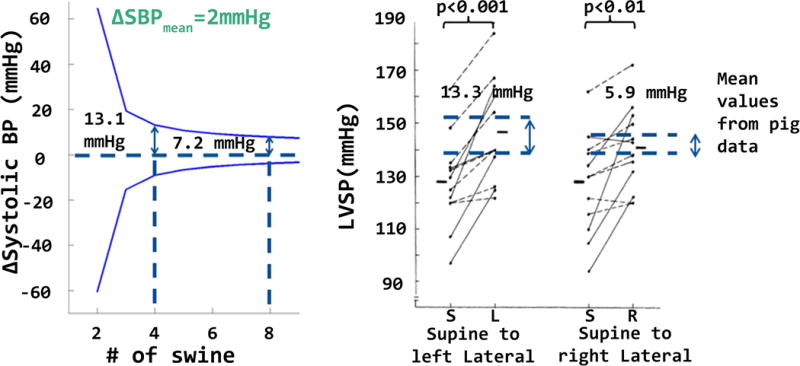
Results: We measured average increases of 2.0 mm Hg (standard deviation [SD], 6.9) in systolic BP and an increase of 4.5 mm Hg (SD, 13.7) in the diastolic BPs: We also noted an average increase of 1.2 beats per minute (SD, 2.5) in the HRs during such.
Conclusion: Data regarding changes in BP and HR in anesthetized swine attributed to whole-body 10.5T exposure are reported. Magn Reson Med 79:511-514, 2018. © 2017 International Society for Magnetic Resonance in Medicine.
Keywords: 10.5T; blood pressure; heart rate; physiological effects; static field exposure.
© 2017 International Society for Magnetic Resonance in Medicine.
Figures
References
-
- Hartmann J. Theory of the laminar flow of an electrically conductive liquid in a homogeneous magnetic field. K Dan Vidensk Selsk Mat Fys Medd. 1937;15(6):1–28.
-
- Hartmann J, Lazarus F. Experimental investigations on the flow of mercury in a homogeneous magnetic field. K Dan Vidensk Selsk Mat Fys Medd. 1937;15(7):1–45.
-
- HIRSCH FG, et al. “THE ELECTRICAL CONDUCTIVITY OF BLOOD” I RELATIONSHIP TO ERYTHROCYTE CONCENTRATION. 1950;5(11):1017–1035. - PubMed
-
- Gaffey CT, et al. A Study of the Influence of Stationary Magnetic-Fields on the Electrocardiographic Indexes and Blood-Pressure of Monkeys. Biophysical Journal. 1982;37(2):A344–A344.
-
- Keltner, et al. Magnetohydrodynamics of Blood Flow. Magn Reson Med. 1990;16:139–149. - PubMed
MeSH terms
Grants and funding
LinkOut - more resources
Full Text Sources
Other Literature Sources
Medical
