


Mutation in TNXB gene causes moderate to severe Ehlers-Danlos syndrome
- PMID: 28344932
- PMCID: PMC5363719
- DOI: 10.5496/wjmg.v6.i2.17
Mutation in TNXB gene causes moderate to severe Ehlers-Danlos syndrome
Abstract
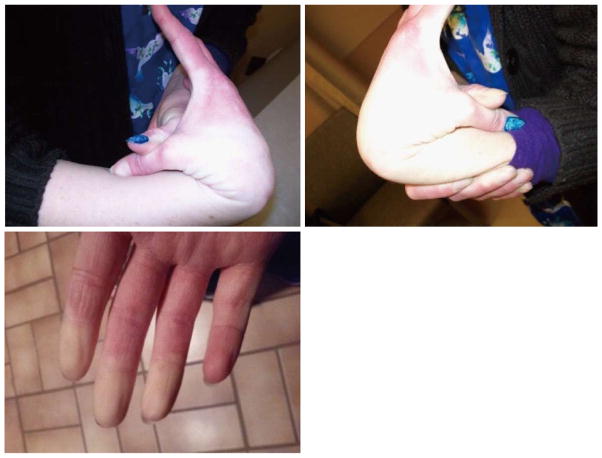
We report a 28-year-old female who presented with severe joint pain, chronic muscle weakness, Raynaud's phenomenon, and hypermobility. She was found to have a 6074A > T nucleotide transition in the TNXB gene causing an amino acid protein change at Asp2025Val classified as likely pathogenic. We add this clinical report to the literature and classical human disease gene catalogs to identify this specific mutation as disease-causing. This gene variant was reported previously in a different 36-year-old patient who shared our patient's symptoms of joint hypermobility, skeletal and joint pain, skin elasticity and musculoskeletal problems, thereby causing a more severe presentation than seen in the hypermobility type of Ehlers-Danlos syndrome (EDS). At the time of writing, a few mutations in the TNXB gene have been recognized as pathogenic causing EDS due to tenascin-X deficiency, but the variant identified in our patient has not been recognized as pathogenic in online genetic databases. Our case study in combination with peer-reviewed literature suggests that the 6074A > T nucleotide transition in the TNXB gene may be classified as disease-causing for EDS due to tenascin-X deficiency.
Keywords: Ehlers-Danlos syndrome; Ehlers-Danlos syndrome due to tenascin-X deficiency; Genetic variants; Hypermobility; Joint pain; Muscle weakness; Mutations; Raynaud’s phenomenon; TNXB; Tenascin-X.
Conflict of interest statement
Conflict-of-interest statement: There are no conflicts of interest.
Figures
References
-
- Online Mendelian Inheritance in Man. Johns Hopkins University; Baltimore, MD: [updated 2014 Aug 26]. Available from: URL: http//omim.org/entry/606408?search=tnxb&highlight=tnxb.
-
- Lee H, Deignan JL, Dorrani N, Strom SP, Kantarci S, Quintero-Rivera F, Das K, Toy T, Harry B, Yourshaw M, Fox M, Fogel BL, Martinez-Agosto JA, Wong DA, Chang VY, Shieh PB, Palmer CG, Dipple KM, Grody WW, Vilain E, Nelson SF. Clinical exome sequencing for genetic identification of rare Mendelian disorders. JAMA. 2014;312:1880–1887. doi: 10.1001/jama.2014.14604. - DOI - PMC - PubMed
-
- Ehlers E. Cutis laxa, neigung zu harmorrhagien in der haut, lockerun mehrer Artikulationen. Dermat Ztschr. 1901;8:173.
Grants and funding
LinkOut - more resources
Full Text Sources
Other Literature Sources
Molecular Biology Databases
Miscellaneous