Review
. 2017 Feb;65(2):85-91.
doi: 10.4103/ijo.IJO_863_16.

Insight into high myopia and the macula

Affiliations
Review

Insight into high myopia and the macula

Atul Kumar et al. Indian J Ophthalmol. 2017 Feb.

Abstract

The incidence of myopia is constantly on the rise. Patients of high myopia and pathological myopia are young and can lose vision due to a number of degenerative changes occurring at the macula. With the emergence of new technologies such as swept-source optical coherence tomography (OCT) and OCT angiography, our understanding of macular pathology in myopia has improved significantly. New conditions such as myopic traction maculopathy have been defined. Early, noninvasive detection of myopic choroidal neovascularization and its differentiation from lacquer cracks is possible with a greater degree of certainty. We discuss the impact of these new exciting and promising technologies and management of macular pathology in myopia. Incorporation of OCT in the microscope has also improved macular surgery. New concepts such as fovea-sparing internal limiting membrane peeling have emerged. A review of literature and our experience in managing all these conditions are discussed.


Conflict of interest statement

There are no conflicts of interest.

Figures
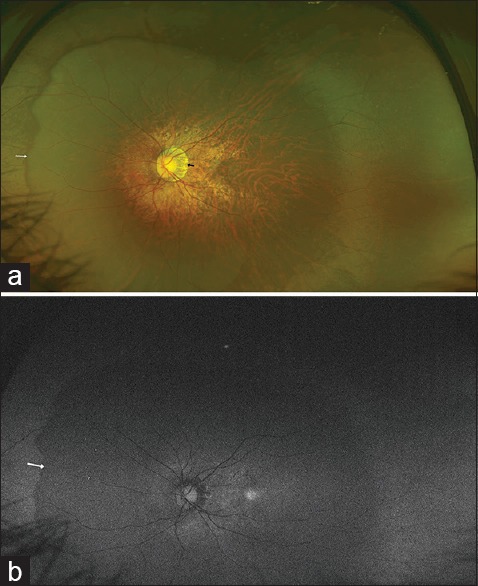
Figure 1
Figure 1
(a) A large myopic conus is seen temporal to the disc (black arrow). A large posterior staphyloma is also evident. The nasal edge of the staphyloma appears as a dark crescent (white arrow). (b) An Optos autofluorescence image of the fundus showing a difference in the autofluorescence signal between the area of the staphyloma and the rest of the peripheral fundus. The white arrow marks the boundary of the staphyloma
Figure 2
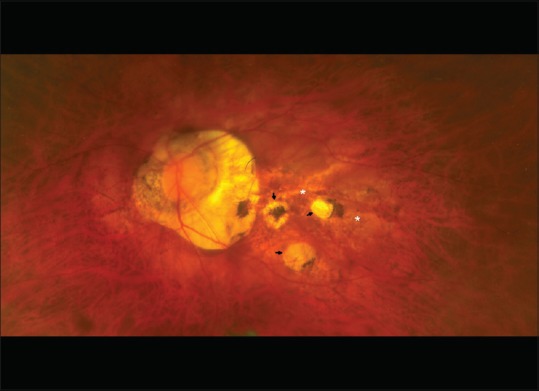
Figure 2
Due to the generalized depigmentation, the entire fundus appears tessellated (tigroid appearance). The areas of generalized atrophy do not have well-defined margins (white asterix). Additional focal areas of atrophy with well-defined margins are also evident (black arrows)
Figure 3
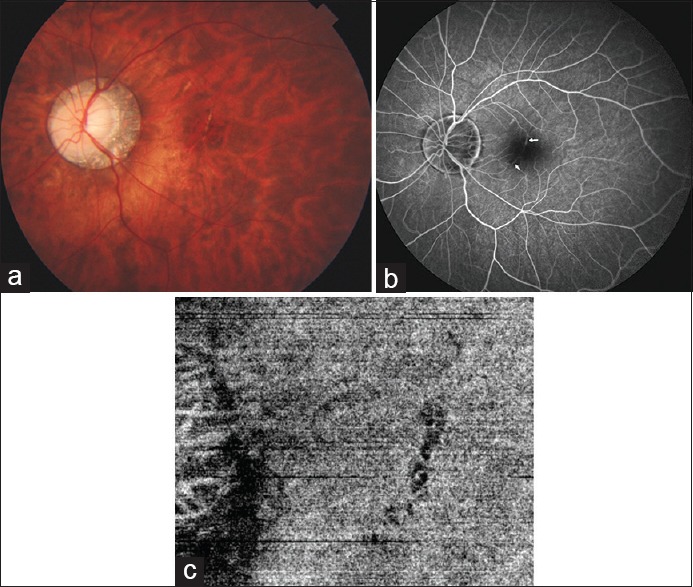
Figure 3
(a) Fundus image showing a well-defined curved hypopigmented line at the fovea suggestive of a lacquer crack. (b) Fundus fluorescein angiogram highlighting the lacquer crack as a hyperfluorescent line (white arrow). (c) Optical coherence tomography angiography image showing the lacquer crack as a black curved line due to lack of flow detected as an area of lack of decorrelation signal
Figure 4
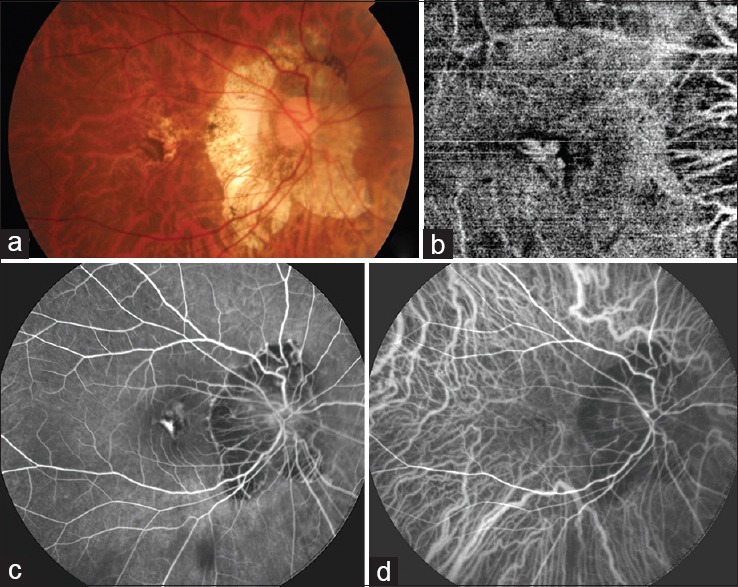
Figure 4
(a) Fundus image of a myopic patient showing a grayish lesion at the fovea with pigmented margins, suggestive of a choroidal neovascular membrane. (b) Optical coherence tomography angiography image of the same patient showing the branching network of vessels of the choroidal neovascular membrane with a surrounding dark halo. (c) Fluorescein angiography showing the hyperfluorescent choroidal neovascular membrane. (d) Indocyanine green angiography also showing the hyperfluorescent choroidal neovascular membrane
Figure 5
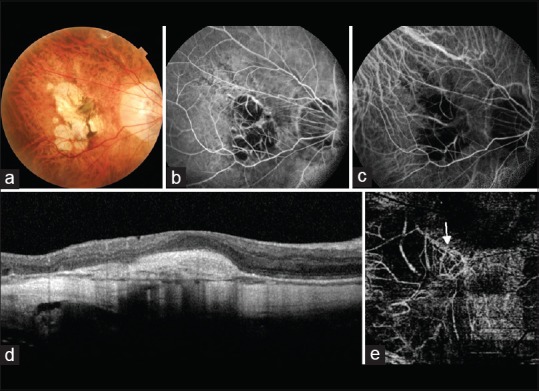
Figure 5
(a) Fundus image of a myopic patient showing a grayish membrane at the fovea clinically suggestive of a choroidal neovascular membrane. (b) The gray membrane appears hyperfluorescent of fundus fluorescein angiography. However, the hyperfluorescence is not as marked as is seen in classic choroidal neovascular membranes. (c) Indocyanine green angiography fails to detect the choroidal neovascular membrane. (d) Optical coherence tomography shows a spindle-shaped hyper-reflective area above the retinal pigment epithelium suggestive of a choroidal neovascular membrane. There is absence of associated subretinal or intraretinal fluid. (e) An abnormal branching network of vessels (white arrow) is visible on the optical coherence tomography angiography image segmented at the deep retinal level. This is suggestive of a Type 2 choroidal neovascular membrane
Figure 6
Figure 6
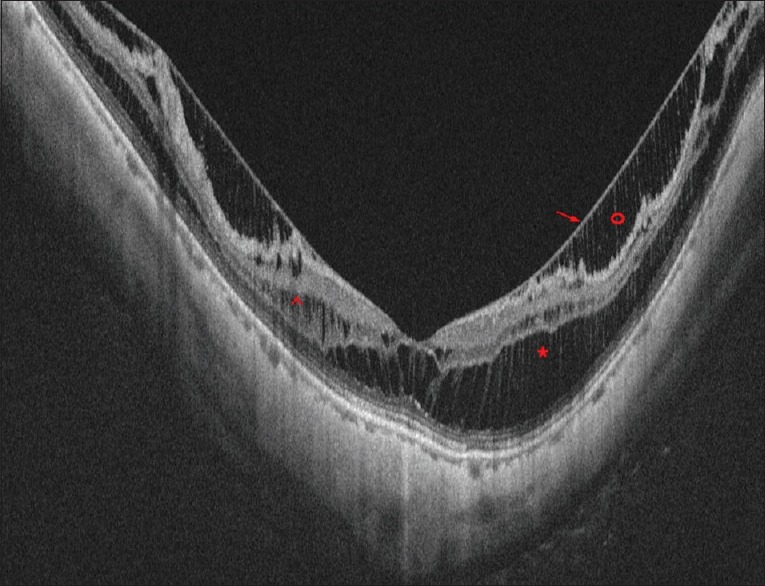
Optical coherence tomography image of a case of myopic maculoschisis with posterior staphyloma. Red * shows the schisis in the outer plexiform layer. Red ^ shows the schisis in the inner nuclear layer. Red o shows the schisis in the nerve fibre layer and the red arrow shows the overlying stretched internal limiting membrane

References

    1. Morgan IG, Ohno-Matsui K, Saw SM. Myopia. Lancet. 2012;379:1739–48. - PubMed
    1. Miller DG, Singerman LJ. Natural history of choroidal neovascularization in high myopia. Curr Opin Ophthalmol. 2001;12:222–4. - PubMed
    1. Hayashi K, Ohno-Matsui K, Shimada N, Moriyama M, Kojima A, Hayashi W, et al. Long-term pattern of progression of myopic maculopathy: A natural history study. Ophthalmology. 2010;117:1595–611. 1611.e1–4. - PubMed
    1. Curtin BJ, Karlin DB. Axial length measurements and fundus changes of the myopic eye. Am J Ophthalmol. 1971;71(1 Pt 1):42–53. - PubMed
    1. Wong TY, Ferreira A, Hughes R, Carter G, Mitchell P. Epidemiology and disease burden of pathologic myopia and myopic choroidal neovascularization: An evidence-based systematic review. Am J Ophthalmol. 2014;157:9–25.e12. - PubMed

MeSH terms