


The cold-induced lipokine 12,13-diHOME promotes fatty acid transport into brown adipose tissue
- PMID: 28346411
- PMCID: PMC5699924
- DOI: 10.1038/nm.4297
The cold-induced lipokine 12,13-diHOME promotes fatty acid transport into brown adipose tissue
Erratum in
-
Corrigendum: The cold-induced lipokine 12,13-diHOME promotes fatty acid transport into brown adipose tissue.Nat Med. 2017 Nov 7;23(11):1384. doi: 10.1038/nm1117-1384b. Nat Med. 2017. PMID: 29117173 Free PMC article.
-
Author Correction: The cold-induced lipokine 12,13-diHOME promotes fatty acid transport into brown adipose tissue.Nat Med. 2026 Jan;32(1):379. doi: 10.1038/s41591-025-04172-x. Nat Med. 2026. PMID: 41484224 No abstract available.
Abstract
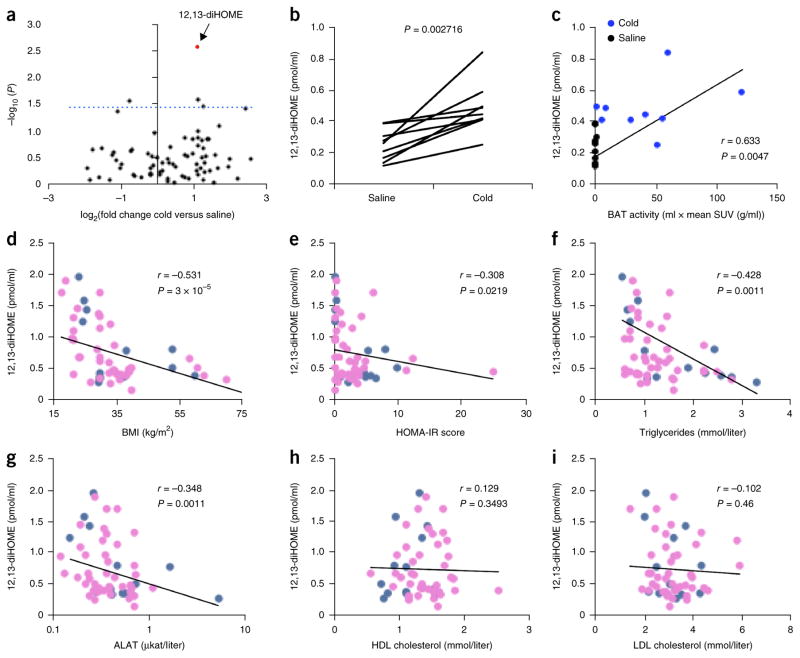
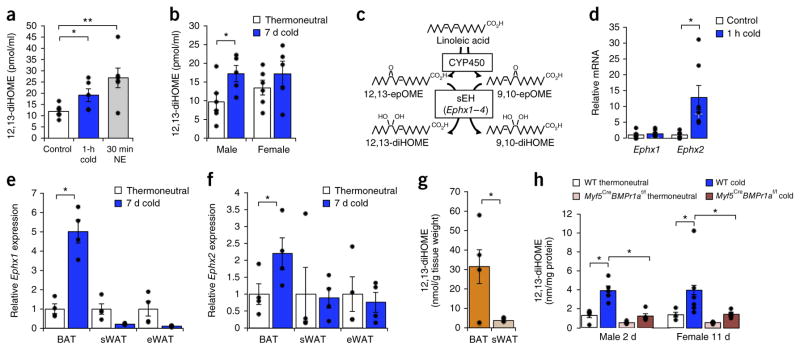
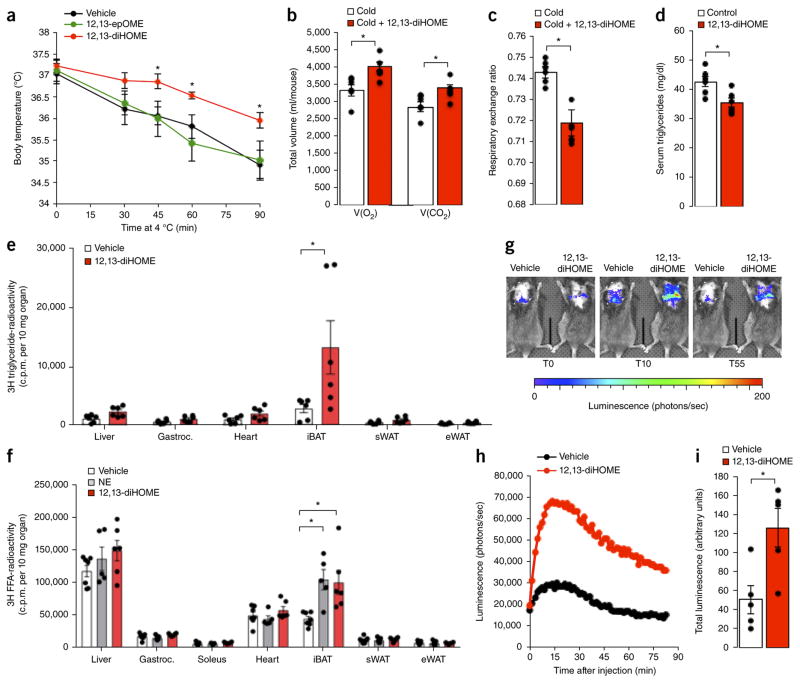
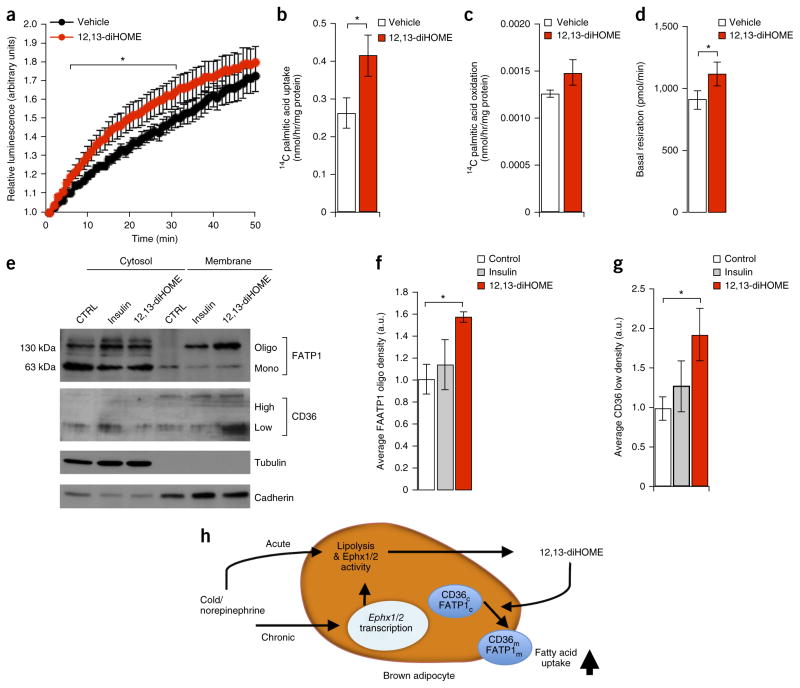
Brown adipose tissue (BAT) and beige adipose tissue combust fuels for heat production in adult humans, and so constitute an appealing target for the treatment of metabolic disorders such as obesity, diabetes and hyperlipidemia. Cold exposure can enhance energy expenditure by activating BAT, and it has been shown to improve nutrient metabolism. These therapies, however, are time consuming and uncomfortable, demonstrating the need for pharmacological interventions. Recently, lipids have been identified that are released from tissues and act locally or systemically to promote insulin sensitivity and glucose tolerance; as a class, these lipids are referred to as 'lipokines'. Because BAT is a specialized metabolic tissue that takes up and burns lipids and is linked to systemic metabolic homeostasis, we hypothesized that there might be thermogenic lipokines that activate BAT in response to cold. Here we show that the lipid 12,13-dihydroxy-9Z-octadecenoic acid (12,13-diHOME) is a stimulator of BAT activity, and that its levels are negatively correlated with body-mass index and insulin sensitivity. Using a global lipidomic analysis, we found that 12,13-diHOME was increased in the circulation of humans and mice exposed to cold. Furthermore, we found that the enzymes that produce 12,13-diHOME were uniquely induced in BAT by cold stimulation. The injection of 12,13-diHOME acutely activated BAT fuel uptake and enhanced cold tolerance, which resulted in decreased levels of serum triglycerides. Mechanistically, 12,13-diHOME increased fatty acid (FA) uptake into brown adipocytes by promoting the translocation of the FA transporters FATP1 and CD36 to the cell membrane. These data suggest that 12,13-diHOME, or a functional analog, could be developed as a treatment for metabolic disorders.
Conflict of interest statement
The authors declare competing financial interests: details are available in the online version of the paper.
Figures
Comment in
-
Adipose tissue: Towards mimicking cold exposure.Nat Rev Endocrinol. 2017 Jun;13(6):316. doi: 10.1038/nrendo.2017.43. Epub 2017 Apr 7. Nat Rev Endocrinol. 2017. PMID: 28387322 No abstract available.
References
-
- Romu T, et al. A randomized trial of cold-exposure on energy expenditure and supraclavicular brown adipose tissue volume in humans. Metabolism. 2016;65:926–934. - PubMed
-
- Schellen L, Loomans MG, de Wit MH, Olesen BW, van Marken Lichtenbelt WD. The influence of local effects on thermal sensation under non-uniform environmental conditions—gender differences in thermophysiology, thermal comfort and productivity during convective and radiant cooling. Physiol Behav. 2012;107:252–261. - PubMed
-
- Hanssen MJ, et al. Short-term cold acclimation improves insulin sensitivity in patients with type 2 diabetes mellitus. Nat Med. 2015;21:863–865. - PubMed
Publication types
MeSH terms
Substances
Grants and funding
LinkOut - more resources
Full Text Sources
Other Literature Sources
Medical
Molecular Biology Databases
