


Comment
doi: 10.1089/thy.2017.0105.
Epub 2017 Mar 27.
TSHR/IGF-1R Cross-Talk, Not IGF-1R Stimulating Antibodies, Mediates Graves' Ophthalmopathy Pathogenesis
Affiliations
- PMID: 28346855
- PMCID: PMC5421635
- DOI: 10.1089/thy.2017.0105
Item in Clipboard
Comment
TSHR/IGF-1R Cross-Talk, Not IGF-1R Stimulating Antibodies, Mediates Graves' Ophthalmopathy Pathogenesis
Thyroid.
2017 May.
No abstract available
Conflict of interest statement
C.C.K., S.N., and M.C.G. have filed a patent pertaining to drug combinations targeting TSHR and IGF-1R.
Figures
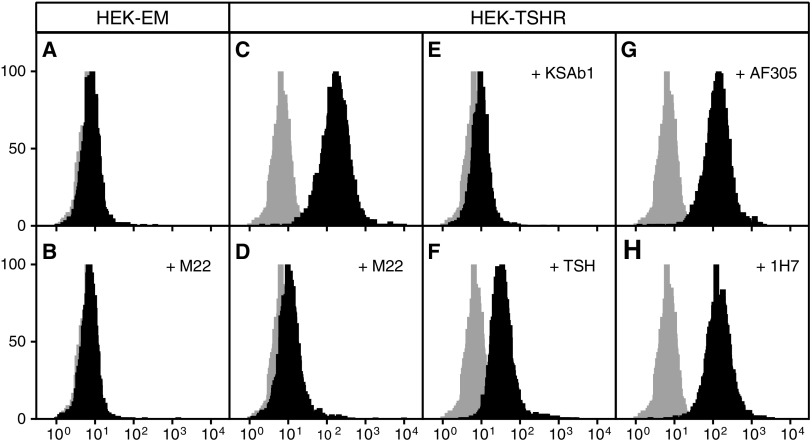
Competitive binding of thyrotropin (TSH) receptor (TSHR) and insulin-like growth factor-1 receptor (IGF-1R) antibodies versus Alexa-M22-647. Binding assays on parental HEK-EM cells that do not express TSHRs but endogenous IGF-1Rs and on HEK-TSHR cells were performed by FACS competitive binding of Alexa-647-M22 by incubating cells with 1:25 ratio of Alexa-647-M22 to unlabeled TSHR antibodies M22 and KSAb1, TSH, and IGF-1R antibodies AF305 and 1H7 and IGF-1. Competing ligands were added at 4°C 15 min prior to the addition of Alexa-647-M22 and incubation for 1 h at 4°C. Gray histograms represent auto-fluorescence. Solid-black histograms show Alexa-647-M22 fluorescence intensity. (A) and (B) Alexa-647-M22 non-specifically bound to HEK-EM cells. (C)–(F) The >10-fold peak shift in Alexa-647 fluorescence in HEK-TSHR cells (C) was markedly reduced by unlabeled TSHR antibodies M22 (D) and KSAb1 (E), and partially reduced by TSH (F). (G) and (H) Anti-IGF-1R antibodies AF305 (G), 1H7 (H), and IGF-1 (not shown) did not reduce peak fluorescence.
Comment in
-
Response to Krieger et al. re: "TSHR/IGF-1R Cross-Talk, Not IGF-1R Stimulating Antibodies, Mediates Graves' Ophthalmopathy Pathogenesis" (Thyroid 2017;27:746-747).Thyroid. 2017 Nov;27(11):1458-1459. doi: 10.1089/thy.2017.0281. Epub 2017 Sep 28. Thyroid. 2017. PMID: 28847224 Free PMC article. No abstract available.
-
Rebuttal to Smith and Janssen (Thyroid 2017;27:746-747. DOI: 10.1089/thy.2017.0281).Thyroid. 2017 Nov;27(11):1459-1460. doi: 10.1089/thy.2017.0472. Epub 2017 Oct 17. Thyroid. 2017. PMID: 28922977 Free PMC article. No abstract available.
Comment on
-
Building the Case for Insulin-Like Growth Factor Receptor-I Involvement in Thyroid-Associated Ophthalmopathy.Front Endocrinol (Lausanne). 2017 Jan 3;7:167. doi: 10.3389/fendo.2016.00167. eCollection 2016. Front Endocrinol (Lausanne). 2017. PMID: 28096798 Free PMC article. Review.
References
Publication types
LinkOut - more resources
Full Text Sources
Other Literature Sources
