Review
. 2015 Jun 9;5(2):1004-1021.
doi: 10.3390/nano5021004.

Antitumor Activities of Metal Oxide Nanoparticles

Affiliations
Review

Antitumor Activities of Metal Oxide Nanoparticles

Maria Pilar Vinardell et al. Nanomaterials (Basel). .

Abstract

Nanoparticles have received much attention recently due to their use in cancer therapy. Studies have shown that different metal oxide nanoparticles induce cytotoxicity in cancer cells, but not in normal cells. In some cases, such anticancer activity has been demonstrated to hold for the nanoparticle alone or in combination with different therapies, such as photocatalytic therapy or some anticancer drugs. Zinc oxide nanoparticles have been shown to have this activity alone or when loaded with an anticancer drug, such as doxorubicin. Other nanoparticles that show cytotoxic effects on cancer cells include cobalt oxide, iron oxide and copper oxide. The antitumor mechanism could work through the generation of reactive oxygen species or apoptosis and necrosis, among other possibilities. Here, we review the most significant antitumor results obtained with different metal oxide nanoparticles.

Keywords: antitumor; cancer therapy; in vitro; in vivo; metal oxide nanoparticles.


Conflict of interest statement

The authors declare no conflict of interest.

Figures
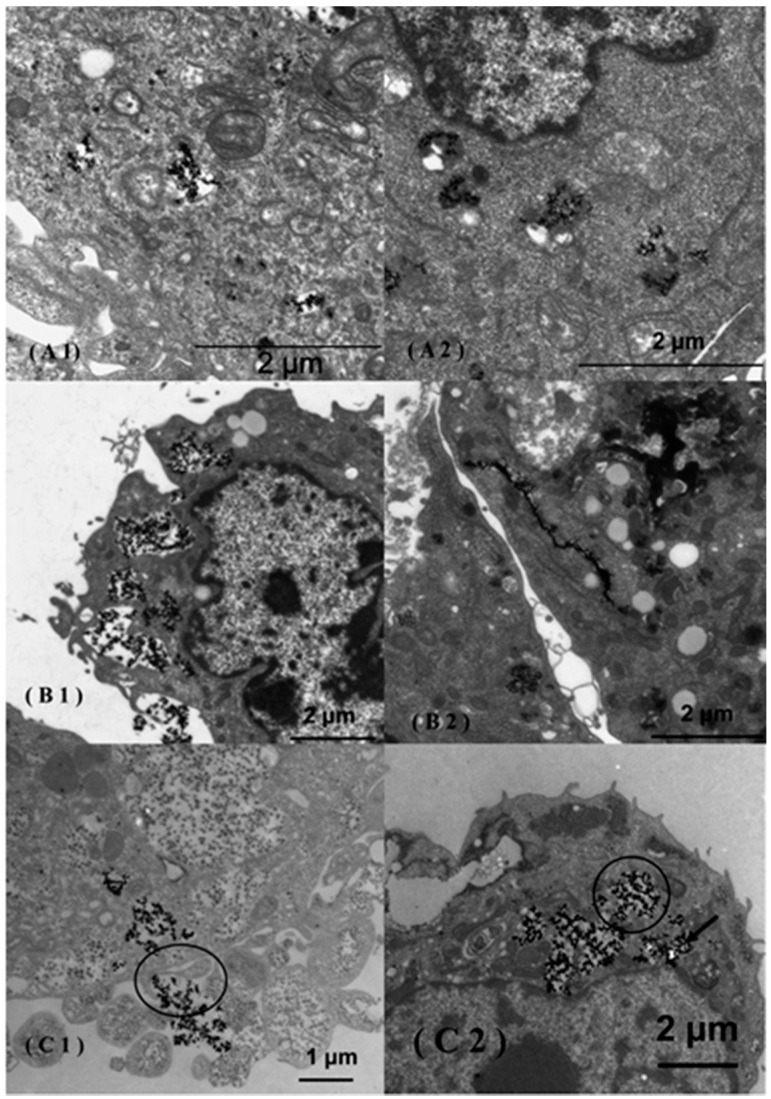
Figure 1
Figure 1
Transmission electron microscopy (TEM) images of MCF-7 (A1,A2), 3T3 (B1,B2) and Caco-2 (C1,C2) cells incubated in the presence of uncoated super-paramagnetic iron oxide NPs (SPIONs). The uncoated SPIONs were internalized via endocytosis in the Caco-2 cells (C1) and afterward released into the cytoplasm (C2). Citrate-coated SPIONs agglomerated in the cytoplasm of MCF-7 cells (A2) and were adsorbed along the endoplasmic reticulum in 3T3 cells (B2). Reproduced with permission from [17]. Copyright 2014, ACS Publications.
Figure 2
Figure 2
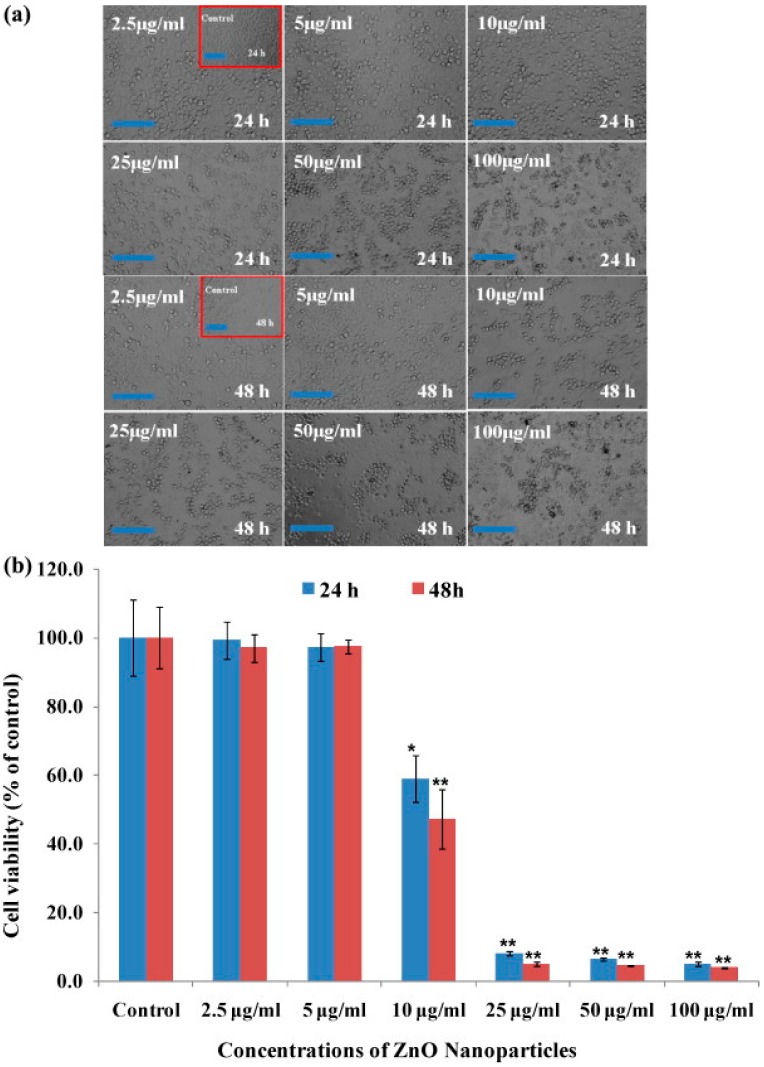
Microscopic images of HepG2 cells after treatment with ZnO NPs and the mitochondrial activity of cells exposed to various concentration of ZnO NPs for 24 and 48 h. The values are the mean ± SD of three independent experiments. * p < 0.01 and ** p < 0.001 vs. the control group (each scale bar = 1 mm). Reproduced with permission from [38]. Copyright 2014, Elsevier.
Figure 3
Figure 3
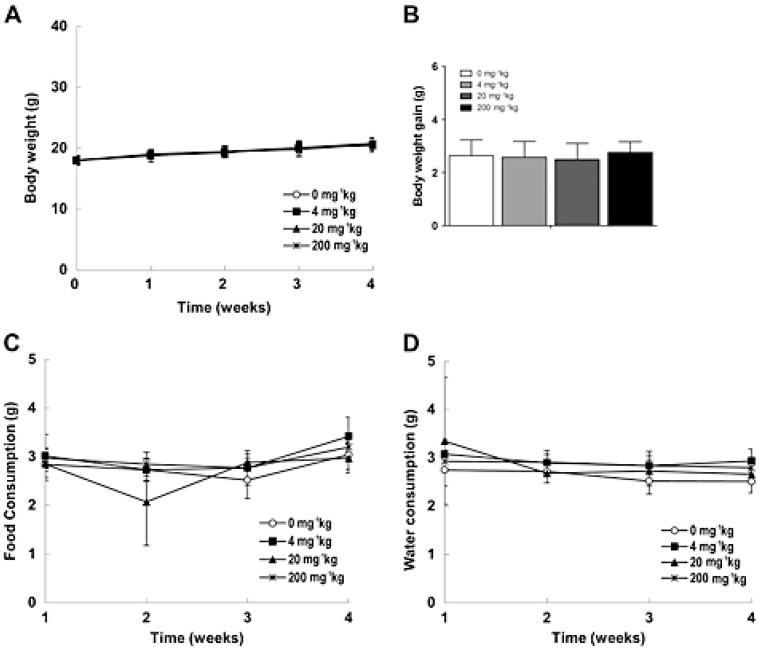
Body weight (A), body weight gain (B), food (C), and water (D) consumption in mice injected with core-shell NPs (CSNPs) for four weeks. Reproduced with permission from [42]. Copyright 2015, John Wiley & Sons, Ltd.
Figure 4
Figure 4
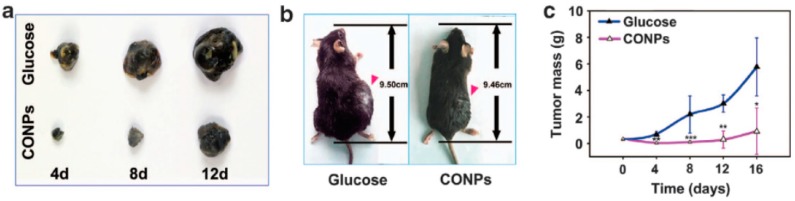
Antitumor effects of copper oxide NP (CONP) therapy on subcutaneous melanoma and metastatic lung tumors. (a) Representative images of stripped subcutaneous tumors; (b) Representative images of mice bearing subcutaneous melanoma from the same study at Day 12; (c) Plot of tumor mass versus time. Reproduced with permission from [54]. Copyright 2015, Associazione Differenziamento e Morte Cellulare.

References

    1. Stewart B., Wild C.P. World Cancer Report 2014. International Agency for Research on Cancer World Health Organization; Lyon, France: 2014. [(accessed on 24 March 2015)]. Available online: http://www.iarc.fr/en/publications/books/wcr/wcr-order.php.
    1. Rasmussen J.W., Martinez E., Louka P., Wingett D.G. Zinc oxide nanoparticles for selective destruction of tumor cells and potential for drug delivery applications. Exp. Opin. Drug Deliv. 2010;7:1063–1077. doi: 10.1517/17425247.2010.502560. - DOI - PMC - PubMed
    1. Felice B., Prabhakaran M.P., Rodríguez A.P., Ramakrishna S. Drug delivery vehicles on a nano-engineering perspective. Mater. Sci. Eng. C. 2014;41:178–195. doi: 10.1016/j.msec.2014.04.049. - DOI - PubMed
    1. Fernandes E., Ferreira J.A., Peixoto A., Lima L., Barroso S., Sarmento B., Santos L.L. New trends in guided nanotherapies for digestive cancers: A systemic review. J. Control Release. 2015;209:288–307. doi: 10.1016/j.jconrel.2015.05.003. - DOI - PubMed
    1. Caputo F., de Nicola M., Ghibelli L. Pharmacological potential of bioactive engineered nanomaterials. Biochem. Pharmacol. 2014;92:112–130. doi: 10.1016/j.bcp.2014.08.015. - DOI - PubMed