


An Investigation of the Cytotoxicity and Caspase-Mediated Apoptotic Effect of Green Synthesized Zinc Oxide Nanoparticles Using Eclipta prostrata on Human Liver Carcinoma Cells
- PMID: 28347066
- PMCID: PMC5304643
- DOI: 10.3390/nano5031317
An Investigation of the Cytotoxicity and Caspase-Mediated Apoptotic Effect of Green Synthesized Zinc Oxide Nanoparticles Using Eclipta prostrata on Human Liver Carcinoma Cells
Abstract
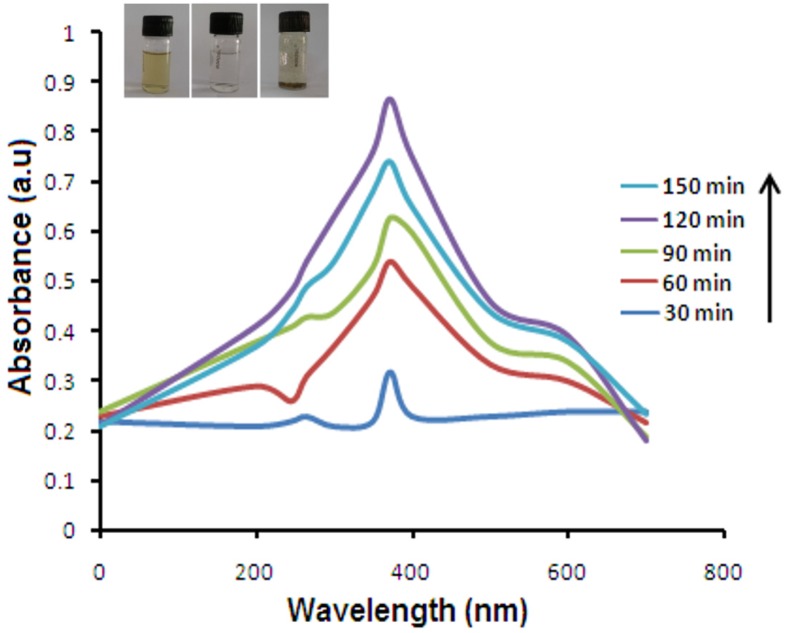
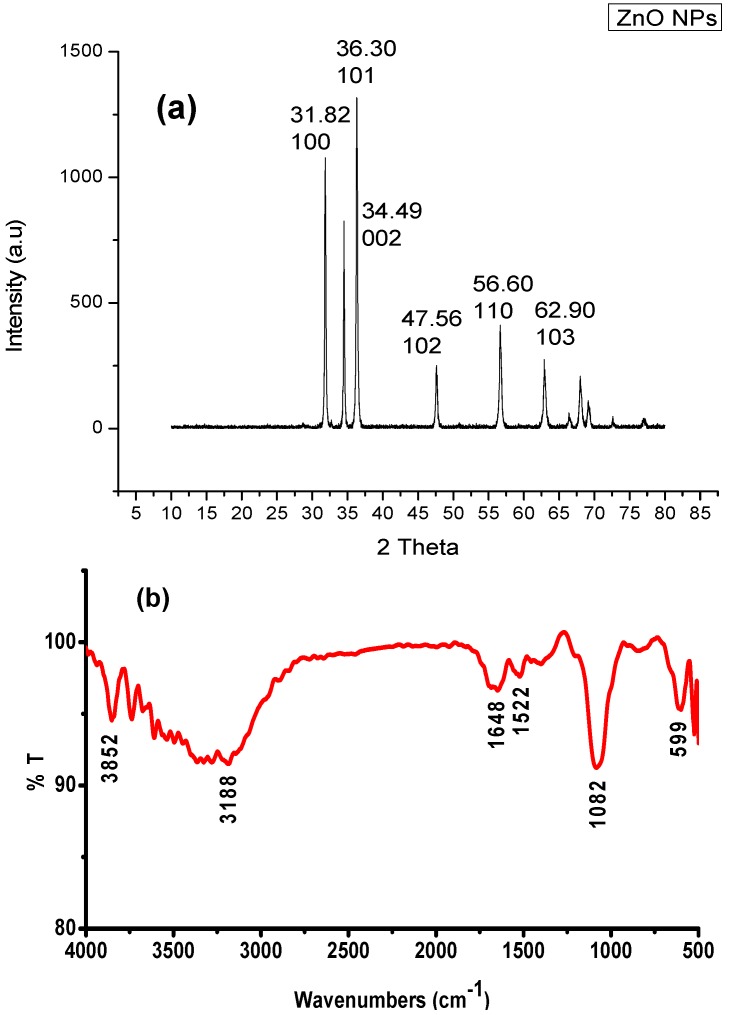
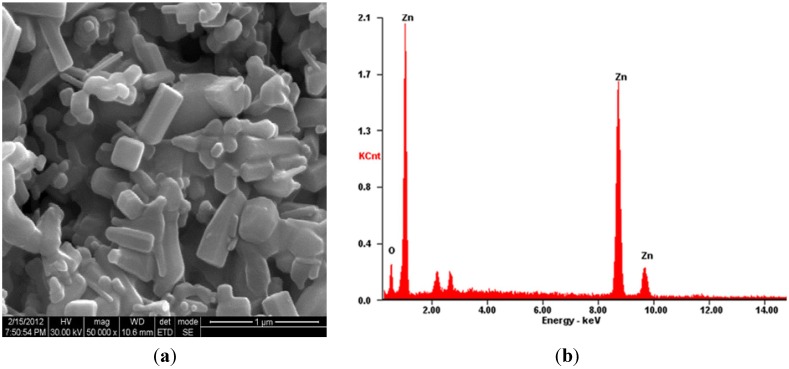
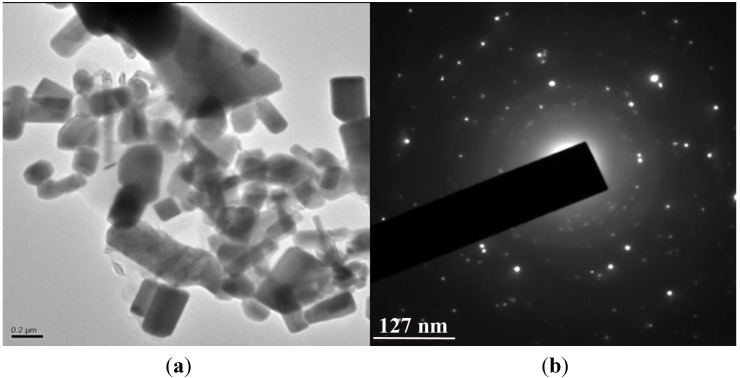
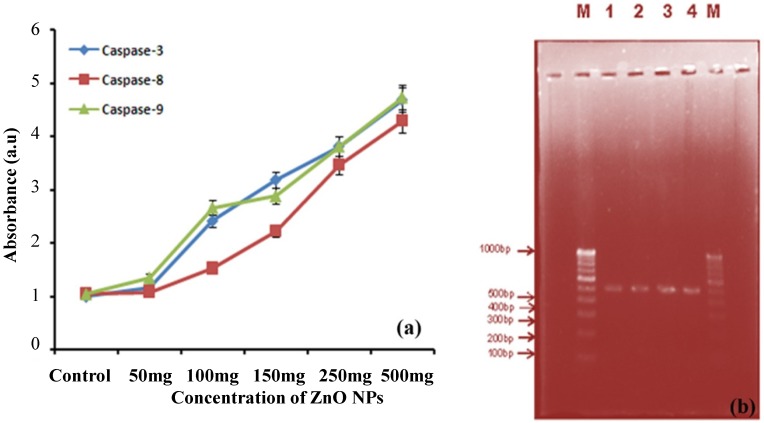
Cancer is a leading cause of death worldwide and sustained focus is on the discovery and development of newer and better tolerated anticancer drugs, especially from plants. In the present study, a simple, eco-friendly, and inexpensive approach was followed for the synthesis of zinc oxide nanoparticles (ZnO NPs) using the aqueous leaf extract of Eclipta prostrata. The synthesized ZnO NPs were characterized by UV-visible absorption spectroscopy, X-ray diffraction (XRD), Fourier transform infrared spectroscopy (FTIR), Scanning electron microscopy with energy dispersive X-ray spectroscopy (SEM-EDX), High-resolution transmission electron microscopy (HRTEM), and Selected area (electron) diffraction (SAED). The HRTEM images confirmed the presence of triangle, radial, hexagonal, rod, and rectangle, shaped with an average size of 29 ± 1.3 nm. The functional groups for synthesized ZnO NPs were 3852 cm-1 for H-H weak peak, 3138 cm-1 for aromatic C-H extend, and 1648 cm-1 for Aromatic ring stretch. The 3-(4,5-Dimethylthiazol-2-yl)-2,5-Diphenyltetrazolium Bromide (MTT), caspase and DNA fragmentation assays were carried out using various concentrations of ZnO NPs ranging from 1 to 100 mg/mL. The synthesized ZnO NPs showed dose dependent cytopathic effects in the Hep-G2 cell line. At 100 mg/mL concentration, the synthesized ZnO NPs exhibited significant cytotoxic effects and the apoptotic features were confirmed through caspase-3 activation and DNA fragmentation assays.
Keywords: Eclipta prostrata; anticancer actions; caspase study; zinc oxide nanoparticles.
Conflict of interest statement
The authors declare no conflict of interest.
Figures
References
-
- Gan D.D., Macaluso M., Cinti C., Khalili K., Giordano A. How does a normal human cell become a cancer cell? J. Exp. Clin. Cancer Res. 2003;22:509–516. - PubMed
-
- Karakosta A., Golias C.H., Charalabopoulos A., Peschos D., Batistatou A., Charalabopoulos K. Genetic models of human cancer as a multistep process: Paradigm models of colorectal cancer, breast cancer, and chronic myelogenous and acute lymphoblastic leukaemia. J. Exp. Clin. Cancer Res. 2005;24:505–514. - PubMed
-
- Eva S., Una F., Afshin S. Caspase-12 and ER-stress-mediated apoptosis: The story so far. Ann. N.Y. Acad. Sci. 2003;1010:186–194. - PubMed
-
- Acharya R.S., Sahoo S.K. Cancer nanotechnology: Application of nanotechnology in cancer therapy. Drug Discov. Today. 2010;15:842–850. - PubMed
LinkOut - more resources
Full Text Sources
Other Literature Sources
Research Materials
