. 2017 Jul:293:27-42.
doi: 10.1016/j.expneurol.2017.03.016. Epub 2017 Mar 25.

BDNF is required for taste axon regeneration following unilateral chorda tympani nerve section

Affiliations

BDNF is required for taste axon regeneration following unilateral chorda tympani nerve section

Lingbin Meng et al. Exp Neurol. 2017 Jul.

Abstract

Taste nerves readily regenerate to reinnervate denervated taste buds; however, factors required for regeneration have not yet been identified. When the chorda tympani nerve is sectioned, expression of brain-derived neurotrophic factor (BDNF) remains high in the geniculate ganglion and lingual epithelium, despite the loss of taste buds. These observations suggest that BDNF is present in the taste system after nerve section and may support taste nerve regeneration. To test this hypothesis, we inducibly deleted Bdnf during adulthood in mice. Shortly after Bdnf gene recombination, the chorda tympani nerve was unilaterally sectioned causing a loss of both taste buds and neurons, irrespective of BDNF levels. Eight weeks after nerve section, however, regeneration was differentially affected by Bdnf deletion. In control mice, there was regeneration of the chorda tympani nerve and taste buds reappeared with innervation. In contrast, few taste buds were reinnervated in mice lacking normal Bdnf expression such that taste bud number remained low. In all genotypes, taste buds that were reinnervated were normal-sized, but non-innervated taste buds remained small and atrophic. On the side of the tongue contralateral to the nerve section, taste buds for some genotypes became larger and all taste buds remained innervated. Our findings suggest that BDNF is required for nerve regeneration following gustatory nerve section.

Keywords: BDNF; Nerve regeneration; Neurotrophins; Sensory; Taste; Taste bud.


Figures

Figure 1
Figure 1
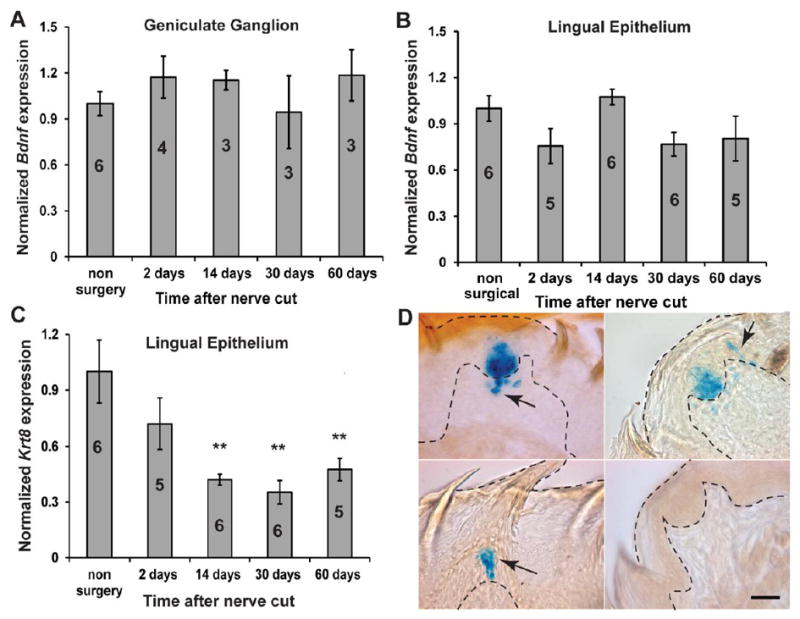
Bdnf continues to be expressed in the geniculate ganglion and lingual epithelium after chorda tympani nerve section, while expression of the taste bud marker, cytokeratin 8 (Krt8), is decreased. Bdnf mRNA expression levels (normalized to non-surgical controls) as determined by qRT-PCR did not change 2, 14, 30, or 60 days after nerve section in the geniculate ganglion (A) and the lingual epithelium (B). In contrast, Krt8 expression levels (normalized to non-surgical controls) in the epithelium decreased 14, 30 and 60 days after nerve section (C). Numbers in each bar are the number of animals contributing to each data point. These findings are consistent with loss and recovery of taste buds following nerve section, with no loss of Bdnf expression, possibly because Bdnf expression is not limited to taste buds. (D) We observed Bdnf expression in both taste and non-taste cells in the tongue. Dashed lines illustrate the border between the laminia propria and th epithelium and also the tongue surface. In a fungiform papilla from a BdnfLacz/+ mouse, the ß-galactosidase reaction product can be seen in the taste bud and in the lamina propria ventral to the taste bud (top left arrow) and immediately adjacent to the taste bud (top right arrow). Occasionally, the ß-galactosidase reaction product was observed in the filiform epithelium of BdnfLacz/+ mice, but never in wild-type mice (D, bottom right). **p<0.01.
Figure 2
Figure 2
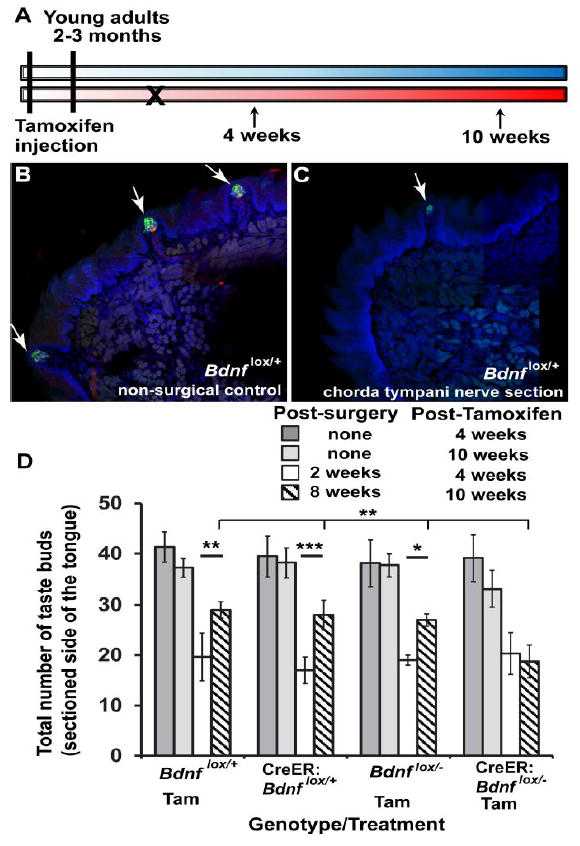
Bdnf deletion did not affect taste bud loss 2 weeks after chorda tympani nerve section, but slowed or prevented recovery of taste bud number 8 weeks after nerve section. Experimental timeline (A) for non-surgical controls (blue) and chorda tympani nerve-sectioned mice (red). Tissues were collected 4 and 10 weeks after tamoxifen (Tam) administration, corresponding to 2 and 8 weeks after chorda tympani nerve section. The total number of taste buds (arrows) were quantified in serial sections on the sectioned side of the tongue in four genotypes following tamoxifen injection, coupled with either no surgery (B, Bdnflox/+) or chorda tympani nerve section (C, Bdnflox/+, 2 weeks after section). Two weeks after nerve section (D), the number of taste buds decreased by half in mice of all four genotypes (Bdnflox/+, CreER:Bdnf lox/+, Bdnflox/-, CreER:Bdnflox/-, all n=3) compared with non-surgical controls 4 (n=3) and 10 weeks (n=4) after tamoxifen treatment. Eight weeks after nerve section, taste buds returned in Bdnflox/+, CreER:Bdnflox/+, and Bdnflox/- mice, but not in CreER:Bdnf lox/- mice (all n=3). There was no significant difference in Bdnf expression level between the three control genotypes. These data demonstrate that normal Bdnf levels are required for taste bud number to recover following nerve section. *p<0.05, **p<0.01, ***p<0.001.
Figure 3
Figure 3
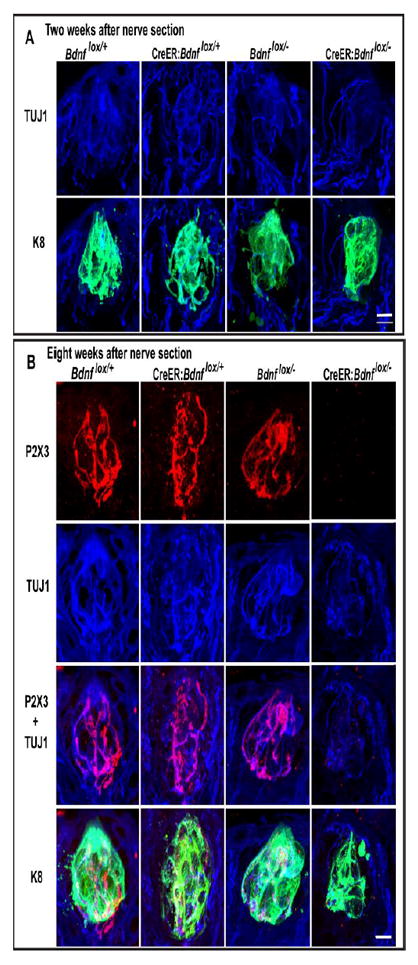
Remaining taste buds lost most of their innervation 2 weeks after chorda tympani nerve section (A). For all genotypes, 2 weeks after chorda tympani nerve section, some TUJ1-positive fibers (blue), but no P2X3-positive fibers, were present in the remaining taste buds identified by staining with cytokeratin 8 (K8, green). There was no obvious difference among the four groups in the amount of remaining TUJ1-positive innervation following nerve section. Eight weeks after nerve section, both P2X3- and TUJ1-labeled nerve fibers were present in many taste buds of control genotypes (B), indicating that reinnervation had occurred. Few taste buds in Bdnf-deleted mice (CreER:Bdnf lox/-), however, had P2X3-positive innervation and TUJ1-positive innervation also appears to have diminished, indicating that reinnervation was prevented or delayed by Bdnf deletion. Scale bar=10 μm and applies to all panels.
Figure 4
Figure 4
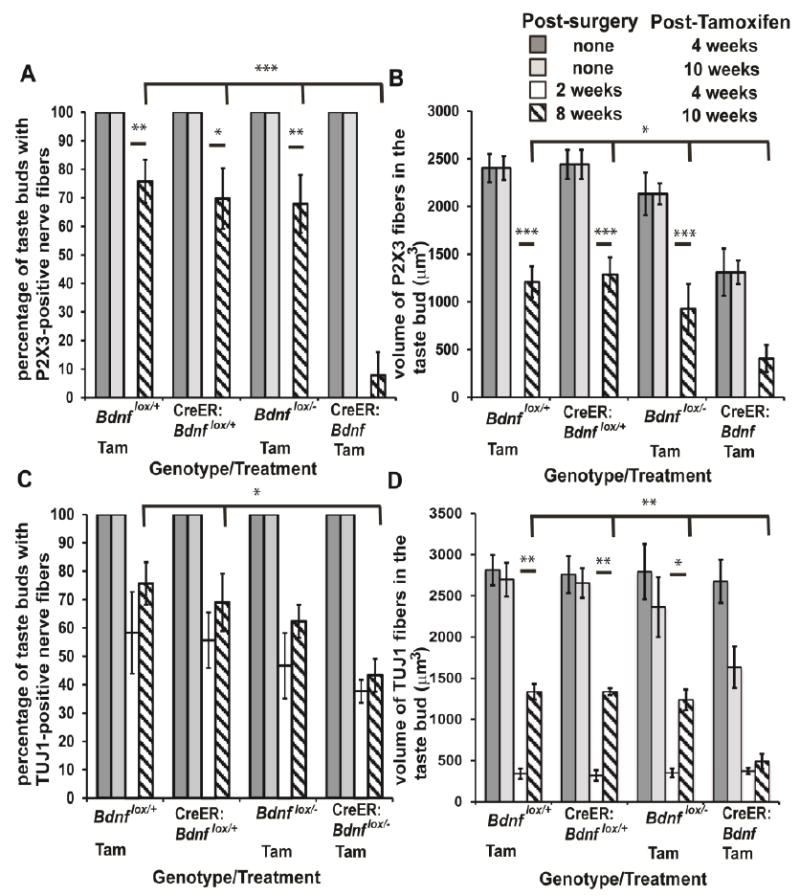
Bdnf deletion prevented taste bud reinnervation after chorda tympani nerve section. In non-surgical controls (4 weeks post-tamoxifen, n=3 each genotype; 10 weeks post-tamoxifen, n=4 each genotype), all taste buds contained P2X3-positive fibers (A). Two weeks after section, taste buds in all genotypes lost P2X3-positive fibers (n=3 each genotype). Eight weeks after section, the percentage of taste buds reinnervated by P2X3-labeled nerve fibers increased in mice expressing Bdnf (Bdnflox/+, CreER:Bdnflox/+, Bdnflox/- , all n=3), but few taste buds regained P2X3-positive innervation when Bdnf was deleted (CreER:Bdnf lox/-, n=3) (A). Furthermore, the volume of P2X3-positive fibers was much lower in the few taste buds that regained innervation in CreER:Bdnf lox/- mice (B, n=4) compared with taste buds from the three other genotypes. There was no difference in P2X3 labeling among the three control genotypes (B). As with P2X3-positive fibers, all taste buds contained TUJ1-positive fibers in the absence of injury (C, Bdnflox/+ n=3, CreER:Bdnflox/+ n=3, Bdnflox/- n=3, CreER:Bdnf ox/- n=4).Two weeks after nerve section, only 50% of the taste buds contained TUJ1-positive fibers in mice of all four genotypes (n=3 each genotype). Eight weeks after chorda tympani nerve section, none of the groups had significantly more TUJ1-positive innervation of taste buds (C). Each of the three control genotypes (Bdnflox/+, CreER:Bdnflox/+, Bdnflox/-, all n=3) regained more TUJ1-positive fibers per taste bud than did mice lacking Bdnf (CreER:Bdnflox/- n=3), which failed to regain TUJ1-positive innervation (D). *p<0.05, **p<0.01, ***p<0.001.
Figure 5
Figure 5
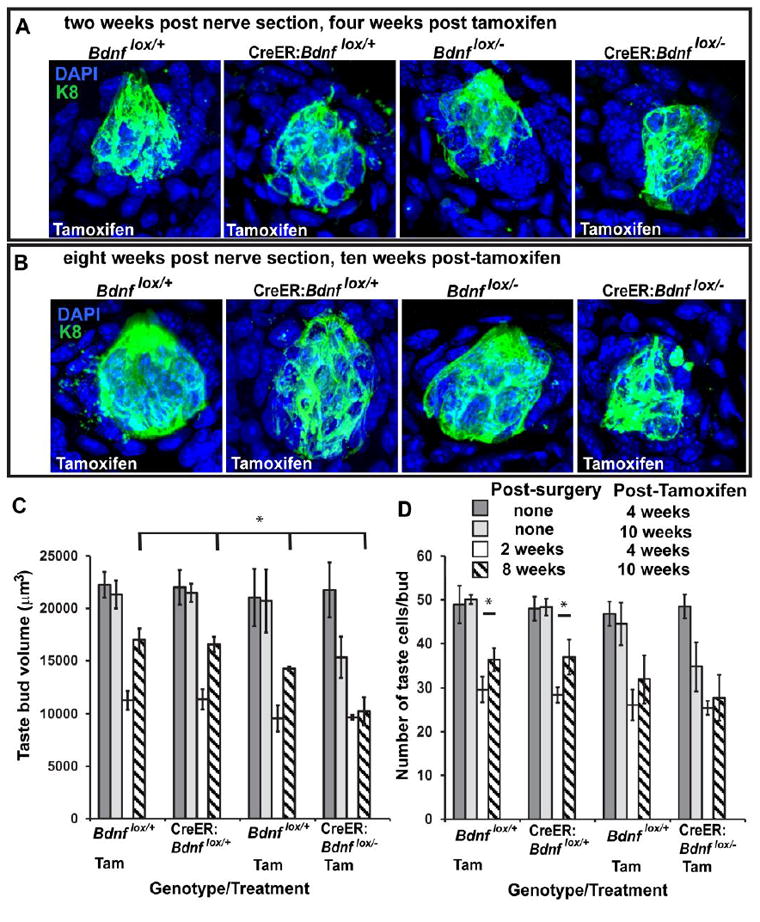
Recovery of taste bud size concurrent with nerve regeneration is BDNF-dependent. Confocal images of taste buds (cytokeratin 8, green) and taste cells (DAPI, blue) in control genotypes (Bdnflox/+, CreER:Bdnflox/+, Bdnflox/-) and in mice with reduced Bdnf expression (CreER:Bdnflox/-) 2 (A) and 8 weeks (B) after chorda tympani nerve section. (C) Two weeks after section, the remaining taste buds were smaller than taste buds from non-surgical controls in all genotypes (p=0.001, Bdnflox/+, CreER:Bdnflox/+, Bdnflox/-, CreER:Bdnflox/-, all n=3). Eight weeks after section, taste bud volumes partially recovered in the three control genotypes (Bdnflox/+ p=0.001, CreER:Bdnflox/+ p=0.001, Bdnflox/- p=0.001, all n=3), but not in mice with reduced Bdnf expression (CreER:Bdnflox/- n=3, p=0.698). The reduction in taste bud size following nerve section is presumably due to a loss of cells in the taste bud, because 2 weeks after nerve section, the remaining taste buds lost nearly 40% of their taste cells (p=0.004), with no significant differences in this respect among the four genotypes (D). Eight weeks after nerve section, mice with normal Bdnf expression (Bdnflox/+ n=3, p=0.016; CreER:Bdnflox/+ n=3, p=0.009) had more taste cells per bud than at 2 weeks after section, while mice with deleted Bdnf (Bdnflox/- n=3, p=0.11; CreER:Bdnflox/- n=3, p=0.431) did not display a similar recovery. Scale bar=10 μm and applies to all panels in A, B. *p<0.05.
Figure 6
Figure 6
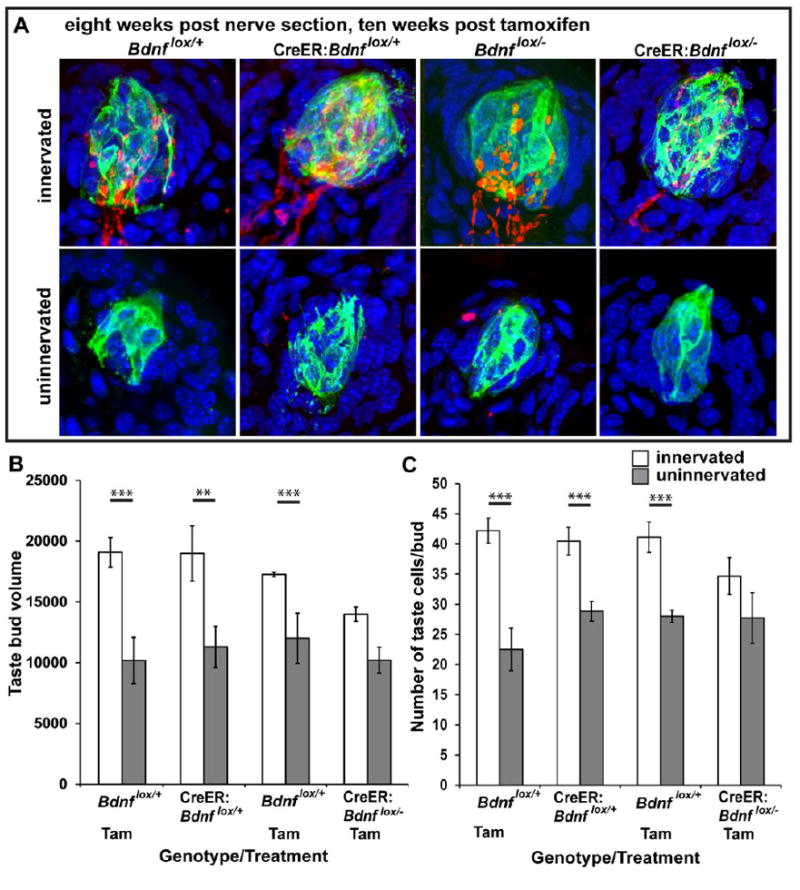
Innervated taste buds are larger than non-innervated taste buds. All genotypes had both P2X3 (red) innervated (A, top) and non-innervated taste buds (A, bottom, taste = green, keratin 8, blue = DAPI for cell nuclei), albeit there were only three taste buds that regained innervation in a single animal lacking BDNF (CreER:Bdnflox/-). We compared the sizes of innervated versus non-innervated taste buds 8 weeks after nerve section to determine whether recovery of taste bud size is associated with reinnervation. Taste buds that were reinnervated had larger volumes than those that remained non-innervated (B). This difference in size appears to be due to differences in the number of cells per taste bud in innervated versus non-innervated taste buds (C). Scale bar=10 μm and applies to all panels in A. **p<0.01, ***p<0.005.
Figure 7
Figure 7
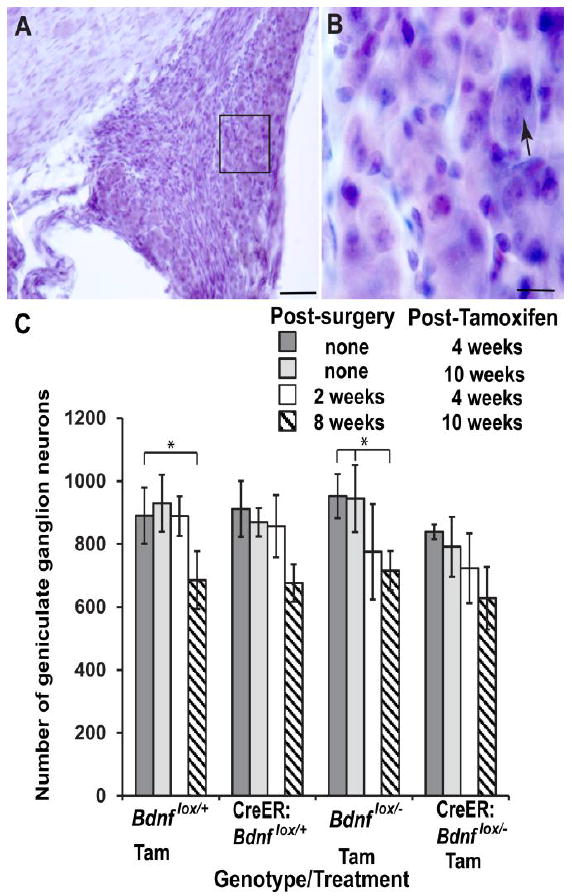
BDNF does not affect geniculate ganglion neuronal loss following chorda tympani nerve section. We counted Nissl-stained geniculate ganglion neurons using stereological methods. (A) Thick (50μm) section through the triangular-shaped geniculate ganglion stained for nissl substance, because of the section thickness neurons are both in and out of the plane of focus. (B) Pale neurons (arrow) were easily distinguished from the dark nuclei of satellite cells. Neurons were only counted when the whole neuron (top and bottom) was present in the 50-μm thick sections, such that whole neurons were quantified in a given volume of ganglion. While some geniculate ganglion neurons were lost 8 weeks after nerve section (C), this loss was not related to BDNF levels. Therefore, the failure of the chorda tympani nerve to regenerate following nerve section in mice lacking BDNF was not due to a loss of neurons. Scale bar=50 μm in A and 10 μm in B. *p<0.05.
Figure 8
Figure 8
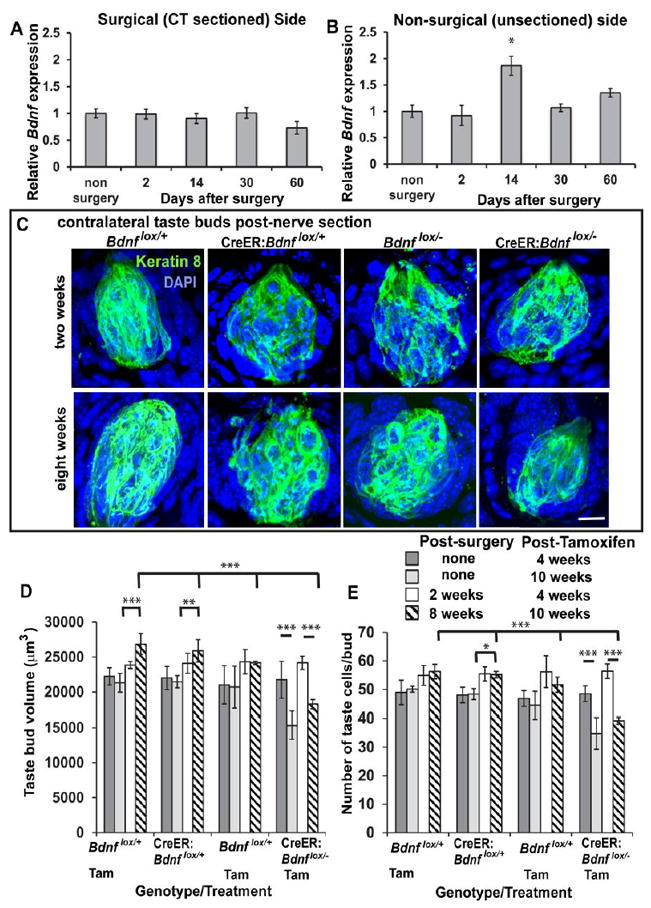
Taste buds on the unsectioned side of the tongue increase in size in the presence of BDNF, but decrease in size when BDNF is reduced. Following unilateral chorda tympani nerve section, there was no change in Bdnf expression in the epithelium on the side contralateral to nerve section (A). The contralateral geniculate ganglion, however, displayed a significant increase in Bdnf mRNA expression levels14 days after section (B), suggesting that it may mediate plasticity on the contralateral side. Taste buds on the contralateral side appeared larger (C) and increased in volume (D) in Bdnflox/+ (n=3) and CreER:Bdnflox/+ (n=3) mice 8 weeks after nerve section compared with Bdnflox/+ (n=4) and CreER:Bdnflox/+ (n=4) mice that only received tamoxifen for the same length of time. Taste buds on the contralateral side decreased in size with Bdnf deletion (CreER:Bdnflox/- n=3) 10 weeks after tamoxifen administration regardless of whether the contra-lateral nerve had been sectioned. They also did not show an increase in either taste bud volume (D) or cell number (E), compared with non-surgical controls (n=4). While the decrease in taste bud size following Bdnf removal is due to a loss of cells within the bud (E), the increase in taste bud size on the uncut side of the tongue when Bdnf levels are normal may not be due to a change in cell number. Scale bar =10 μm and applies to all images in C. *p<0.05, ** p<0.01, ***p<0.001.
Figure 9
Figure 9
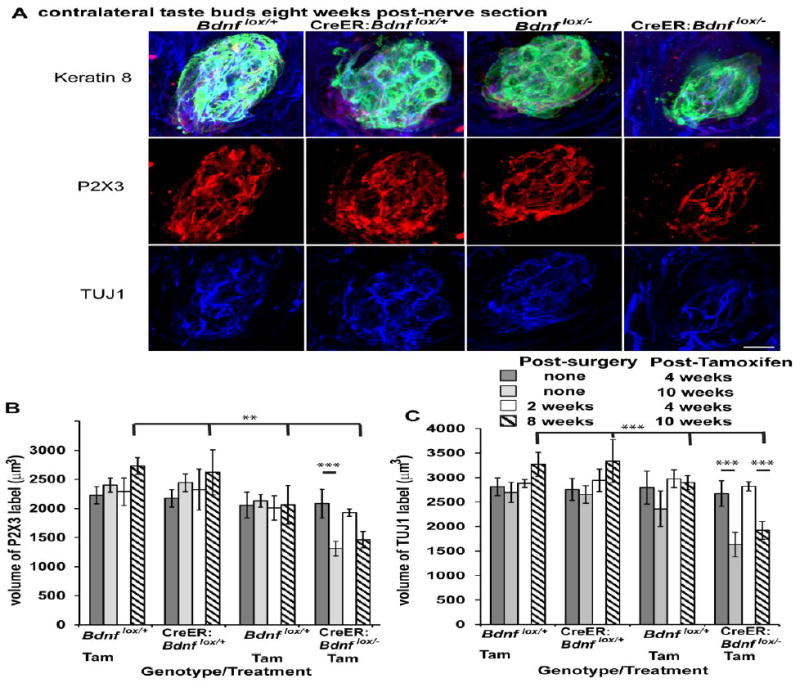
Bdnf deletion results in a loss of innervation on the contralateral side after unilateral chorda tympani nerve section. Eight weeks after nerve section, taste buds on the contralateral side in mice lacking normal Bdnf appeared smaller and showed reduced innervation (A). The volume of P2X3-positive innervation decreased on the contralateral side in mice lacking Bdnf (CreER:Bdnflox/- n=3) compared with the three control genotypes (Bdnflox/+ p<0.001, CreER:Bdnflox/+, p<0.001, Bdnflox/-, p=0.01, n=3 all genotypes). This finding was corroborated by a reduction in the TUJ1-positive volume of innervation in the same animals (p<0.001 for all genotypes). There was no consistent significant increase in innervation on the contralateral side compared with non-surgical controls in control genotypes (B, C). Therefore, the increase in taste bud size cannot be explained by an increase in innervation.

Similar articles

Cited by

References

    1. Angeletti PU, Levi-Montalcini R, Caramia F. Analysis of the effects of the antiserum to the nerve growth factor in adult mice. Brain Res. 1971;27:343–355. - PubMed
    1. Biggs BT, Tang T, Krimm RF. Insulin-Like Growth Factors Are Expressed in the Taste System, but Do Not Maintain Adult Taste Buds. PloS one. 2016;11:e0148315. - PMC - PubMed
    1. Cain P, Frank ME, Barry MA. Recovery of chorda tympani nerve function following injury. Exp Neurol. 1996;141:337–346. - PubMed
    1. Castillo D, Seidel K, Salcedo E, Ahn C, de Sauvage FJ, Klein OD, Barlow LA. Induction of ectopic taste buds by SHH reveals the competency and plasticity of adult lingual epithelium. Development. 2014;141:2993–3002. - PMC - PubMed
    1. Cheal M, Dickey WP, Jones LB, Oakley B. Taste fiber responses during reinnervation of fungiform papillae. J Comp Neurol. 1977;172:627–646. - PubMed

Publication types

MeSH terms