Review
. 2018 Feb 1;10(2):a031989.
doi: 10.1101/cshperspect.a031989.

Bone Morphogenetic Proteins in Vascular Homeostasis and Disease

Affiliations
Review

Bone Morphogenetic Proteins in Vascular Homeostasis and Disease

Marie-José Goumans et al. Cold Spring Harb Perspect Biol. .

Abstract

It is well established that control of vascular morphogenesis and homeostasis is regulated by vascular endothelial growth factor (VEGF), fibroblast growth factor (FGF), Delta-like 4 (Dll4), angiopoietin, and ephrin signaling. It has become clear that signaling by bone morphogenetic proteins (BMPs), which have a long history of studies in bone and early heart development, are also essential for regulating vascular function. Indeed, mutations that cause deregulated BMP signaling are linked to two human vascular diseases, hereditary hemorrhagic telangiectasia and pulmonary arterial hypertension. These observations are corroborated by data obtained with vascular cells in cell culture and in mouse models. BMPs are required for normal endothelial cell differentiation and for venous/arterial and lymphatic specification. In adult life, BMP signaling orchestrates neo-angiogenesis as well as vascular inflammation, remodeling, and calcification responses to shear and oxidative stress. This review emphasizes the pivotal role of BMPs in the vascular system, based on studies of mouse models and human vascular disorders.


Figures

Figure 1.
Figure 1.
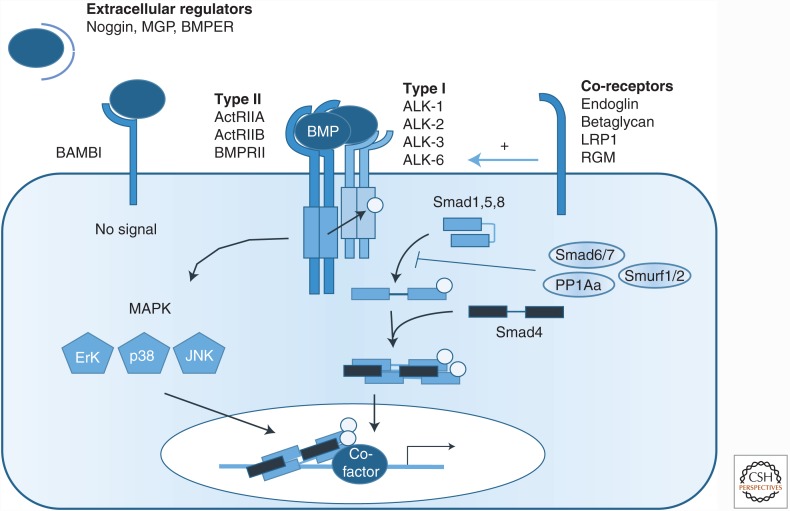
Bone morphogenetic protein (BMP) signaling pathway. Schematic representation of the BMP signaling pathway. BMPs interact with specific type I and type II receptors to form a heterotetrameric complex. Complex formation and ligand binding can be potentiated by a coreceptor—that is, endoglin, betaglycan, lipoprotein receptor-related protein 1 (LRP-1), or repulsive guidance molecule (RGM). After complex formation, the type II receptor phosphorylates the type I receptor, which then carboxy-terminally phosphorylates Smad1, Smad5, and Smad8 (canonical BMP signaling). Phosphorylated Smads propagate the signal via complex formation with Smad4, translocation into the nucleus, and regulation of the expression of target genes. Besides Smad-dependent signaling, BMPs can also transduce signals by mitogen-activated proteins kinases (MAPKs) (noncanonical BMP signaling). Canonical BMP signaling is intracellularly inhibited by inhibitory Smads—that is, Smad6 and/or Smad7, E3 ubiquitin ligases, such as Smurf1 or Smurf2, or phosphatases (PPA1α). BMPs are extracellularly inhibited from binding to the receptor complex by secreted inhibitors, like noggin, matrix Gla protein (MGP), and the decoy receptor BAMBI. BMP signaling can be extracellularly stimulated or inhibited by BMPER.
Figure 2.
Figure 2.
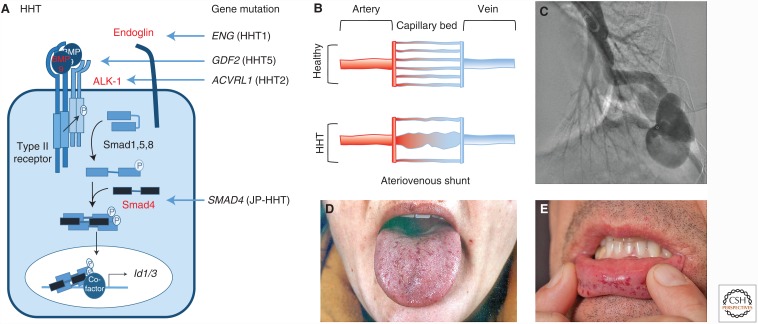
Mutations in bone morphogenetic protein (BMP) signaling components result in hereditary hemorrhagic telangiectasia (HHT). (A) The genetic vascular disorder HHT, also known as the Osler–Weber–Rendu syndrome, is linked to mutations (shown in red) in the ENG gene, which encodes the coreceptor endoglin (HHT1), ACVRL1, which encodes the activin receptor-like kinase (ALK)-1 type I receptor (HHT2), GDF2, which encodes BMP-9 (HHT5), and SMAD4 (juvenile polyposis [JP]-HHT). (B) Mutations in these genes result in disturbed endothelial cell (EC) growth and specification, the development of tortuous fragile vessels, and loss of arterial venous specification that lead to arteriovenous shunts (AVMs). (C,D) Typical features of the disease are pulmonary AVMs (C) and telangiectasia visible as red dots on lips and tongue (D).
Figure 3.
Figure 3.
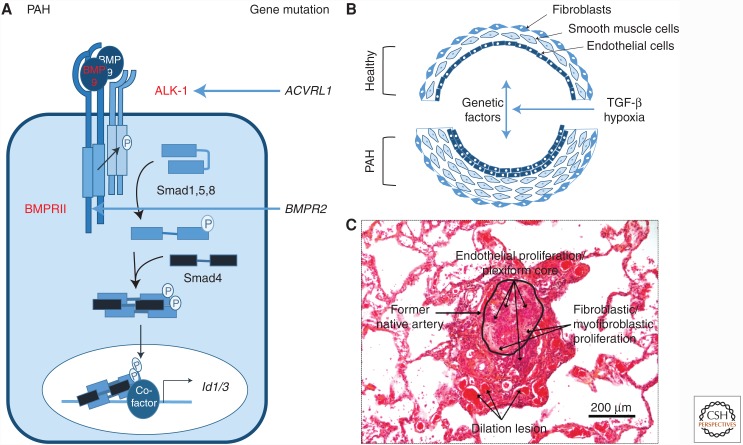
Mutations in bone morphogenetic protein (BMP) signaling cascade results in pulmonary arterial hypertension (PAH). (A) The genetic vascular disorder PAH has been linked to mutations mainly in the BMPR2 gene for the BMPRII receptor, as well as the ACVRL1 gene, encoding the activin receptor-like kinase (ALK)-1 receptor (mutations indicated in red). Recently, a mutation in GDF2, encoding BMP-9, was described in a PAH patient. Rare cases of mutation in ENG or SMAD8 have also been described but are not shown here. (B) Mutations in these genes increase endothelial cell (EC) and vascular smooth muscle cell (VSMC) proliferation, resulting in a multilayered vessel that will lead to vessel obstruction. (C) Plexiform lesion distal to a pulmonary artery in the lung of a patient with idiopathic PAH, which is characteristic for plexogenic pulmonary arteriopathy. The section is stained with hematoxylin and eosin.
Figure 4.
Figure 4.
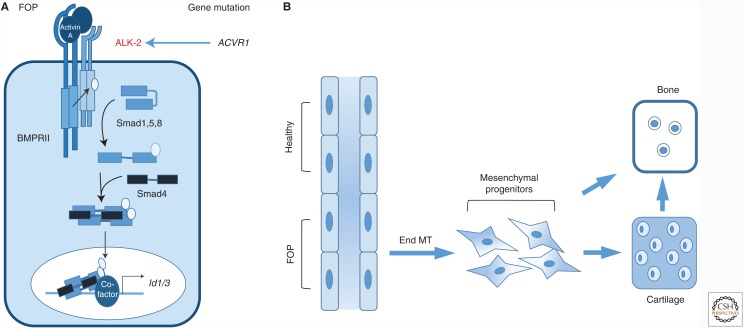
Mutations in the bone morphogenetic protein (BMP) type I receptor activin receptor-like kinase (ALK)-2 results in fibrodysplasia ossificans progressiva (FOP). (A) The genetic vascular disorder FOP is linked to activating mutations in ACVR1 encoding the receptor ALK-2 (indicated in red). (B) These mutations enhance activin and BMP signaling and heterotopic endochondral ossification. Cells of endothelial origin have been found in bone, which could result from endothelial-to-mesenchymal transition (EndMT). These mesenchymal precursors will then differentiate into chondrocytes and osteoblasts.

References

    1. Akers AL, Johnson E, Steinberg GK, Zabramski JM, Marchuk DA. 2009. Biallelic somatic and germline mutations in cerebral cavernous malformations (CCMs): Evidence for a two-hit mechanism of CCM pathogenesis. Hum Mol Genet 18: 919–930. - PMC - PubMed
    1. Alt A, Miguel-Romero L, Donderis J, Aristorena M, Blanco FJ, Round A, Rubio V, Bernabéu C, Marina A. 2012. Structural and functional insights into endoglin ligand recognition and binding. PLoS ONE 7: e29948. - PMC - PubMed
    1. Anderson L, Lowery JW, Frank DB, Novitskaya T, Jones M, Mortlock DP, Chandler RL, de Caestecker MP. 2010. Bmp2 and Bmp4 exert opposing effects in hypoxic pulmonary hypertension. Am J Physiol Regul Integr Comp Physiol 298: R833–842. - PMC - PubMed
    1. Aranguren XL, Beerens M, Coppiello G, Wiese C, Vandersmissen I, Lo Nigro A, Verfaillie CM, Gessler M, Luttun A. 2013. COUP-TFII orchestrates venous and lymphatic endothelial identity by homo- or hetero-dimerisation with PROX1. J Cell Sci 126: 1164–1175. - PubMed
    1. Aristorena M, Blanco FJ, de Las Casas-Engel M, Ojeda-Fernandez L, Gallardo-Vara E, Corbí A, Botella LM, Bernabéu C. 2014. Expression of endoglin isoforms in the myeloid lineage and their role during aging and macrophage polarization. J Cell Sci 127: 2723–2735. - PubMed

Publication types

MeSH terms

Substances

LinkOut - more resources