


Effect of high-intensity training on endothelial function in patients with cardiovascular and cerebrovascular disease: A systematic review
- PMID: 28348736
- PMCID: PMC5354182
- DOI: 10.1177/2050312116682253
Effect of high-intensity training on endothelial function in patients with cardiovascular and cerebrovascular disease: A systematic review
Abstract
Objectives: Exercise improves endothelial dysfunction, the key manifestation of cardiovascular and cerebrovascular disease, and is recommended in both cardiovascular and cerebrovascular rehabilitation. Disagreement remains, however, on the role of intensity of exercise. The purpose of this review was to gather current knowledge on the effects of high-intensity training versus moderate-intensity continuous exercise on endothelial function in cardiovascular and cerebrovascular patients.
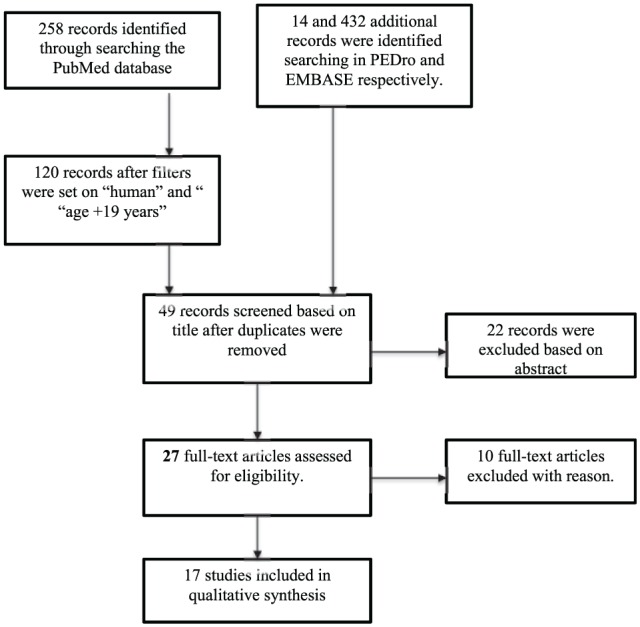
Methods: A systematic review was performed in PubMed database, Embase and Cochrane libraries and on PEDro using the Preferred Reporting Items for Systematic Reviews and Meta-Analyses guidelines. Studies were restricted to cardiovascular and cerebrovascular patients, and healthy subjects as general reference. Interventions comprised of high-intensity training alone, high-intensity training compared to moderate-intensity continuous exercise, or no training, with endothelial function as outcome measure. Endothelial function was measured either physiologically by flow-mediated dilatation and/or by systemic biomarkers. Data were analyzed descriptively due to non-comparability for a meta-analysis to be performed.
Results: A total of 20 studies were included in the review. Although there was great heterogenecity in design, population and exercise protocols, all studies found high-intensity training to be safe. High-intensity training was equal to moderate-intensity continuous exercise through improvement in endothelial function in 15 of the 20 selected studies, as measured by flow-mediated dilatation, nitric oxide bioavailability and circulating biomarkers. Only a few studies examined high-intensity training in cerebrovascular patients, none with endothelial function as outcome.
Conclusion: High-intensity training is promising as a time-efficient exercise strategy in cardiovascular rehabilitation, but data on endothelial effects in cerebrovascular rehabilitation are warranted. Agreement on a more uniform exercise protocol is essential to further investigate the optimal exercise mode for cerebrovascular rehabilitation.
Keywords: Vascular endothelium; aerobic exercise; endothelial function; flow-mediated dilatation; high-intensity exercise; high-intensity training; interval training.
Conflict of interest statement
Declaration of conflicting interests: R.S.K. was funded by grant from Herlev Hospital Research Council.
Figures
References
-
- Sacco RL, Wolf PA, Kannel WB, et al. Survival and recurrence following stroke. The Framingham study. Stroke 1982; 13(3): 290–295. - PubMed
-
- Schmidt W, Endres M, Dimeo F, et al. Train the vessel, gain the brain: physical activity and vessel function and the impact on stroke prevention and outcome in cerebrovascular disease. Cerebrovasc Dis 2013; 35(4): 303–312. - PubMed
-
- Deanfield JE, Halcox JP, Rabelink TJ. Endothelial function and dysfunction: testing and clinical relevance. Circulation 2007; 115(10): 1285–1295. - PubMed
-
- Vita JA. Endothelial function. Circulation 2011; 124(25): e906–e912. - PubMed
-
- Benjamin EJ, Larson MG, Keyes MJ, et al. Clinical correlates and heritability of flow-mediated dilation in the community: the Framingham Heart Study. Circulation 2004; 109(5): 613–619. - PubMed
LinkOut - more resources
Full Text Sources
Other Literature Sources
