Genome-Wide Location Analyses of N6-Methyladenosine Modifications (m6A-Seq)
- PMID: 28349453
- PMCID: PMC5755608
- DOI: 10.1007/978-1-4939-6807-7_4
Genome-Wide Location Analyses of N6-Methyladenosine Modifications (m6A-Seq)
Abstract
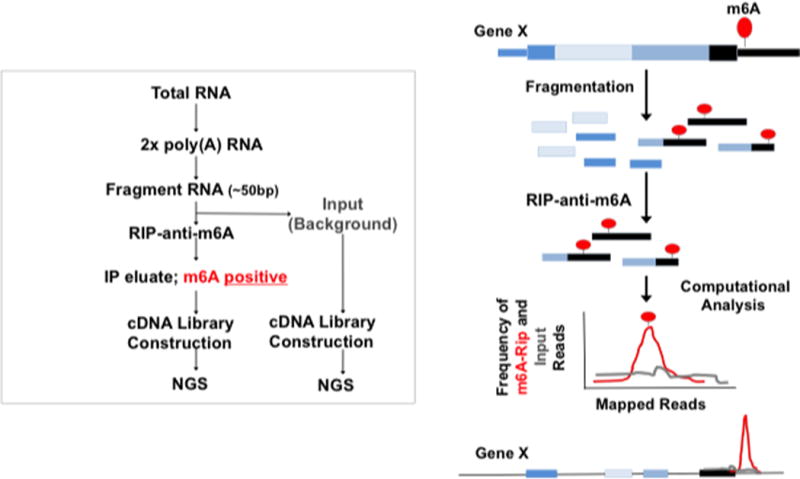
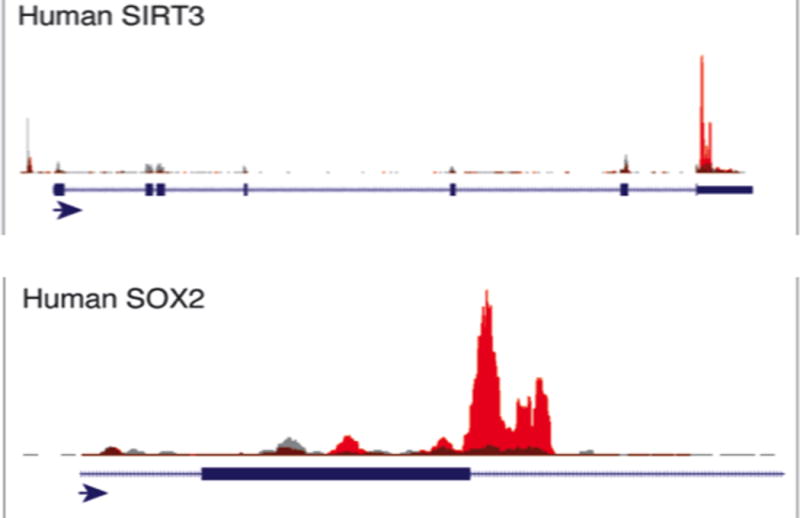
N6-methyladenosine-sequencing (m6A-seq) is a critical tool to obtain an unbiased genome-wide picture of m6A sites of modification at high resolution. It allows the study of the impact of various perturbations on m6A modification distribution and the study of m6A functions. Herein, we describe the m6A-seq protocol, which entails RNA immunoprecipitation (RIP) performed on fragmented poly(A) RNA utilizing anti-m6A antibodies. The captured/enriched m6A positive RNA fragments are subsequently sequenced by RNA-seq in parallel with background control non-immunoprecipitated input RNA fragments. Analyses reveal peaks of m6A enrichment containing sites of modifications analogous to chromatin modification immunoprecipitation experiments.
Keywords: Epitranscriptome; Genome-wide; METTL14; METTL3; N6-Methyladenosine; m6A-Seq.
Figures
References
-
- Batista PJ, Molinie B, Wang J, Qu K, Zhang J, Li L, Bouley DM, Lujan E, Haddad B, Daneshvar K, Carter AC, Flynn RA, Zhou C, Lim KS, Dedon P, Wernig M, Mullen AC, Xing Y, Giallourakis CC, Chang HY. m(6)A RNA modification controls cell fate transition in mammalian embryonic stem cells. Cell Stem Cell. 2014;15(6):707–719. doi: 10.1016/j.stem.2014.09.019. - DOI - PMC - PubMed
-
- Dominissini D, Moshitch-Moshkovitz S, Schwartz S, Salmon-Divon M, Ungar L, Osenberg S, Cesarkas K, Jacob-Hirsch J, Amariglio N, Kupiec M, Sorek R, Rechavi G. Topology of the human and mouse m6A RNA methylomes revealed by m6A-seq. Nature. 2012;485(7397):201–206. doi: 10.1038/nature11112. - DOI - PubMed
-
- Schwartz S, Agarwala SD, Mumbach MR, Jovanovic M, Mertins P, Shishkin A, Tabach Y, Mikkelsen TS, Satija R, Ruvkun G, Carr SA, Lander ES, Fink GR, Regev A. High-resolution mapping reveals a conserved, widespread, dynamic mRNA methylation program in yeast meiosis. Cell. 2013;155(6):1409–1421. doi: 10.1016/j.cell.2013.10.047. - DOI - PMC - PubMed
MeSH terms
Substances
Grants and funding
LinkOut - more resources
Full Text Sources
Other Literature Sources
Miscellaneous