


First year physical activity findings from turn up the HEAT (Healthy Eating and Activity Time) in summer day camps
- PMID: 28350830
- PMCID: PMC5369693
- DOI: 10.1371/journal.pone.0173791
First year physical activity findings from turn up the HEAT (Healthy Eating and Activity Time) in summer day camps
Abstract
Background: Summer day camps (SDCs) serve 14 million children yearly in the U.S. and aim to provide participating children with 60 minutes of moderate-to-vigorous physical activity (MVPA). This study evaluated an intervention designed to increase the percent of children meeting this MVPA guideline.
Design: Two-group, pre-post quasi-experimental.
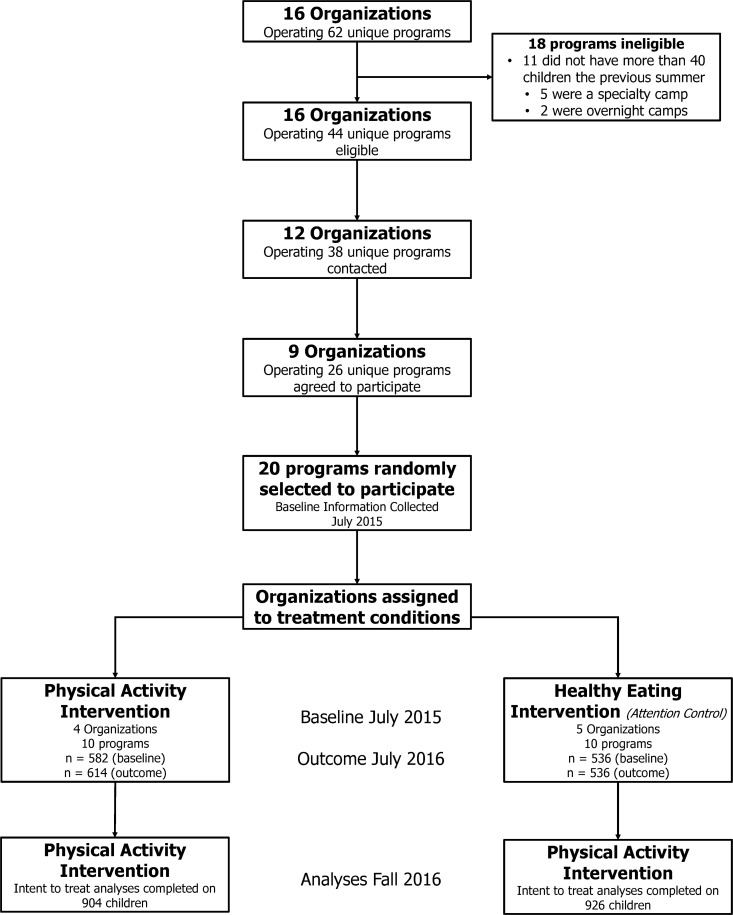
Setting/participants: Twenty SDCs serving 1,830 children aged 5-12 years were assigned to MVPA intervention (n = 10) or healthy eating attention control (n = 10).
Intervention: The STEPs (Strategies to Enhance Practice) intervention is a capacity-building approach grounded in the Theory of Expanded, Extended and Enhanced Opportunities. Camp leaders and staff receive training to expand (e.g., introduction of activity breaks/active field trips), extend (e.g., schedule minimum of 3 hours/day for PA opportunities), and enhance (e.g., maximize MVPA children accumulate during schedule activity) activity opportunities. Camps in the comparison condition received support for improving the types of foods/beverages served.
Main outcome measures: Percent of children accumulating the 60min/d MVPA guideline at baseline (summer 2015) and post-test (summer 2016) measured via wrist-accelerometry.
Results: Multilevel logistic regression conducted fall 2016 indicated boys and girls attending intervention SDCs were 2.04 (95CI = 1.10,3.78) and 3.84 (95CI = 2.02,7.33) times more likely to meet the 60min/d guideline compared to boys and girls attending control SDCs, respectively. This corresponded to increases of +10.6% (78-89%) and +12.6% (69-82%) in the percentage of boys and girls meeting the guideline in intervention SDCs, respectively. Boys in comparison SDCs increased by +1.6% (81-83%) and girls decreased by -5.5% (76-71%). Process data indicated intervention SDCs successfully extended and enhanced PA opportunities, but were unable to expand PA opportunities, compared to control SDCs.
Conclusions: Although substantial proportions of children met the MVPA guideline at baseline, no SDCs ensured all children met the guideline. This intervention demonstrated that, with support, SDCs can help all children in attendance to accumulate their daily recommended 60min MVPA.
Trial registration: ClinicalTrials.gov NCT02161809.
Conflict of interest statement
Figures
References
-
- YMCA of the USA. Choices Within Limits: Healthy Eating and Physical Activity Standards: YMCA of the USA; 2014 [Available from: http://www.ymca.net/hepa/standards/.
-
- Boys & Girls Clubs of America. Boys & Girls Clubs of America and National Recreation and Park Association Join Partnership for a Healthier America: Creating a Healthier Environments for Five Million Kids 2015 [Available from: http://www.bgca.org/newsevents/PressReleases/Pages/PartnershipForAHealth....
-
- National Recreation and Parks Association. Commit to Health 2015 [Available from: http://www.nrpa.org/committohealth/.
-
- American Camp Association. Camp Trends Fact Sheet. 2016 [Available from: http://www.acacamps.org/media-center/camp-trends/fact.
Publication types
MeSH terms
Associated data
Grants and funding
LinkOut - more resources
Full Text Sources
Other Literature Sources
Medical
Miscellaneous
