


Transition to Independence: Characteristics and Outcomes of Mentored Career Development (KL2) Scholars at Clinical and Translational Science Award Institutions
- PMID: 28351069
- PMCID: PMC5373479
- DOI: 10.1097/ACM.0000000000001473
Transition to Independence: Characteristics and Outcomes of Mentored Career Development (KL2) Scholars at Clinical and Translational Science Award Institutions
Abstract
Purpose: To describe the transition from mentored to independent research funding for clinical and translational scholars supported by institutional KL2 Mentored Career Development programs.
Method: In 2013, faculty leaders at Clinical and Translational Science Award institutions completed an online survey, reporting characteristics of scholars in their KL2 programs from 2006 to 2013. The primary outcome variable was a report that the scholar had received independent funding as a principal investigator. Data analysis included descriptive summaries and mixed-effects regression models.
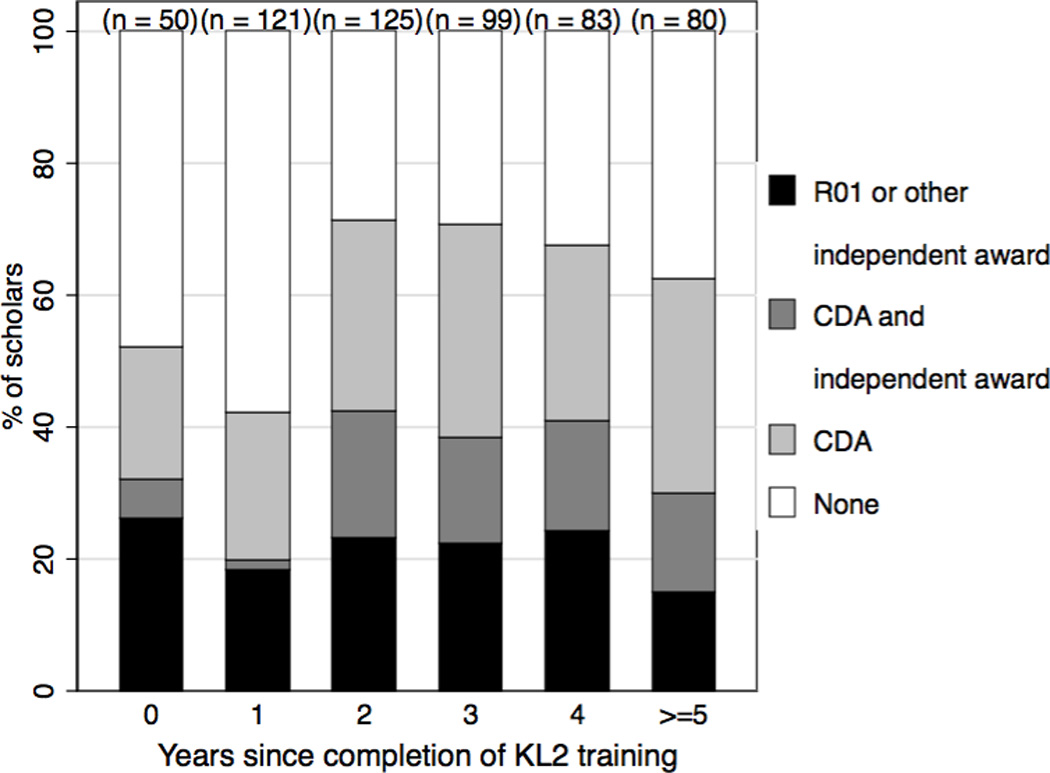
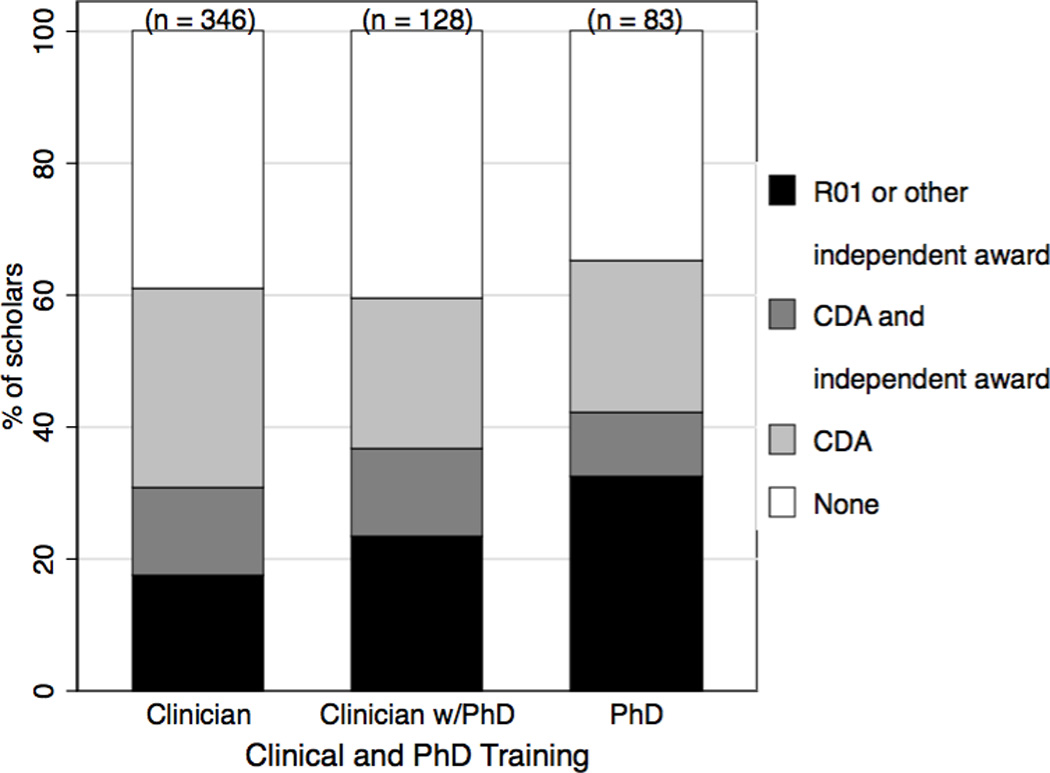
Results: Respondents from 48 institutions (of 62 eligible; 77%) provided information about 914 KL2 scholars. Of those, 620 (68%) were medical doctors, 114 (12%) had other clinical training, and 177 (19%) were nonclinician PhDs. Fifty-three percent (487) were female; 12% (108/865) were members of racial or ethnic groups underrepresented in medicine (URM). After completing KL2 training, 96% (558/582) remained engaged in research. Among scholars who completed KL2 training two or more years earlier, 39% (149/374) received independent funding. Independent funding was from non-National Institutes of Health (NIH) sources (120 scholars) more often than from NIH (101 scholars). The odds of a nonclinician attaining independent funding were twice those of a clinician (odds ratio 2.05; 95% confidence interval 1.11-3.78). Female and URM scholars were as likely as male and non-URM scholars to attain independent funding.
Conclusions: KL2 programs supported the transition to independent funding for clinical and translational scientists. Female and URM scholars were well represented. Future studies should consider non-NIH funding sources when assessing the transition to research independence.
Figures
References
-
- Wyngaarden JB. The clinical investigator as an endangered species. N Engl J Med. 1979;301:1254–1259. - PubMed
-
- Meyers FJ, Begg MD, Fleming M, Merchant C. Strengthening the career development of clinical translational scientist trainees: A consensus statement of the Clinical Translational Science Award (CTSA) Research Education and Career Development Committees. Clin Transl Sci. 2012;5:132–137. - PMC - PubMed
-
- National Institutes of Health. Physician-Scientist Workforce Working Group Report. Bethesda, MD: National Institutes of Health; 2014. Office of Extramural Research.
MeSH terms
Grants and funding
LinkOut - more resources
Full Text Sources
Other Literature Sources
